
In a surprising twist in South Australia’s political landscape, One Nation is poised to secure up to four seats in the lower house following a significant surge in statewide support. The party emerged as a formidable force, claiming the second-highest number of primary votes, while the Liberal Party experienced a noticeable decline.
This election marks One Nation’s most successful performance at a state level in nearly three decades, capturing 22 percent of the primary vote and securing positions within the top two in approximately half of the contested seats.
Currently, One Nation holds the lead in four electoral districts, though the final outcomes are yet to be determined and depend on preference distributions. Meanwhile, Labor has comfortably retained power, securing at least 32 of the 47 lower-house seats.
The Liberals are anticipated to claim only five seats, signaling a significant shift in the political dynamics of South Australia, with One Nation stepping in as the principal opposition to Labor in several swing areas.
In the Ngadjuri district, located just north of Adelaide’s outskirts, One Nation’s candidate David Parton leads with 34.5 percent of the primary vote, surpassing Labor’s Tony Piccolo, who stands at 28.9 percent. Parton appears likely to clinch victory with the help of Liberal preferences.
Similarly, in Hammond, which encompasses Murray Bridge and Strathalbyn, One Nation’s Robert Roylance is locked in a tight race with Labor’s Simone Bailey. Roylance is also expected to benefit from preferences from the Liberal candidate, who is currently in third place.
In both MacKillop in the state’s southeast and Narungga, which covers the entire Yorke Peninsula, the One Nation candidates have a sizeable lead on primary vote but Liberal rivals could get in on Labor preferences.
Labor’s vote has actually gone down by two per cent on the previous election but has notched a landslide win due to the collapse in the Liberal vote to just 19 per cent
Labor won all but one of the seats in metropolitan Adelaide and picked up former safe Liberal sears of Colton, Morialta and Hartley, where former Liberal leader Vincent Tarzia was defeated.

One Nation could win up to four seats in the SA lower house and three in upper house
Even long‑held Liberal bastions such as Unley in Adelaide’s wealthy inner southern suburbs fell to a Labor team led by Peter Malinauskas, who said there was ‘a lot to unpack’ with how the voting played out.
‘In a world of serious volatility, we see that play itself out at the ballot box locally,’ he said.
In regional South Australia, One Nation’s surge amplified the collapse in Liberal support, but, in a twist, Labor preferences may end up saving some Liberal seats.
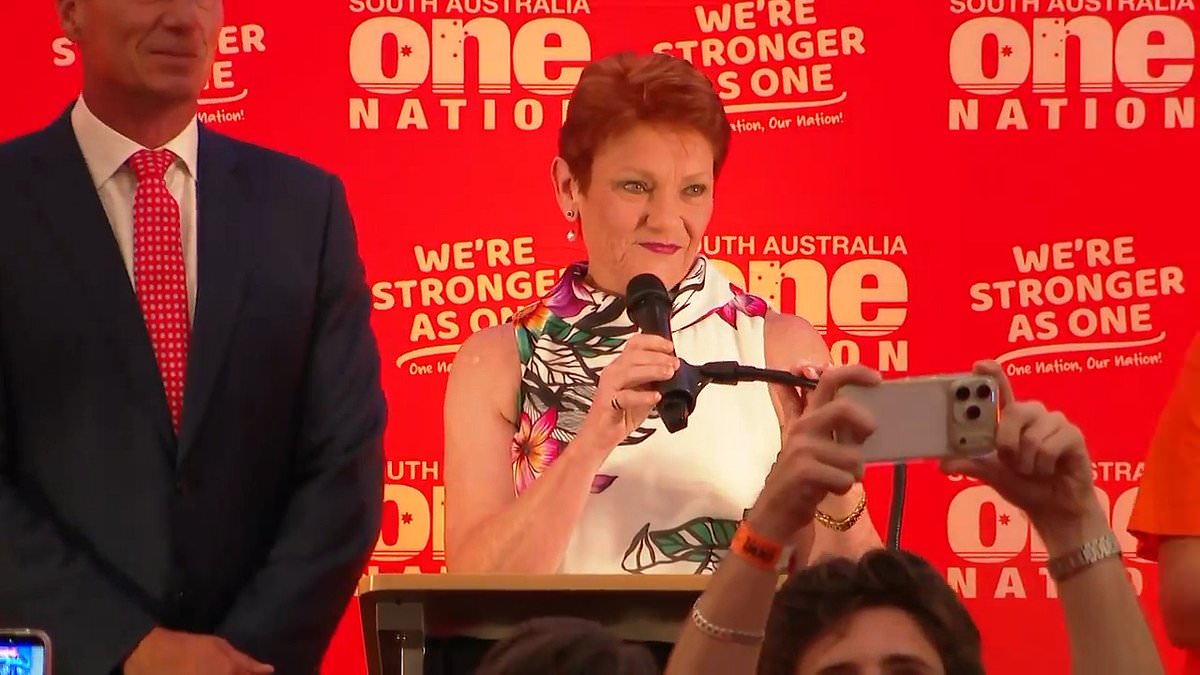
The Liberals’ decision to preference One Nation above Labor may also come back to haunt them. While at One Nation’s after‑party, Pauline Hanson declared she had left a series of ‘landmines’ for the Premier.
In the Upper House, One Nation is on track to snare up to three seats, positioning the party as a major force in a chamber where Labor will fall short of a majority.
Former Liberal senator Cory Bernardi has secured an Upper House seat for One Nation, alongside Carlos Quaremba.
Rebecca Hewett is favoured to claim the party’s third seat, bettering the Liberals, who have won two, while Labor has secured four and the Greens one.
One Nation sees its breakthrough as a springboard for the Victorian state election and the federal Farrer by‑election.

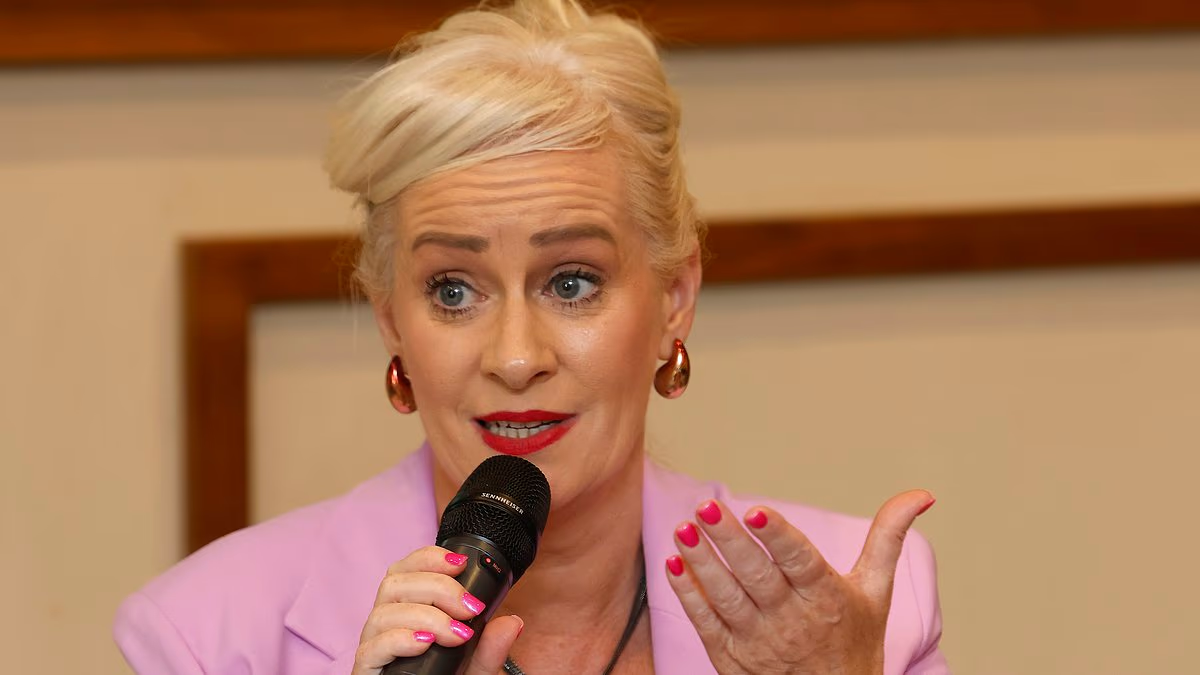
Liberal Ashton Hurn (pictured) will stay on as leader despite the party’s heavy defeat.
The conservative and right‑leaning side of politics has fractured completely.
While some observers have regarded One Nation’s result arising chiefly from Liberal instability and division, others have said uneasiness with the country’s record levels of immigration, chiefly from the subcontinent and Asia, have driven voters to the party.
‘There’s a movement, there’s an undercurrent and it’s people saying we’ve had a gutful,’ she told Sky News.
‘We want our country back. We want to have a voice.’
Bernardi said an political earthquake had rattled the foundations of the traditional party system in South Australia.
Liberal leader Ashton Hurn has retained her Barossa Valley seat and will remain in the role.
Federal Liberal senator Anne Ruston said the party had been sent a clear and ‘sobering’ message, warning the Liberals could not win by shifting further right or left.
‘The Liberal Party has got a lot of work to do to rebuild the trust of Australians, I absolutely believe that we can do that,’ she said.

Peter Malinauskas (pictured) and Labor have won a whopping 32 of the 47 lower house seats
Historically, One Nation has held only a minimal presence in South Australia, usually drawing around 4 per cent of the primary vote.
One Nation finished in the top two in around half of the seats, based on counting on Sunday afternoon, securing more votes statewide than a Liberal opposition that was only certain of holding four seats, with a handful of others in doubt.
Flinders University public policy lecturer Josh Sunman said the state would have to wait weeks for a full result in one of the most complicated elections the nation had seen.
One Nation claimed a similar vote share in the 1998 Queensland election and won 11 seats in the then-89-person parliament, but it now holds no seats in its home state.
The huge significance of the Labor victory had been lost amid the focus on One Nation, Mr Sunman said.
‘This is a massive victory, but a dampener for them is they didn’t manage to make any regional inroads, which they’d been hoping to,’ he said.
‘The really significant takeaway is that while One Nation didn’t win a massive amount of seats, in the outer metro area in particular, it is now the second party – they are Labor’s competitor, not the Liberal Party.’
Speaking in the former Liberal stronghold of Unley, an inner-Adelaide seat that Labor hadn’t held for 32 years, Mr Malinauskas said there was no such thing as a safe electorate.
‘This seat now has a margin of over 10 per cent for Labor,’ he said.