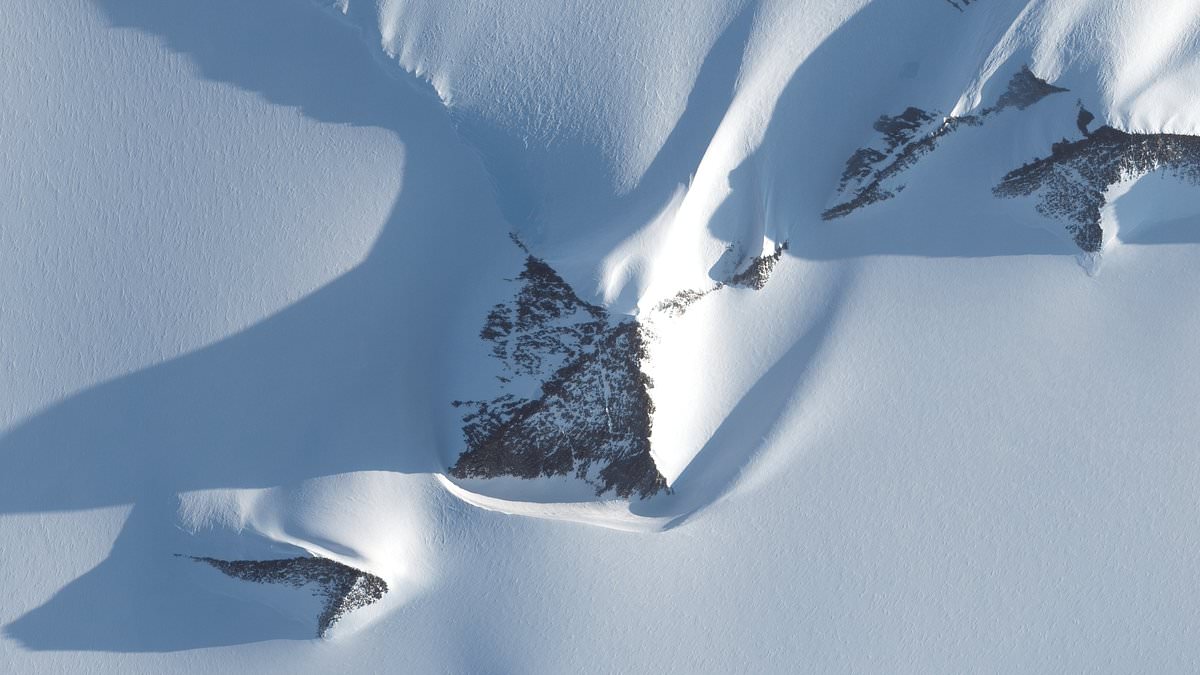

An enigmatic formation in Antarctica, bearing a striking resemblance to the pyramids of Giza, has fueled speculation about the existence of an ancient global civilization.
Independent researcher Jay Anderson discovered these ice-clad structures via Google Earth. To underscore their uncanny resemblance, he compared the sharply defined Antarctic peaks with satellite images of Egypt’s Giza pyramids, highlighting their seemingly intentional alignment.
These intriguing formations can be found at the coordinates 79°58’39.0″S 81°57’34.0″W on Google Earth, nestled within the southern expanse of the Ellsworth Mountains—one of the most rugged and elevated areas of the continent.
The remarkable likeness has set off a whirlwind of debate online, with many pondering if the formations are the result of natural processes or human ingenuity.
One commentator remarked, “If proven true, this could serve as undeniable evidence of crustal displacement, suggesting that the Earth’s surface once occupied different positions.”
They added, “It would also indicate the presence of an advanced civilization that existed long before our earliest historical records.”
However, others suggested the Antarctic formations were created by natural erosion.
Geologists say the mountain’s pyramid-like shape was likely formed over hundreds of millions of years through freeze-thaw erosion, a process in which water seeps into cracks, freezes, expands and eventually breaks off large chunks of rock.

Independent researcher Jay Anderson spotted the ice-covered structures on Google Earth, showing three sharply angled Antarctic peak

Anderson featured an image of Egypt’s Giza pyramids along side the Antarctica structures
The central formation rises about 4,500 feet tall, with four steep sides, and appears to be flanked on each side by two smaller pyramid-like peaks protruding from the snow.
The Giza plateau features three main pyramids, Khufu, Khafre and Menkaure, arranged in a diagonal formation, a layout some have suggested resembles the stars of Orion’s Belt, though the idea is widely debated.
Observers have also noted that the pattern mirrors the alignment of the three Antarctic peaks.
However, Eric Rignot, a professor of Earth system science at the University of California, Irvine and senior research scientist at NASA, previously told Live Science that the formations in Antarctica are ‘just a mountain that looks like a pyramid.’
The steep sides on all three formations were likely carved and smoothed into shape by hundreds of millions of years of erosion, particularly through a process known as freeze-thaw weathering.
This occurs when water and snow seep into tiny cracks during warmer periods, then freeze as temperatures drop, expanding and forcing the rock apart until large sections eventually break away.
Mauri Pelto, a professor of environmental science at Nichols College in Dudley, Massachusetts, told Live Science that freeze-thaw erosion probably forged other pyramidal mountains, including the Matterhorn in the Swiss Alps.
The pyramid-shaped mountain in Antarctica, which has no official name, drew internet attention in 2016, sparking claims that it was an alien base hidden in the snowy mountain range.

Geologists say the mountain’s pyramid-like shape was likely formed over hundreds of millions of years through freeze-thaw erosion, a process in which water seeps into cracks, freezes, expands and eventually breaks off large chunks of rock
The theory surfaced when a video was posted by Third Phase of the Moon, a YouTube channel that regularly posts conspiracy theories about aliens.
It showed a pyramid-like structure in the snow, with a Google Earth-type label and pin.
The label reads ‘Antartica Pyramid’ – a misspelling of Antarctica, which suggested that the image might have been doctored.
Responses to the video have varied, with some users backing up the claims, such as James Jason, who commented: ‘Excellent report, Third Phase, I also believe things are about to get very dramatic, and that is for everyone on our planet.’
But others have dismissed it, such as Gordon Anderson, who said: ‘I have spent a LOT of time on snow-covered mountains- skiing down, and this looks natural to me – not manmade anyway!’
It is unclear what the structure could be, but it looks similar to a nunatak – a natural mountain peak that juts up above glaciers.
Nigel Watson, author of the UFO Investigations Manual, told Daily Mail in 2016: ‘Pictures of the pyramid structures are either photoshopped, cropped pictures to make the mountains look more like pyramids or simply pictures of natural formations called nunataks.
‘They are mountainous formations created by shifting glaciers and erosion, not by laser zapping aliens.’