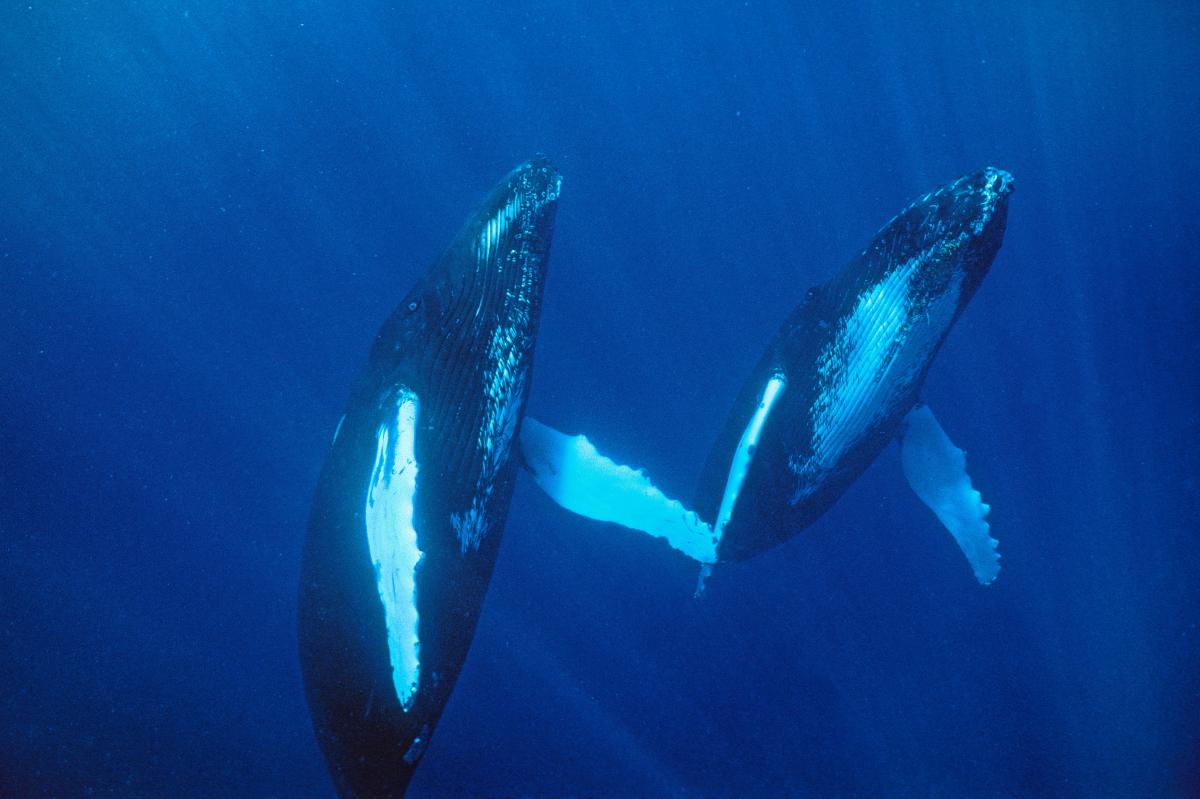

It seems that older male humpback whales have mastered the art of romance.
According to recent research, these majestic creatures have honed their courtship songs over several decades, allowing them to outshine their younger competitors in the ocean’s fiercely competitive mating arena. With a lifespan that can reach up to 90 years, male humpbacks typically begin their romantic pursuits between the ages of five and 25.
Throughout their lives, they dedicate significant time to perfecting a repertoire of intricate and culturally passed-down songs. Some of these whales have been documented with a library of 184 distinct melodies. Remarkably, humpback whales are known to repeat a single, elaborate song for durations of 10 to 30 minutes, continuously for up to 22 hours.
Initially, it was the younger humpback males that captured the attention of the females. However, the seasoned crooners’ persistence and experience have evidently given them an edge in the underwater serenade scene.

Some whales have been recorded singing 184 different, unique melodies, while humpback whales can repeat a single, complex song lasting 10 to 30 minutes for up to 22 consecutive hours.
At first, the younger humpback males were the main attraction for females.
But humpback reproduction patterns shifted as populations — nearly wiped out by centuries of commercial whaling — claw their way back from the brink of extinction, according to scientists from the Sea Mammal Research Unit at the University of St. Andrews in Scotland.
A global moratorium which began Jan. 1, 1986 finally shut down the slaughter, and four decades later the study confirms that the comeback is real — to the delight of the female whales.
And as the populations rebounded and grew, from about 15,000 in 1965 to 130,000 today, the underwater dating scene shifted along with it.
Experienced warblers began replacing young studs to dominate the baby-making charts, scientists said.
The mature whales weigh up to 50 tons and reach 60 feet in length. And they can still brawl, and will battle youthful bulls for females.
The research, published in the journal Current Biology, analyzed two decades of humpback whale data from breeding grounds in New Caledonia in the South Pacific.
“As the population recovered, there were more older males than expected singing, escorting females, and successfully fathering calves compared to younger animals,” said senior author Dr. Ellen Garland, of the Sea Mammal Research Unit.
The study’s lead author, Dr. Franca Eichenberger, also from the Sea Mammal Research Unit, said new technology is allowing new insights.
“It is only now, as whale populations recover and new analytical tools become available, that we are beginning to understand how far-reaching the consequences of whaling truly are.
“The impacts extend beyond population size — they’re shape behavior, competition, and reproduction. Virtually all populations of whales have changed due to whaling; our work shows that they continue to change as they recover,” she said.
“Now is the time we can learn so much more about their behavior and life history. We just need to keep looking.”


