
In Brief
- The fuel excise will be halved for three months.
- The heavy vehicle road user charge has also been reduced.
Relief at the Pump for Australians as PM Announces Fuel Excise Reduction
In a move to offer financial relief amid soaring fuel prices, Prime Minister Anthony Albanese has announced a reduction in the fuel excise. This decision follows a virtual National Cabinet meeting held on Monday morning, where Albanese and state and territory leaders discussed strategies to address the ongoing global fuel crisis, exacerbated by the conflict in the Middle East.
Starting Wednesday, the current fuel excise of 52.6 cents per litre will be slashed in half for a period of three months. According to Treasury estimates, this reduction is expected to lower the cost of filling up a typical 65-litre tank by about $19.
This initiative is part of a comprehensive set of actions under the newly unveiled National Security Plan, which also includes a temporary reduction in the heavy vehicle road user charge over the same timeframe.
“By halving the fuel excise, we aim to cut fuel costs by 26.3 cents per litre,” Albanese stated on Monday.
He further encouraged Australians to consider public transportation when possible, as a means to conserve fuel for sectors where it is most critically needed.
Albanese said the country has entered phase two of four stages under the new plan, which includes planning and preparing by monitoring global factors and keeping Australia moving by ensuring fuel is moving.
The next phase, which the prime minister said “we hope to avoid”, includes targeted action and the final phase is to protect critical services, ensuring “critical users are protected, and the economy remains open and operating”.
The fuel excise cut will cost the federal budget $2.55 billion, and reducing the heavy vehicle road user charge an additional $53 million, Treasurer Jim Chalmers revealed.
The Australian Chamber of Commerce CEO Andrew McKellar had pushed for reprieve for truckies on Sunday, calling for a cut to the 32.4 cents per litre charge to reduce costs down the supply chain.
“So for things like food and grocery prices, it will help insulate the impact there and moderate any inflationary impact,” he told reporters in Canberra.
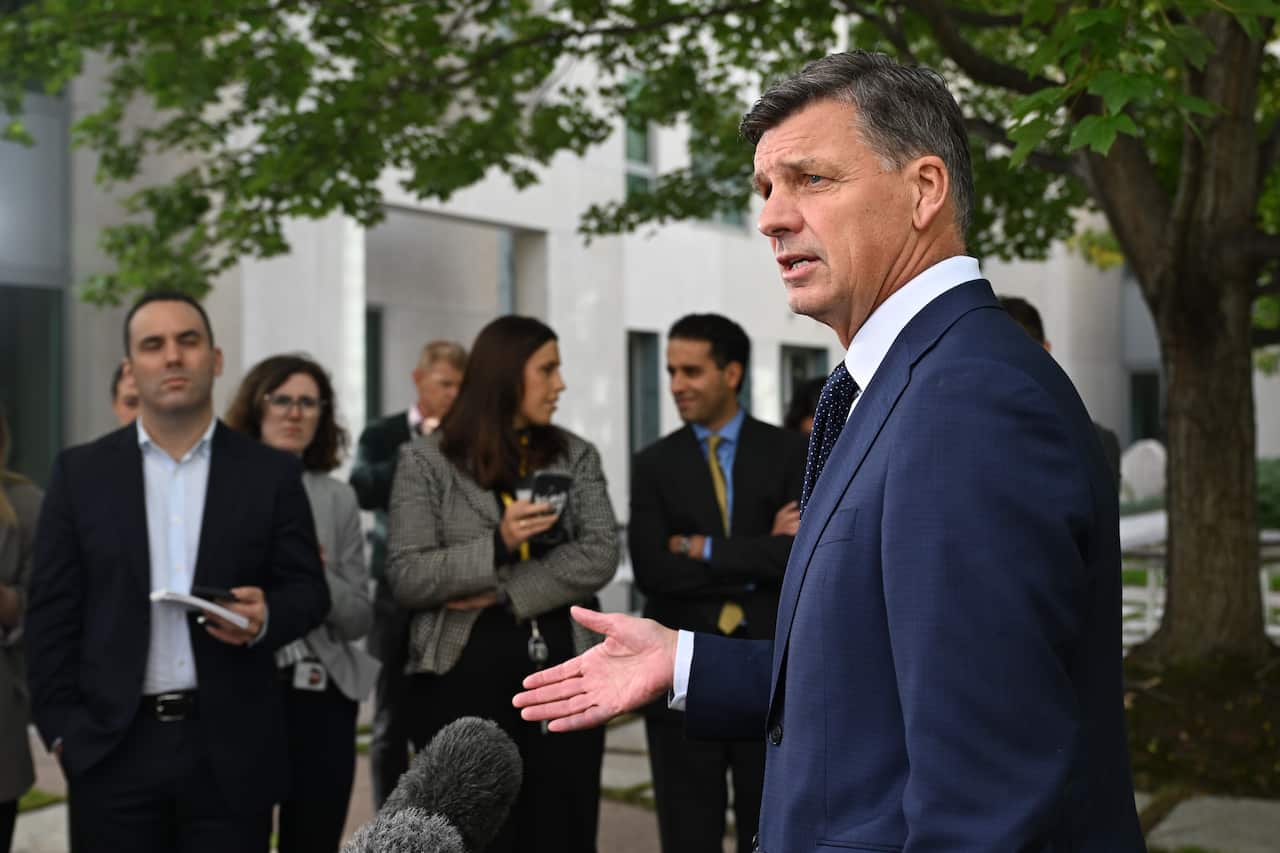
Opposition leader Angus Taylor listed the move, which the Coalition has advocated for since last week, as one of four key tests for the government.
The Coalition has also included moving fuel to areas where petrol stations have run dry as a top priority, pushed for transparency in the fuel supply chain and urged the government to outline its next steps to manage the crisis.
“It’s time to be out the front with exactly what, where this goes next, and what the government has got in its plans,” Taylor said in Canberra on Monday.
Australia’s fuel stocks remain at normal levels, but fears of future shortages and price spikes caused by the ongoing blockage of the Strait of Hormuz have spurred users to bulk-buy petrol and diesel, leading to localised shortfalls.
The government has responded to supply concerns with a series of measures — including releasing 20 per cent of fuel reserves, changing petrol and diesel standards and creating a new fuel taskforce.
Is it time for work-from-home mandates?
Chalmers has encouraged working from home but said the government was not considering mandating such measures, a sentiment shared by the Opposition.
“We’re trying to avoid those kind of a heavier-handed COVID [style] interventions. But work from home in a number of instances makes a lot of sense,” he told ABC News Breakfast ahead of the meeting.
“The prime minister has indicated more of a willingness to go down the voluntary path than the compulsory path.”
On Monday, the government will introduce emergency legislation to parliament that will allow it to take on the financial risk of importing additional fuel.
Energy Minister Chris Bowen called it a vital intervention to help Australians secure petrol, diesel and crude oil shipments that showed the government was “one step ahead” of the crisis.
— With additional reporting by Australian Associated Press.


