
Concerns have been mounting among scientists regarding the heat shield of NASA’s Orion capsule, crucial for the upcoming Artemis II mission.
Scheduled to launch as early as April 1, this mission will carry astronauts Reid Wiseman, Victor Glover, Christina Koch, and Jeremy Hansen on a 10-day voyage to the moon.
Throughout their journey, the crew will navigate space in the Orion capsule, a compact spacecraft with dimensions of just 11 by 16.5 feet.
Ed Macaulay, a Physics and Data Science lecturer at Queen Mary University of London, has expressed apprehension about the heat shield’s integrity, as it faces extreme temperatures upon re-entering Earth’s atmosphere.
Dr. Macaulay noted that during the Artemis I mission, significant portions of the heat shield material were lost.
If a similar issue arises during Artemis II, the crew could be at risk of exposure to dangerously high temperatures.
‘During the final phase of the Artemis II mission, there’s no backup, no contingency, and no chance of escape,’ Dr Macaulay explained in an article for The Conversation.
‘The four astronauts on board will be depending on a few inches of resin–coated silica to shield themselves from temperatures approaching half that of the surface of the Sun.’

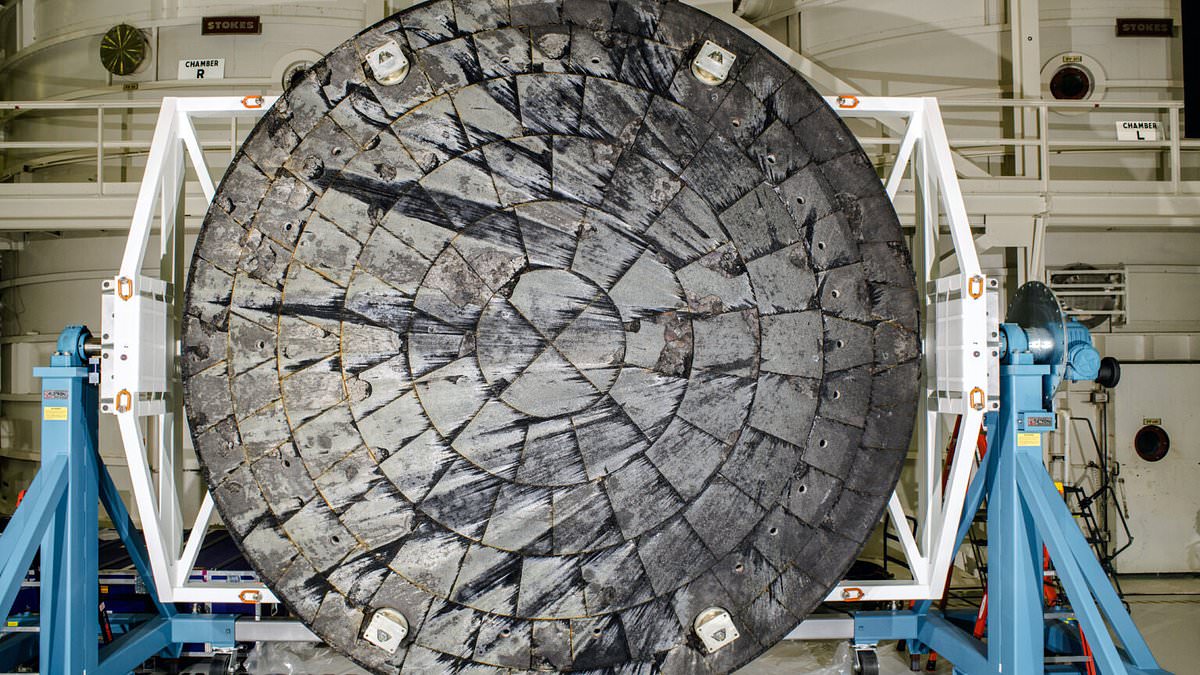
The most dangerous moment will occur during re–entry, as Orion’s heatshield is subjected to enormous temperatures due to friction with the atmosphere. Pictured: Orion’s heatshield after re–entry during Artemis I
During 2022’s unmanned Artemis I test, NASA found that Orion’s heat shield was cracked and cratered with unexpected damage.
The heat shield material, known as Avcoat, is designed to burn away during re–entry to help dissipate the heat.
However, the damage was well beyond what NASA had expected.
‘Instead of burning away evenly over the whole surface, parts of the Artemis I heat shield were lost unexpectedly in uneven chunks,’ Dr Macaulay explained.
‘This uneven ablation makes modelling the thermal loads of re–entry more unpredictable, and raises the possibility that the Orion capsule could be exposed to dangerous levels of heating.’
Further investigation found that the problem was that the Avcoat layer wasn’t permeable enough, so gases built up in pockets and blasted off entire chunks.
Following the mission, Dr Danny Olivas, a former NASA astronaut who served on review team that investigated the incident, told CNN: ‘There’s no doubt about it: This is not the heat shield that NASA would want to give its astronauts.’
Surprisingly, NASA has decided not to change the heat shield going into Artemis II.

NASA has not altered the heatshield for Artemis II, but has adjusted the trajectory so that Orion will spend less time at critical temperatures

The heatshield coating is designed to burn away during re–entry, however, NASA found that the coating had chipped and deteriorated far more than expected during Artemis I
Instead, it has made some important changes to the mission itself.
Instead of ‘skipping’ back to Earth – a technique that sees the capsule act like a stone bouncing on water as it dips and lowers itself into the atmosphere – NASA will use a more direct re–entry model for the crewed Orion capsule.
This should reduce the uncertainty in the heating profile, and will mean less time at peak temperatures for trapped gases to damage the heat shield.
‘[It] also means that the crew will be subjected to increased deceleration on re–entry,’ Dr Macaulay added.
As the astronauts return to Earth, the heat shield is all that will protect them – so NASA’s tweaks to the mission could prove vital.
‘Human spaceflight has always brought with it calculated risks, but it has also provided a uniquely human perspective on our place in the cosmos,’ Dr Macaulay added.
‘The Artemis II mission will make its crew the first humans in over half a century to observe the blue marble of planet Earth in its entirety with their own eyes.
‘The crew will carry with them the hopes and aspirations of a whole new generation of explorers.
‘They will be depending on the meticulous work of thousands of scientists and engineers for their safe return, bringing with them a renewed human perspective on not just the Moon, but the planet we all call home.’