

JERUSALEM: In a significant move, Israel’s Knesset, the national parliament, has enacted a law stipulating the death penalty for Palestinian terrorists found guilty of committing fatal terrorist acts. This decision has drawn criticism from European nations and an opposition leader within Israel.
The law, championed by the far-right National Security Minister Itamar Ben Gvir, passed with a vote of 62-47. The legislation, which prescribes execution by hanging, was put forward by Ben Gvir and his political faction, Otzma Yehudit.
Tzvika Foghel, a member of Otzma Yehudit and the head of the National Security Committee, helped shepherd the bill through the legislative process. Speaking to Fox News Digital, Foghel expressed the sentiment that Israelis have grown weary of strategies focused on containment and compromise.
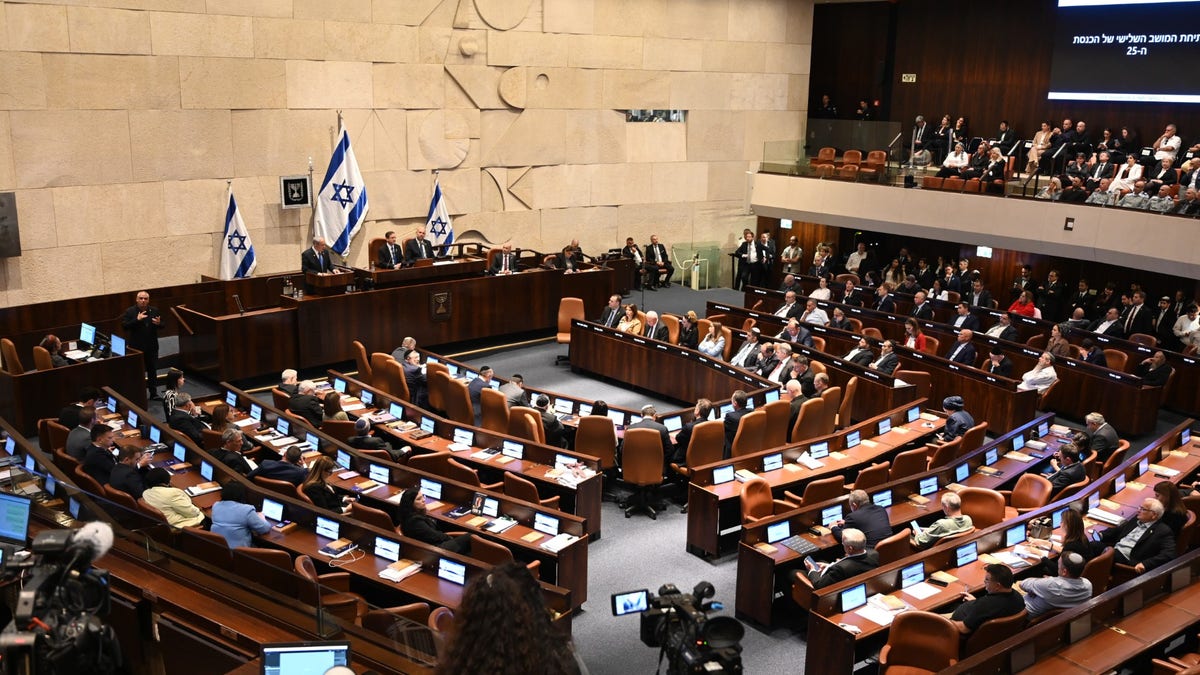
The opening of the Knesset’s winter session took place on Monday evening. (Yoav Dudkevitch/TPS-IL)
“For many years, Israel has tried to appease the international community, even as our citizens were being attacked on our streets,” Foghel stated. “Since the events of October 7, we’ve adopted a more assertive stance to shape our future reality.”
Foghel emphasized that implementing the death penalty for terrorists is part of a larger strategic shift within Israel. This shift acknowledges that Israel uniquely faces the challenge of radical Islamic terrorism from regions like Gaza, Lebanon, the West Bank, as well as threats from Yemen and Iran.
“The death penalty for terrorists who burned, raped, mutilated and abused children and parents is the same punishment we established for the Nazis,” he said.
Kaja Kallas, the European Union’s High Representative for Foreign Affairs and Security Policy, said, “The EU has a principled position against the death penalty in all cases and in all circumstances. Israel had long upheld a de facto moratorium on both executions and capital punishment sentencing, thereby leading by example in the region despite a complex security environment.”
She added, “The approval of the Death Penalty Bill by the Israeli Parliament marks a grave regression from that practice and from Israel’s own commitments. We are deeply concerned about the de facto discriminatory character of the Bill.”

Israeli opposition leader Yair Lapid speaks at the Knesset, Israel’s parliament, on Oct. 13, 2025 in Jerusalem. ((Photo by Evelyn Hockstein – Pool/Getty Images))
Israel has applied the death penalty only once in the state’s history for the Nazi mass murderer Adolf Eichmann in 1962. The death penalty exists on the books in Israel, but Israeli courts have limited latitude to apply execution to cases beyond penalties for Nazi war criminals.
Former Prime Minister and current leader of the centrist Yesh Atid party, Yair Lapid said the legislation is fundamentally flawed because it does not apply to Hamas terrorists involved in the Oct. 7, 2023 massacre that killed 1,200 people.
“This law is not a show of force; it is a sign of panic. This law is more extreme than anything in the United States, and they know it will get struck down by the law. It isn’t a law for justice or for deterrence, it is a law for public relations,” he added.
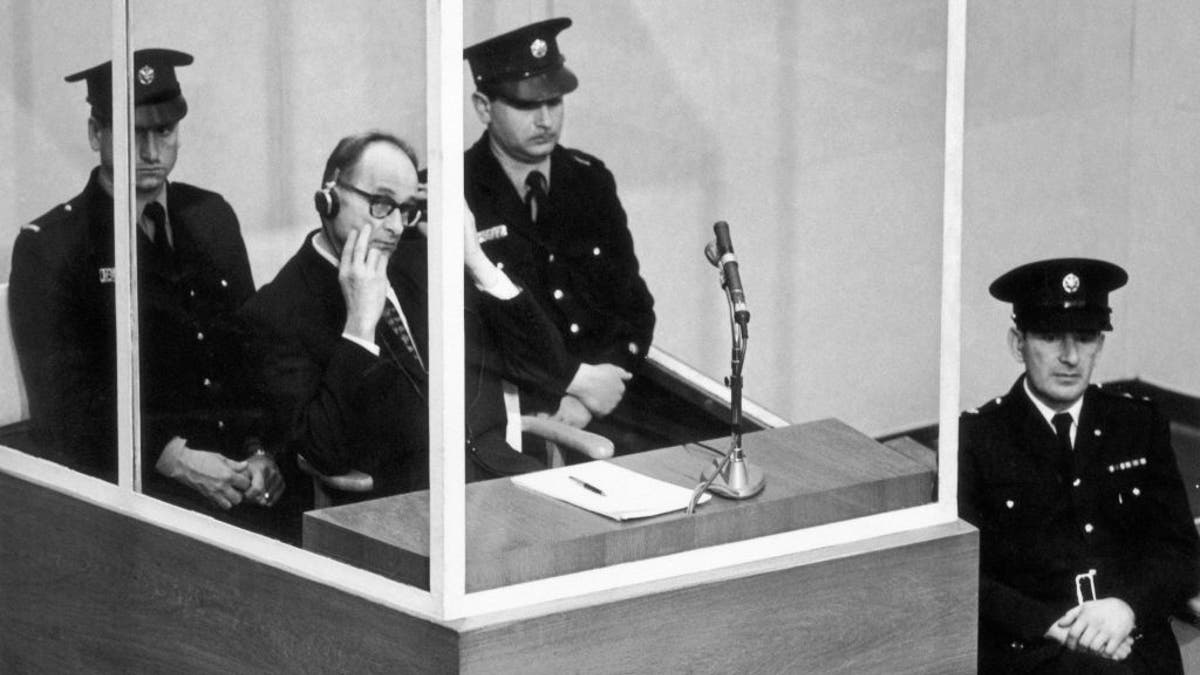
Adolf Eichmann, in a bullet-proof cabin, puts on earphones to hear the reading of the act of accusation against him, Dec. 17, 1961. He was in charge of the extermination of Jews in Poland and then organized the deportation and extermination of Jews in 13 European countries. (Keystone-France/Gamma-Keystone via Getty Images)
Likud lawmaker Dan Illouz, a supporter of the legislation, told Fox News Digital that the events of Oct. 7 underscored, in his view, the need to prevent terrorists from viewing the kidnapping of civilians as a viable means of securing the release of imprisoned militants.
“The death penalty shatters that equation. It serves as the ultimate deterrent, ensuring that terrorists know their actions lead only to their own demise, not a negotiated release. We are a life-loving nation, but to protect life, we must deal decisively with those who seek to destroy it,” he said.
“Prime Minister Netanyahu’s vote in favor was crucial. It projects an unmistakable message of strength and moral clarity from the very top of Israel’s leadership. By personally casting his vote, the Prime Minister showed our enemies, and the entire world, that our government is completely united and unyielding in our resolve to eradicate terrorism and defend our citizens,” he added.
The Israeli Channel 12 political commentator, Amit Segal, wrote that he supports “executing terrorists who attempt to murder civilians — especially the monsters of October 7,” but was critical of Ben Gvir’s legislation.
He wrote in his newsletter, “The law defines terrorism as acts ‘to negate the existence of the state,’ a definition that could apply to groups such as extremist Haredi factions and violent members of the ‘Hilltop Youth’ (which Ben-Gvir supports.)

Hamas terrorists killed civilians, including women, children and the elderly, when they attacked Israel on Oct. 7, 2023. (Israel Defense Forces via AP)
Segal said that “while Ben-Gvir’s law is essentially a campaign stunt, a more responsible law is making its way through the system. Proposed by MKs Simcha Rotman and Yulia Malinovsky, the law establishes the practical mechanisms — procedural and evidentiary — to secure convictions of Nukhba terrorists, after which the death penalty could be imposed.”
Another Likud lawmaker, Amit Halevi, told Fox News Digital that the central element of the legislation is the distinction between criminal offenses and crimes against the state or against humanity.
“A terrorist commits his crimes as part of an ideology aimed at killing, oppressing and controlling all Jews. These terrorists, if they could, would kill every one of us. They are ideological murderers, in a different category from ordinary criminals, and that is a critical point of the bill,” he said.
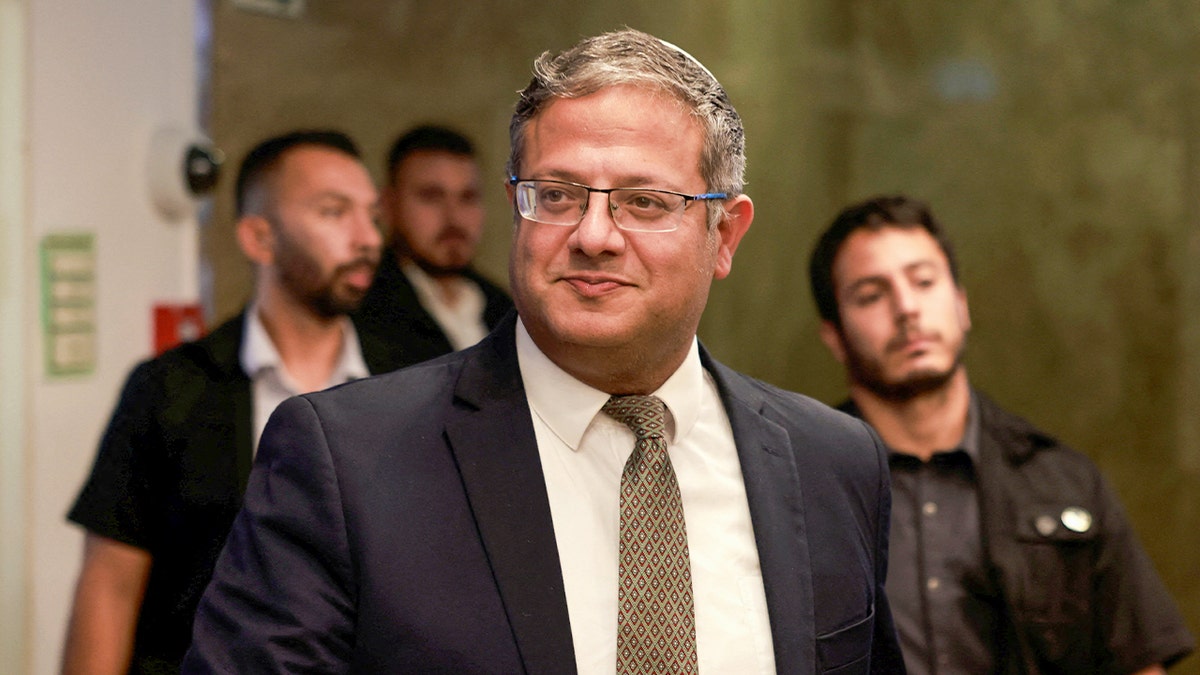
Israel’s National Security Minister Itamar Ben-Gvir arrives for a cabinet meeting at the prime minister’s office in Jerusalem on Aug. 27, 2023. (MENAHEM KAHANA/Pool via REUTERS)
Halevi added that further efforts are needed to clearly delineate crimes against the state, including what falls within that category and what does not.
“Generally speaking, this legislation is a step in the right direction. Much of the criticism I hear relates to ordinary criminals. People do not understand the enemy — who he is and what this war is about,” he said.