
On a pivotal Wednesday morning, the Supreme Court delved into the contentious case of Trump v. Barbara, stirring widespread attention as it challenges President Donald Trump’s 2025 executive order aimed at ending birthright citizenship. While the justices expressed skepticism towards the administration’s stance, the very consideration of this issue highlights the significant inroads nativist ideologies have made since Trump’s initial presidency. The 14th Amendment’s language stands clear: “all persons born or naturalized in the United States, and subject to the jurisdiction thereof, are citizens of the United States and of the State wherein they reside.” Yet, Trump persists in his bid to dismantle this principle, threatening to create a stateless underclass in America, and alarmingly, he has come quite a distance in this endeavor.
Immediately after being inaugurated for his second term, Trump issued an executive order entitled “Protecting the Meaning and Value of American Citizenship.” This directive aimed to strip citizenship from children born in the United States to undocumented mothers or those on non-immigrant visas, unless the child’s father was a citizen or permanent resident. Set to be enacted 30 days post-issuance, the order faced swift legal challenges and subsequent federal injunctions have so far prevented its enforcement, keeping birthright citizenship intact for the moment.
The crux of Trump’s argument lies in the interpretation of a critical phrase: “subject to the jurisdiction thereof.” The Trump administration posits that individuals without citizenship or permanent residency are not fully under U.S. jurisdiction, as they owe allegiance to another nation. This reinterpretation threatens to upend centuries of legal tradition and English common law, potentially leaving many children born in the U.S. without citizenship. Karen Tumlin, director of the Justice Action Center, warned of the broader implications, describing the case as a “canary in the coal mine for our democracy.” If birthright citizenship can be dismantled so easily, no constitutional safeguard is secure.
During the proceedings, most justices, save for the staunchest conservatives, appeared unconvinced by the administration’s arguments. Their inquiries delved into two historic rulings: Dred Scott v. Sandford, the infamous 1857 decision denying citizenship to enslaved individuals, which the 14th Amendment aimed to overturn, and United States v. Wong Kim Ark, the 1898 case affirming citizenship for American-born children of Chinese nationals despite prevailing exclusionary laws.
Justice Clarence Thomas pressed for clarity on how the citizenship clause addresses Dred Scott. In response, Sauer conceded the 1857 ruling represented a grave injustice, yet maintained that the 14th Amendment was specifically ratified to endow citizenship to newly emancipated slaves and their descendants, who, he argued, had no ties to foreign powers.
Sauer further contended that the legislators of the 19th century could not have anticipated modern phenomena such as birth tourism. He cited the existence of numerous birth tourism companies, particularly in China, which facilitate births on U.S. soil to secure citizenship. According to Sauer, the original framers of the amendment would never have imagined a world where global travel could so easily circumvent the intended scope of birthright citizenship. “We’re in a new world,” Sauer remarked, “where 8 billion people are one plane ride away from having a child who’s a US citizen.”
Justice Neil Gorsuch, who was questioning Sauer, appeared unswayed. “It’s a new world,” he agreed, but “it’s the same Constitution.”
“It’s a new world,” Gorsuch said, but “it’s the same Constitution”
Chief Justice John Roberts called Sauer’s examples of existing exceptions — including children of ambassadors or enemies during a hostile invasion — “very quirky” and not necessarily comparable to“a whole class of illegal aliens who are here in the country.” Justice Elena Kagan noted that most of Sauer’s brief focused on people who are temporarily in the country on visas — but Trump’s executive order was clearly intended to restrict immigration, and the president has said so himself.
In 2019, Trump called birthright citizenship a “magnet for illegal immigration.” Last year, presidential adviser Stephen Miller said the US-born children of immigrants are just as much of a problem as the immigrants themselves. “With a lot of these immigrant groups, not only is the first generation unsuccessful,” Miller said in a Fox News interview, citing the Somali-American community, which the administration would soon target in Minneapolis, as an example. “You see persistent issues in every subsequent generation. So you see consistent high rates of welfare use, consistent high rates of criminal activity, consistent failures to assimilate.”
The administration has sought to restrict legal immigration in all its forms: it implemented a steep fee for H-1B work visas, has signaled it may end a work program for international students, and enacted a travel ban on several countries that is even affecting World Cup players. The operation is barefacedly racist. The president famously complained about “all these people from shithole countries” who migrate and expressed his desire to have “more people from Norway.” Last year, he cut the refugee resettlement cap to just 7,500 and prioritized the resettlement of white South Africans. The Department of Homeland Security has linked the “homeland” to a decidedly white vision of Manifest Destiny that, like debates about birthright citizenship, harkens back to the nineteenth century.
Experts are broadly in agreement that most justices weren’t convinced by the administration’s argument, but it’s not clear exactly how the court will rule.
If the court did hand Trump an unexpected victory, a series of grim questions would immediately come into play — starting with when the change kicks in. The order was supposed to be implemented on February 19, 2025, thirty days after Trump signed the order, and would have gone into effect if not for a number of federal injunctions. “If the court sides with Trump, it will have to decide on a date on which to begin applying the president’s interpretation of the 14th amendment,” César Cuauhtémoc García Hernández, a professor of civil rights and civil liberties at the Ohio State University College of Law, told The Verge. “Anyone born on or after that date and described in Trump’s order would be treated as a migrant rather than a U.S. citizen.”
Sauer asked the court to apply Trump’s executive order “proactively” and not retroactively, and backdating the change to 2025 would pose a number of problems, calling the citizenship of millions of children into question.
The Trump administration is trying to narrow who counts as an American while simultaneously pushing for policies that prevent noncitizens from participating in public life. The administration has tried to prohibit states from offering in-state tuition to undocumented immigrants who live there, revoked accreditation for training centers that work with noncitizen truckers, and has broadly sought to turn America into a “papers, please” country.
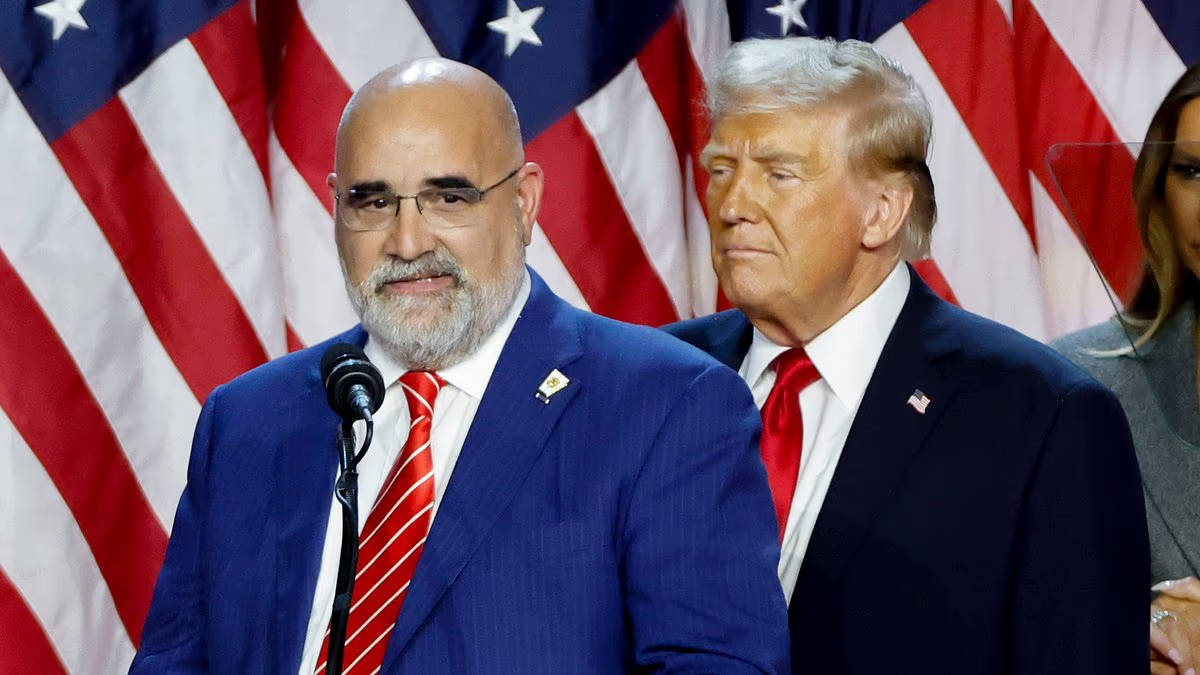
Trump was in the audience during Wednesday’s arguments, making him the first sitting president to attend oral arguments before the Supreme Court. His presence may have intended to intimidate skeptical justices into taking his side. Norman Wong, a direct descendant of Wong Kim Ark, was also outside the courthouse, according to the New York Times. Wong and his family embody the stakes of this case, and he had a message for the justices: “They will be shamed for history if they get this wrong.”