Share this @internewscast.com
The White House has been sending mixed signals regarding the Strait of Hormuz as President Donald Trump oscillates in his views on its importance to the United States amidst escalating tensions with Iran.
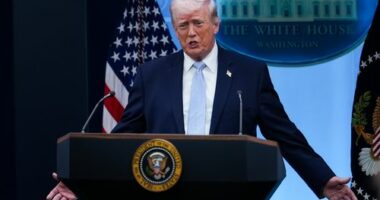
Initially, in a national address, President Trump indicated that the U.S. might reduce its reliance on this crucial oil passage. He asserted that America had ample fuel resources and did not need to depend on Middle Eastern oil supplies. However, his tune changed dramatically in subsequent communications.
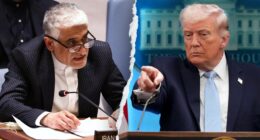
Following his public statements, Trump took to Truth Social to issue a stark warning to Iran. In a forceful message, he demanded the reopening of the Strait of Hormuz, threatening military action against crucial infrastructure if Iran didn’t comply.
In his post, he exclaimed, “Open the F—-n’ Strait, you crazy bastards, or you’ll be living in Hell — JUST WATCH!” He concluded his fiery message with an unexpected “Praise be to Allah.”
By mid-week, however, there was a notable softening in Trump’s stance. He took to social media once more to announce a temporary two-week ceasefire with Iran, a move that came just before the expiration of his ultimatum for reopening the strait.
This rapid shift in approach underscores the unpredictable nature of U.S.-Iran relations and highlights the strategic importance of the Strait of Hormuz in global oil supply dynamics.
Trump said the deal was subject to Iran’s agreement to pause its blockade of oil and gas supplies through the strait.
The backflips come amid a deepening global energy crisis, triggered since Iran effectively seized control of Hormuz, utilising missiles, drones, and mines to attack more than 20 commercial vessels, causing a nearly 95 per cent drop in daily traffic.
Markets are continuing to feel the acute impact of near-total shipping disruptions.
While there may be myriad reasons for Trump’s rhetoric, there are clear financial pressures that mean he’s very unlikely to give up on the Strait of Hormuz entirely.
Experts say the abrupt shift in tone points to a lack of a clear strategy behind Trump’s decision to launch the war — triggered by joint US and Israeli strikes against Iran on 28 February.
Dara Conduit, a lecturer in political science at the University of Melbourne, told SBS News the US president has failed to articulate a coherent narrative around both the decision to enter the conflict and its ultimate objective, with the lack of a clear exit plan likely behind his latest outburst.
“I think Trump is flip-flopping on the Iran war, because he never had a clear strategy as to why he went into Iran,” she said.
“I think we’re seeing this erratic behaviour because reality has well and truly set in … This is not something that he’s going to be able to get out of easily,” she added.
“The Iran war has become so polarising in the US and so unpopular that it is within the realm of possibility that politically he’s actually in the most vulnerable position he has been in.”
How critical is the Strait of Hormuz to the US?
The Strait of Hormuz is one of the most strategically important maritime corridors in the world, and its disruption is reverberating far beyond the Gulf.
Before the war, roughly 20 per cent of global oil and liquefied natural gas passed through the strait each day, equating to around 20 million barrels of oil and hundreds of billions of dollars in annual energy trade.
The narrow channel, bordered by Iran to the north and Oman and the United Arab Emirates to the south, serves as a vital export route for major oil producers including Saudi Arabia, Iraq, Kuwait, Qatar and the UAE.
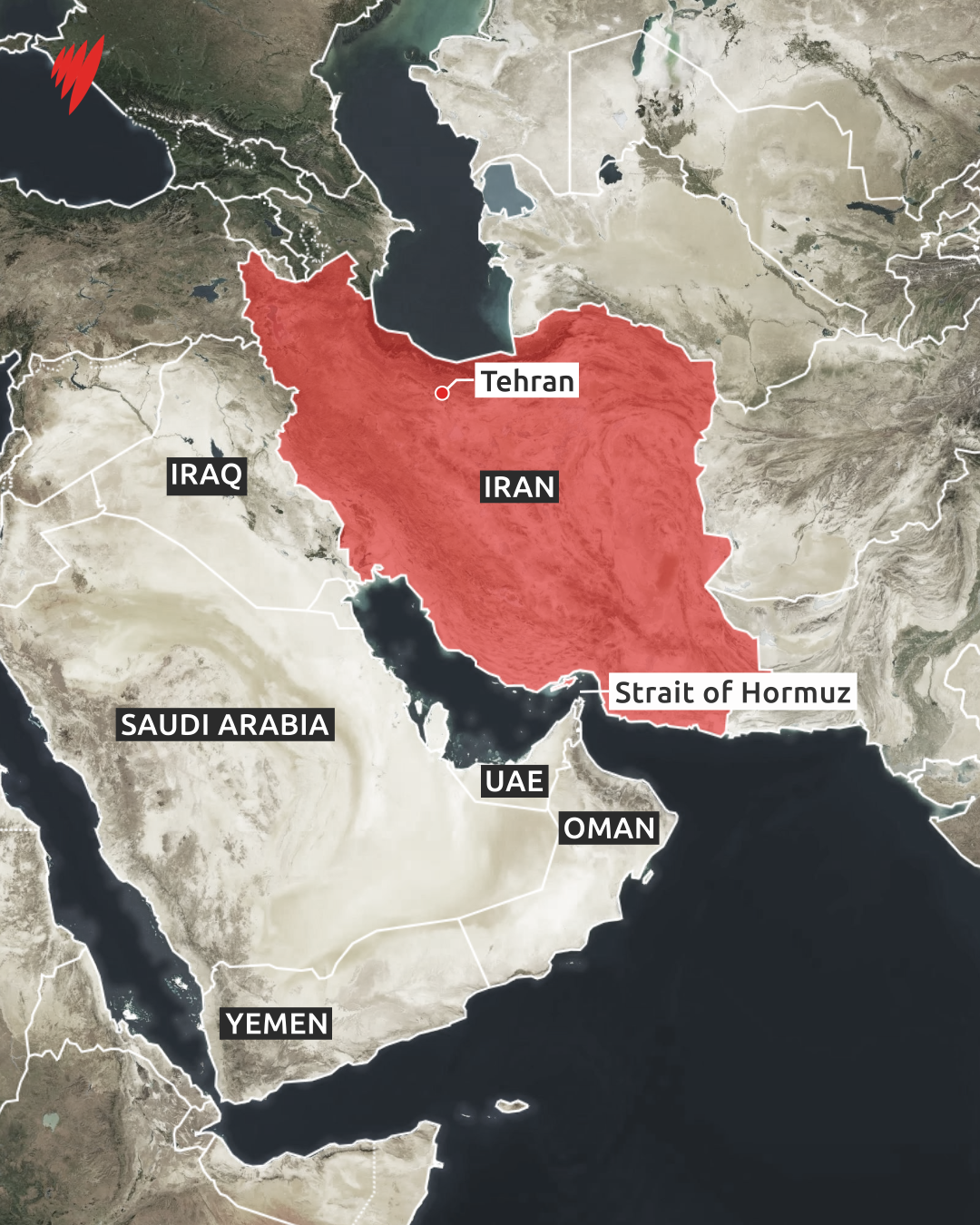
Iran’s strategic choking of the strait is also causing major global supply chain disruptions beyond oil, severely impacting urea and ammonia used for farming, and helium for MRI machines and semiconductors.
Around the world the consequences include surging energy prices, the tightening of supply chains, and countries across Asia, Europe and Africa already implementing fuel-saving measures.
While some alternative pipelines do exist, such as Saudi Arabia’s East–West pipeline and the UAE’s Fujairah route, they are not sufficient to fully replace its flows.
But for the US, the picture is more complex.
Saul Kavonic, head of energy research at research platform MST Marquee, told SBS News that while the US isn’t structurally dependent on oil through Hormuz, its disruption still poses a price issue — one affecting American consumers.
While the US can sustain itself, he said, it will remain exposed to global price shocks, despite being better off than most.
“In particular, Africa, Europe and Asia will suffer from disruption to the strait … While the United States will have to pay higher prices for oil, it will otherwise be faring far better than most of the rest of the world,” Kavonic said.
“It could cause an economic slowdown from high prices but would be able to persevere through that and certainly withstand that global shock far better than most of the rest of the world.”
The average price of petrol has topped $US4 ($5.78) a gallon in the US for the first time in nearly four years while the price of diesel also rose considerably in March.
Midterm pressure
Trump’s sudden rhetoric escalation also comes at a politically sensitive moment, with his popularity falling to its lowest since he started his second term.
With US midterm elections approaching in November, Trump is facing growing unease over both the war in Iran and rising living costs.
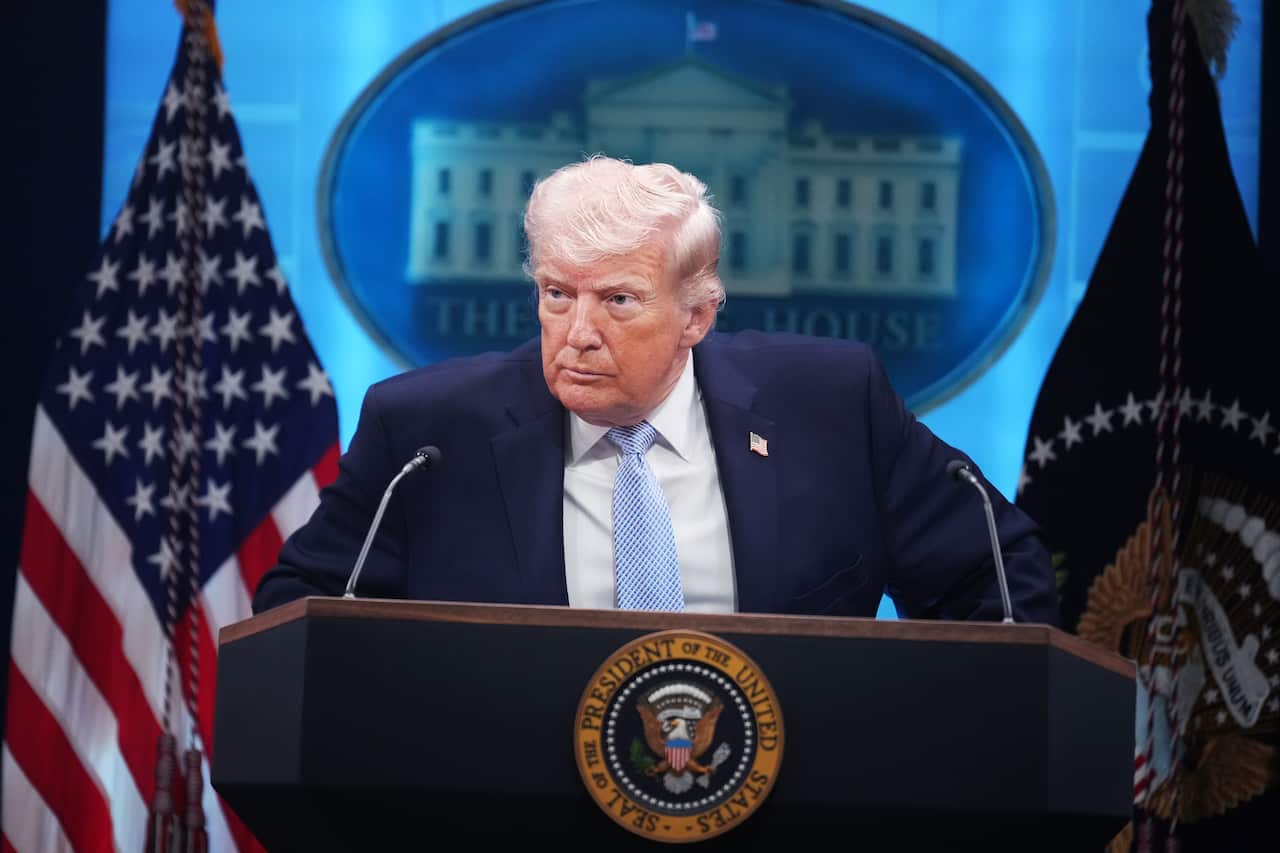
Polling suggests a majority of Americans oppose the conflict, while economic concerns, particularly inflation driven by higher energy prices, remain front of mind for many voters.
According to a poll of nearly 1,600 by broadcasters NPR and PBS, along with the Marist Institute for Public Opinion, 56 per cent of respondents said they oppose military action in Iran.
That’s alongside the US president’s record-low approval ratings on immigration (40 per cent) and the economy (35 per cent).
In a separate analysis, The Economist reported that the president’s net approval rating had fallen to -20 among surveyed voters, as 59 per cent of Americans oppose the war because of its role in driving up inflation and petrol prices.
Bruce Wolpe, a senior fellow at the University of Sydney’s United States Studies Centre, told SBS News Trump’s policy may be simply dysfunctional, or his ambiguity may be a deliberate ploy to keep Iran off balance.
“The US has a surplus of oil, but price is still an issue and that is killing him politically and he has to get out of it,” he said.
Against that backdrop, experts say Trump’s shift in tone may reflect an attempt to project strength and reassert control over a situation that risks undermining one of his core political promises: lowering costs and avoiding prolonged foreign conflicts.
At the same time, his earlier insistence that the US could step back from the Strait of Hormuz sits uneasily with the current reality, where instability in the strait is driving exactly the kind of economic pressure voters tend to punish at the ballot box.
Whether the tougher rhetoric signals a genuine strategic shift, or a politically motivated recalibration remains unclear, Wolpe said.
“Trump changes what he says almost daily,” he said.
“So far, the war has not gone America’s way in terms of the strategic outcomes … It has been terrific tactically, they’ve executed everything, but it hasn’t delivered the goods strategically.”
For the latest from SBS News, download our app and subscribe to our newsletter.