

Donald Trump is contemplating a significant shift in the U.S.’s military strategy concerning NATO allies he perceives as unsupportive of American and Israeli efforts in the conflict with Iran. This plan involves relocating American forces from NATO member countries deemed uncooperative to those more aligned with U.S. objectives. Recently, Trump has intensified his rhetoric about potentially withdrawing the U.S. from the 32-member alliance, particularly after several NATO nations rebuffed his request to assist in reopening the crucial Strait of Hormuz, a key passage for 20% of the world’s oil and gas.
Strain on Transatlantic Relations Over Military Disputes

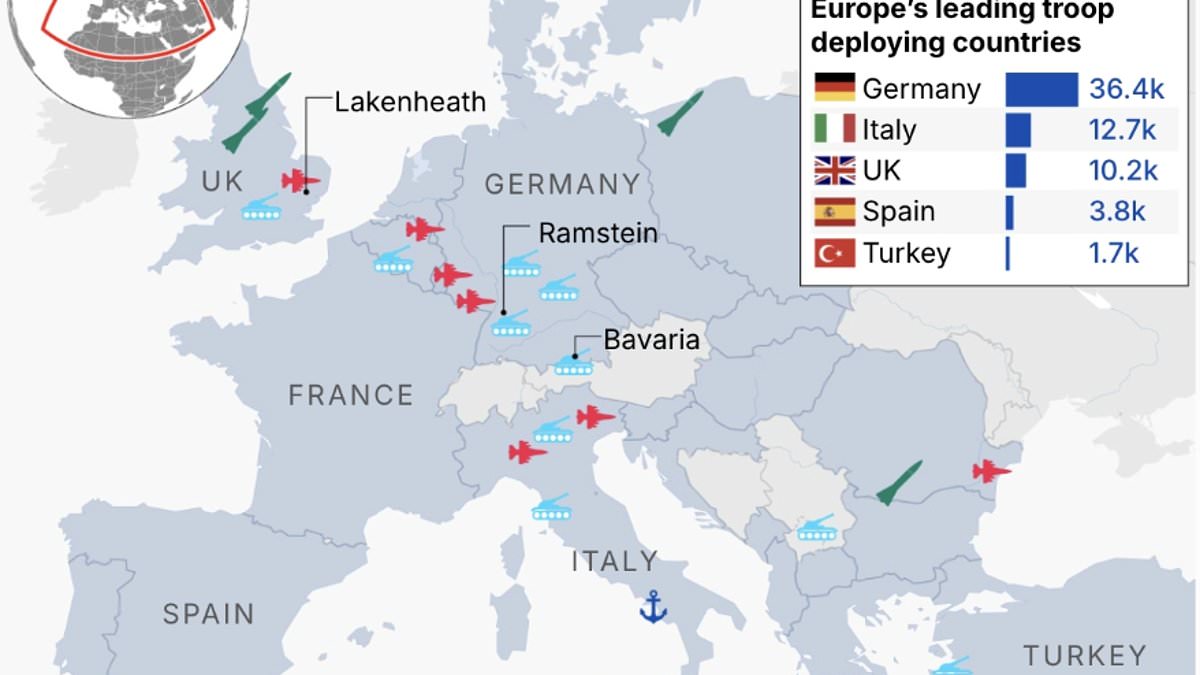
The President’s dissatisfaction with the lack of support during Operation Epic Fury is threatening to destabilize the trans-Atlantic partnership, posing what many see as an unprecedented challenge to NATO’s cohesion. Currently, approximately 84,000 U.S. troops are stationed across Europe, where their presence not only supports global military operations but also significantly contributes to the local economies. Bases in Eastern Europe play a crucial role in deterring Russian aggression.
Potential U.S. Military Withdrawal from Europe

In addition to troop relocations, the proposed punitive measures may include shutting down a U.S. military base in Europe, with Spain or Germany as potential targets, according to sources familiar with the administration’s discussions reported by the Wall Street Journal. This development follows Trump’s fierce criticism of NATO on Truth Social after meeting with Secretary General Mark Rutte at the White House. In his post, Trump expressed his disillusionment, stating, “NATO WASN’T THERE WHEN WE NEEDED THEM, AND THEY WON’T BE THERE IF WE NEED THEM AGAIN.” He also hinted at renewed interest in Greenland, a territory he has shown interest in acquiring.

The relationship between the White House and NATO had already soured before the war with Tehran, largely as a result of disagreements over Trump’s desire to seize the semi-autonomous territory of the Kingdom of Denmark. The plan to transfer US troops away from certain NATO nations has circulated and gained support among senior administration officials in recent weeks, highlighting the growing rift between Trump and his European allies. ‘It’s quite sad that NATO turned their backs on the American people over the last six weeks when it’s the American people who have been funding their defence,’ White House press secretary Karoline Leavitt said on Wednesday.

She said the President planned to have a very ‘frank and candid conversation’ with Rutte, who was expected to cajole and convince Trump that it’s in his interest, and America’s, to stay in the alliance. When asked for comment on the proposals, White House referred to recent statements made by Secretary of State Marco Rubio criticising NATO nations for failing to be more supportive to Washington with the war in Tehran. While it is still unclear which countries would lose US troops, several alliance members have publicly condemned Trump’s military campaign, and may in turn be considered as the nations to be punished.

Spain – the only NATO country that has not pledged to spend five per cent of its GDP on defence – prevented US planes involved in the war from using its airspace, and American officials are also frustrated with Germany after top politicians criticised the war strategy. Nevertheless, Germany serves as one of the largest and most significant hubs for the US military to support its activities in the Middle East. Italy also briefly blocked American use of the Sigonella air base in Sicily, and Emmanuel Macron permitted the US to use a base in southern France after it promised only planes not involved in Iranian strikes would land there.

Administration officials said that the countries which may benefit from more troop deployment include Poland, Romania, Lithuania and Greece, because they are deemed by the President as more supportive. The Eastern European countries have some of the highest defence spending rates in NATO and were some of the first to announce they would join an international coalition to secure the Strait of Hormuz. After the joint US-Israeli operation against Iran began on February 28, Romania quickly approved Washington’s requests to allow its bases to be used by the US Air Force. The proposal could result in deploying more US soldiers closer to the Russian border, in a move that will likely antagonise Vladimir Putin. Following his sit-down with Trump, Rutte described the conversation as ‘very frank’ and ‘very open’, despite clear disagreements.

While the President took to Truth Social to attack the alliance further, Rutte, who infamously called Trump ‘daddy’ at a summit last year, took on a conciliatory tone as he praised him for the ceasefire agreement in Iran. The NATO Secretary General told CNN that Trump was ‘clearly disappointed’ by his allies refusal to send help, adding: ‘He clearly told me what he thought of what happened over the last couple of weeks.’ When anchor Jake Tapper asked if Rutte believed the world is safer today than before the war started at the end of February, the NATO leader said: ‘Absolutely… this is thanks to President Trump’s leadership.’ But Rutte declined to comment on whether Trump had expressed any desire to leave NATO, telling CNN: ‘It is a nuanced picture.’ He then went on to explain that degrading Iran’s nuclear capabilities is ‘really important for yours and my safety here in the US, in Europe and in the Middle East’.

Trump last week warned that he was strongly considering pulling the US out of the ‘paper tiger’ bloc. He said: ‘I was never swayed by NATO. I always knew they were a paper tiger, and Putin knows that too, by the way.’ On Monday, he said he was ‘very disappointed’ with the alliance and that their unwillingness to support the US on the Iran war is ‘a mark on NATO that will never disappear’. During his first term in 2020, Trump ordered the withdrawal of around 12,000 troops from Germany, but the move was reversed by President Joe Biden after he took office in 2021.