
If you’ve noticed a decline in your sexual desire or find your mood persistently low, you might be questioning whether your testosterone levels have dropped.
For many aging men—and increasingly, women undergoing menopause—boosting testosterone levels, although traditionally known as a male hormone, is becoming a sought-after solution to revitalize energy and enthusiasm. While men produce it in larger quantities, women also possess this hormone but in smaller amounts.
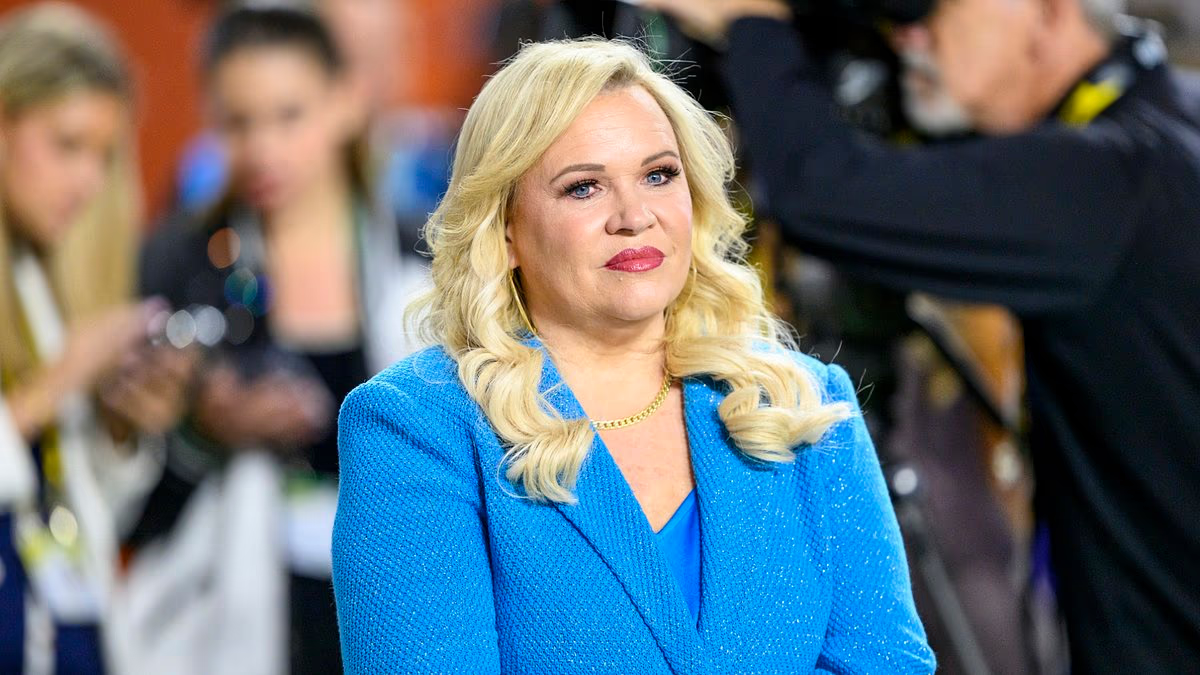
Television personality Davina McCall attributes her vibrant energy during midlife to testosterone therapy. Her striking transformation is reportedly a major influence behind the significant rise in testosterone usage among women in the UK, which has surged tenfold from 2015 to 2023.
It’s well-established that testosterone supplementation can enhance libido and elevate mood.
However, less widely recognized is testosterone’s substantial role in promoting heart health and combating other potentially life-threatening conditions associated with aging, such as diabetes and osteoporosis (we’ll delve into this further).
This hormone interacts with receptors all over the body, resulting in its extensive range of effects.
Perhaps the story that illustrates this best is from my medical centre in New York, where I use my decades-long expertise as an endocrinologist and longevity medicine specialist to develop personalised treatments for my patients.
One of those patients was Dick. He had a heart attack aged 57, which damaged his heart muscle. He told the tale matter-of-factly: ‘I was dead. I was on a respirator for 12 hours.’ Fortunately he survived, and through a referral from a friend became my patient, hoping to get back to good health.

Florence says she always test her patients – both men and women alike – for ‘free’ testosterone as it’s a critical biomarker of the true state of your health
Among the first things we did was take some blood samples, which appeared largely typical for a man who had heart disease. But one result stood out: his ‘free’ testosterone level was low.
I always test my patients – both men and women alike – for ‘free’ testosterone as it’s a critical biomarker of the true state of your health. (In contrast to general testosterone level readings, the ‘free’ type is not bound to proteins in blood and, therefore, is available to act on your tissues.)
It’s measured in picograms per millilitre – or pg/ml. Optimal free testosterone in men should fall in the range of 180 to 250pg/ml. For women, it’s about 10 per cent of that (18 to 25pg/ml).
(The NHS recommends around 190pg/ml for the top range of ‘normal’ free testosterone. But through examining the published literature, and with my real-world research and my experience, I’ve come to the conclusion that this is much too low. Individuals need a higher level for optimal health.)
Dick had free testosterone levels of just 40 – lower than the typical levels of a ten-year-old boy.
I started him on weekly testosterone injection therapy, which more than quadrupled his levels within just a few weeks. Dick reported feeling much ‘younger, more vibrant, and totally functional again – in the boardroom and the bedroom!’.
More benefits were to be revealed. During a check-up – three years after coming to see me, and while continuing to take testosterone – Dick’s cardiologist discovered something incredible: an MRI of his heart showed that the muscle wall which had been damaged no longer showed signs of the trauma from his heart attack.
Further testing confirmed that his heart’s ejection fraction (its ability to pump blood around Dick’s system) had doubled. His doctor was amazed and called me to ask about the treatment. I told him Dick wasn’t my only patient who responded similarly to testosterone therapy following a heart attack.
Dick is now 76 and – still taking testosterone – is proof you can strengthen your heart even after it’s been dealt a life-threatening blow, with a little hormonal help.

Davina McCall credits her own midlife vitality to testosterone supplementation and is said to be a driving force behind the tenfold increase in testosterone use for women in the UK
Testosterone is so effective for improving heart health because, as Dick’s tests showed, it increases the heart’s ability to pump blood around the body, as well as improving muscle strength and exercise capacity.
After all, not only is the heart a formidable and resilient organ, it is a muscle like any other. I’ve seen similar transformations to Dick’s so often that I know physicians should no longer wait for a life-threatening event or symptoms before supplementing patients’ testosterone, if their biomarkers show they need it.
I believe in proactive medicine, rather than just being responsive to illnesses – which means I prescribe testosterone to men and women much younger than you might expect, often in their 30s, and even before that, right down to their late teens in certain medical circumstances.
For testosterone doesn’t just help heart health. Clinical studies reveal a correlation between the drop in testosterone and the onset of disorders of ageing: cardiovascular disease, stroke, heart attack, type 2 diabetes, erectile dysfunction, sarcopenia (gradual muscle loss), osteoporosis (weak bones), cancer, cognitive decline and dementia.
A 2021 study in the Canadian Journal of Cardiology found that men with the lowest testosterone levels had a 40 per cent higher likelihood of dying within 20 years compared with those with higher levels. More recently, research published in the Annals of Internal Medicine in 2024 reported that low testosterone in men correlates with a shorter lifespan.
As for women, a 2023 review of studies published in the Journal of the Endocrine Society concluded that testosterone in combination with oestrogen therapy reduced postmenopausal women’s risk of heart disease.
A separate study in Nature Scientific Reports analysed data of 2,198 women aged 40 to 60 and found a significant correlation between levels of testosterone and mineral density of lumbar bone (bones in the lower spine).
Indeed, while it has long been accepted that oestrogen therapy strengthens bones, research has shown that in menopausal women, treatment with both oestrogen and testosterone is more effective in increasing bone mineral density than oestrogen alone.
Some physicians, however, are still wary of testosterone replacement therapy (TRT) because early research suggested an increased risk of heart attack and stroke. However, those small initial studies have since been discounted.
A landmark 2023 study, published in the New England Journal of Medicine, tracked more than 5,200 men who had low testosterone and showed TRT did not increase the risk of heart attack or stroke, compared to a placebo.
For decades, it has also been postulated that testosterone supplementation fuels prostate cancer. But that’s simply not true.
This belief stems from a tiny study of four patients back in 1941, which observed that prostate cancer tumours regressed in patients who were castrated.
Since then, studies have disproven this hypothesis. What’s more, cause and effect seem highly unlikely when you consider that prostate cancer risk rises with age, while testosterone levels decline with age. And men in their 20s and 30s have the highest levels of testosterone of any age – and yet prostate cancer is virtually non-existent in this group.
Still, though, testosterone therapy remains misunderstood. The NHS, for example, does not currently license testosterone for use in women, although specialist doctors may still prescribe it.
But research published in the European Society of Medicine in 2025 has demonstrated that TRT in women improves mood, energy, cognition, bone and vascular health and sexual function.
And contrary to earlier beliefs, it has not been associated with increased breast cancer risk; instead data suggest protective effects. For instance a nine-year retrospective study of 2,377 women treated with testosterone or testosterone and oestrogen showed a 35.5 per cent reduction in breast cancer incidence.
I have been prescribing testosterone for decades to both men and women, long before such treatment became a talking point.
An internationally recognised endocrinologist, I set up the Women’s Health centre at Yale University – and in the early 1990s was the first physician to identify and treat the midlife hormonal declines in men, the ‘peri-andropause’ and ‘andropause’.
So how does testosterone have such widespread benefits?
One crucial factor is the fact testosterone improves blood glucose control and insulin sensitivity (how effectively the body’s cells respond to insulin to take up glucose out of the bloodstream).
And as I’ve already said, testosterone is the prime driver of muscle repair and growth.
Long before wrinkles appear on your face – normally around 30 – your hormones begin to change, testosterone first, in both men and women, waning at the rate of 1-3 per cent per year. That change is virtually unrecognisable on the surface. But it’s a hugely significant internal alteration because less testosterone means less muscle.
Muscle sucks up glucose from your blood like a straw. If you have less muscle, this sugar floats around your bloodstream or is deposited as future fuel in the form of visceral fat around your most important organs, such as your liver and heart.
This fat is active, secreting toxins that contribute to inflammation and illnesses such as type 2 diabetes and Alzheimer’s.
Indeed, low testosterone is also strongly associated with type 2 diabetes and metabolic syndrome (conditions that increase the risk of heart disease, stroke and diabetes, such as high blood pressure, blood sugar and cholesterol).
In fact, the percentage of US men over 65 with low testosterone mirrors the percentage diagnosed with diabetes, 33.3 per cent.
Other research, published in the Journal of Endocrinology in 2023, has shown that taking TRT for two years can reduce the risk of developing diabetes by 40 per cent – beyond the effects achieved through lifestyle changes alone.
Low testosterone can also lead to sarcopenia (muscle loss), which undermines one’s overall strength and stability.
This has many knock-on effects. Significantly, it damages how well your body uses fat as an energy source. This is because muscle is a metabolically active organ that burns energy even at rest. The more muscle you have, the more efficient your body will be at converting food into an energy source.
For women, sarcopenia is particularly significant because their peak muscle mass in their early to mid-30s – when testosterone levels are dipping – is significantly less than it is for men.
This means that when women start to lose muscle, they experience the negative effects earlier in their lives than men do – particularly in their bones.
While it’s not as well-known as the link to muscle, your bones are also profoundly affected by testosterone. It stimulates osteoblasts, the cells responsible for new bone formation and turnover. As production of osteoblasts falters, bone density declines, setting the stage for osteopenia (a loss of bone density which is less severe than osteoporosis) and, subsequently, osteoporosis itself.
These conditions were once thought to affect only women. In fact, studies suggest about 25 per cent of men are osteoporotic. (Onset of weak bones in men begins about a decade after women, largely due to their naturally higher testosterone levels.)
Research proves that strong muscles and bones protect you as you age – by preventing falls, a leading cause of death. Testosterone supplementation, then, can be a vital in helping avoid weak muscles and bones like these.
I’ve been taking testosterone for more than three decades – because of my increased risk of bone loss: my father had osteoporosis; my aunt also had severe osteoporosis (it contributed to her death from lung compression, as it led to her having low oxygen levels). My mother had bone loss and was shrinking – but it stabilised when I started her on testosterone.
Taking testosterone has had an impact on my health – from maintaining my bone density (documented on DEXA scans over the years) as well as leading to significant muscle gain. In contrast, my identical twin sister has taken testosterone for only around ten years, compared to my 30 years – she has early spinal osteoporosis and osteopenia in both hips, while her body composition has relatively less muscle with higher body fat than me.
I have prescribed testosterone to patients who are perhaps younger than you might imagine, with the health of their bones and muscles in mind.
For instance, I have prescribed testosterone for young men in their teens and 20s whose blood tests have revealed a need for it, or have shown symptoms of low testosterone, such as muscle loss.
(Their low testosterone linked to a disruptive event during puberty, such as a car accident, or varicoceles – an enlargement of the veins within the testicles, for instance.)
Similarly, I often initiate women TRT a decade or more prior to perimenopause, especially for women who take oral contraceptives, even as young as 18. This is because the Pill reduces testosterone production, leading to more fat and less muscle.
Suboptimal levels of testosterone have also been linked to mental decline, poor cognition and memory problems.
We know that testosterone receptors in the brain play a critical role in focus, learning, memory, cognition, and mental clarity. As levels of testosterone are raised, it has been shown that ‘brain fog’ can clear.
It’s also been shown that low testosterone levels carry an increased risk for Alzheimer’s in both men and women.
Studies, such as one published in the journal Reviews in Endocrine and Metabolic Disorders in 2022, indicate that testosterone has neuroprotective properties, with low levels found to be correlated with accelerating the build-up of amyloid plaques – proteins that cluster between the brain’s neurons – which are a primary sign of Alzheimer’s disease.
I believe the majority of people will need testosterone due to the processes of biological ageing.
Of course, testosterone isn’t a quick fix and you should only have TRT if your levels show you need it. But it can make a significant difference, especially if combined with a protein-rich diet and resistance training (such as weight lifting) to maximise the effect of testosterone on your body’s muscles.
Because in essence, muscle is the real fountain of youth – and testosterone is one of its primary architects.
Adapted from Invincible by Florence Comite (Cornerstone, £22) to be published April 30. © Florence Comite 2026. To order a copy for £19.80 (offer valid to 25/04/26; UK P&P free on orders over £25) go to books.mailshop.co.uk or call 020 3176 2937.