
Saudi Arabia is increasingly concerned that Iran might attempt to block the remaining oil routes in the Middle East in response to former U.S. President Donald Trump’s naval blockade of the Strait of Hormuz.
These concerns include the potential for Iran to use its Houthi allies in Yemen to disrupt the Bab al-Mandeb Strait. This strategic passageway is crucial as it facilitates 10 percent of global trade, allowing goods to travel between Asian and European markets via the Suez Canal.
The Wall Street Journal reports that Riyadh is pressuring Trump to remove the blockade on Hormuz and engage in renewed dialogue with Iran.
Ali Akbar Velayati, an adviser to Iran’s Supreme Leader, issued a warning over the weekend, suggesting that the U.S. perceives Bab el-Mandeb in the same strategic light as the Strait of Hormuz.
He cautioned that if the U.S. repeats what he describes as previous errors, it would soon understand how easily global energy and trade routes could be disrupted.
Additionally, Iran’s parliamentary speaker, Mohammad Bagher Ghalibaf, has hinted that Tehran might consider blocking the Bab el-Mandeb Strait, also known as the “Gate of Tears,” which is infamous for its challenging navigation conditions.
‘What share of global oil, LNG, wheat, rice, and fertilizer shipments transits the Bab-el-Mandeb Strait?’ he asked on April 3. ‘Which countries and companies account for the highest transit volumes through the Strait?’
The strait – just 18 miles wide at its narrowest point – is the gateway between the Red Sea and the Gulf of Aden, and the only sea route connecting Asian and Persian Gulf oil to the Suez Canal and European markets.

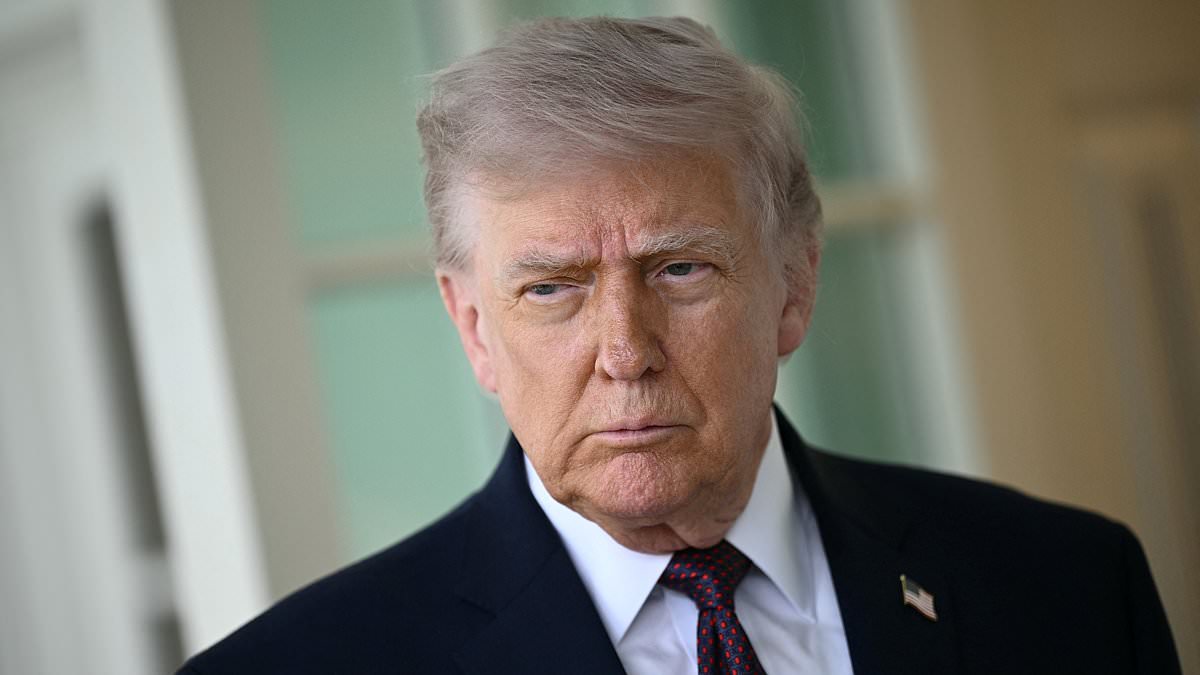
Donald Trump speaks to the press outside the Oval Office at the White House in Washington, DC, on April 13

A Yemeni soldier stands guards in front of a commercial ship ‘Al-Nuba’, which is docked for maintenance, on the coast near the strategic Bab el-Mandeb Strait, Yemen, Sunday, April 5, 2026

Yemen’s Houthi supporters’ children wearing army uniforms, holding mock guns and shouting slogans during a demonstration staged to show solidarity with Iran on April 3, 2026 in Sana’a, Yemen

Houthi supporters shout slogans and hold up weapons during an anti-US and anti-Israel protest in Sana’a, Yemen, May 9, 2025
At its peak in 2023, more than 9 million barrels of crude and petroleum liquids – almost one in ten barrels consumed globally – passed through per day, according to the US Energy Information Administration.
The Houthis’ 2023-24 campaign already slashed that figure by more than half – to around 4 million barrels per day – forcing major carriers including Maersk to reroute around the Cape of Good Hope. A full closure would compound that disruption at a moment when the Strait of Hormuz is already restricted.
Trump’s blockade has sent shockwaves through energy markets, pushing US gas prices above $4 nationwide and driving global oil past $100 a barrel.
The President shut down Hormuz and has refused to allow other foreign vessels to enter or leave the waterway since Monday after previously threatening to resume military strikes on Iran.
Peace talks led by JD Vance in Pakistan collapsed after the US pushed to bar Tehran from enriching uranium for 20 years, failing to produce a long-term nuclear deal.
Trump and Tehran could return to the negotiating table in Pakistan later this week, with Saudi Arabia and Gulf allies pressing both sides to step back from the brink.
US wholesale prices surged last month as the Iran war drove up the cost of energy.

Strait of Hormuz, a strait between the Persian Gulf and the Gulf of Oman, seen from space

Yemen’s Houthi supporters’ children wearing army uniforms, holding mock guns and shouting slogans during a demonstration staged to show solidarity with Iran on April 3
The Labor Department reported Tuesday that its producer price index – which measures inflation before it hits consumers – rose 0.5 percent from February and 4 percent from March 2025.
The year-over-year gains was the biggest in more than three years. Energy prices surged 8.5 percent from February.
Excluding volatile food and energy prices, so-called core producer prices rose a modest 0.1 percent from February and 3.8 percent from a year earlier. The gains in wholesale prices were smaller than economists had forecast.
The surge in prices complicates the work of the inflation fighters at the Federal Reserve, who have faced intense pressure from Trump to lower their benchmark interest rate. But some Fed policymakers are inclined to raise rates instead, as higher energy costs increase the inflation threat.
Wholesale prices can offer an early look at where consumer inflation might be headed.
Economists also watch it because some of its components, notably measures of health care and financial services, flow into the Fed’s preferred inflation gauge – the personal consumption expenditures, or PCE, price index.
The Labor Department reported last week that soaring gasoline prices pushed consumer prices up 3.3 percent last month from a year earlier, the biggest year-over-year increase since May 2024.
Compared to February, March consumer prices jumped 0.9 percent, the biggest gain in nearly four years.