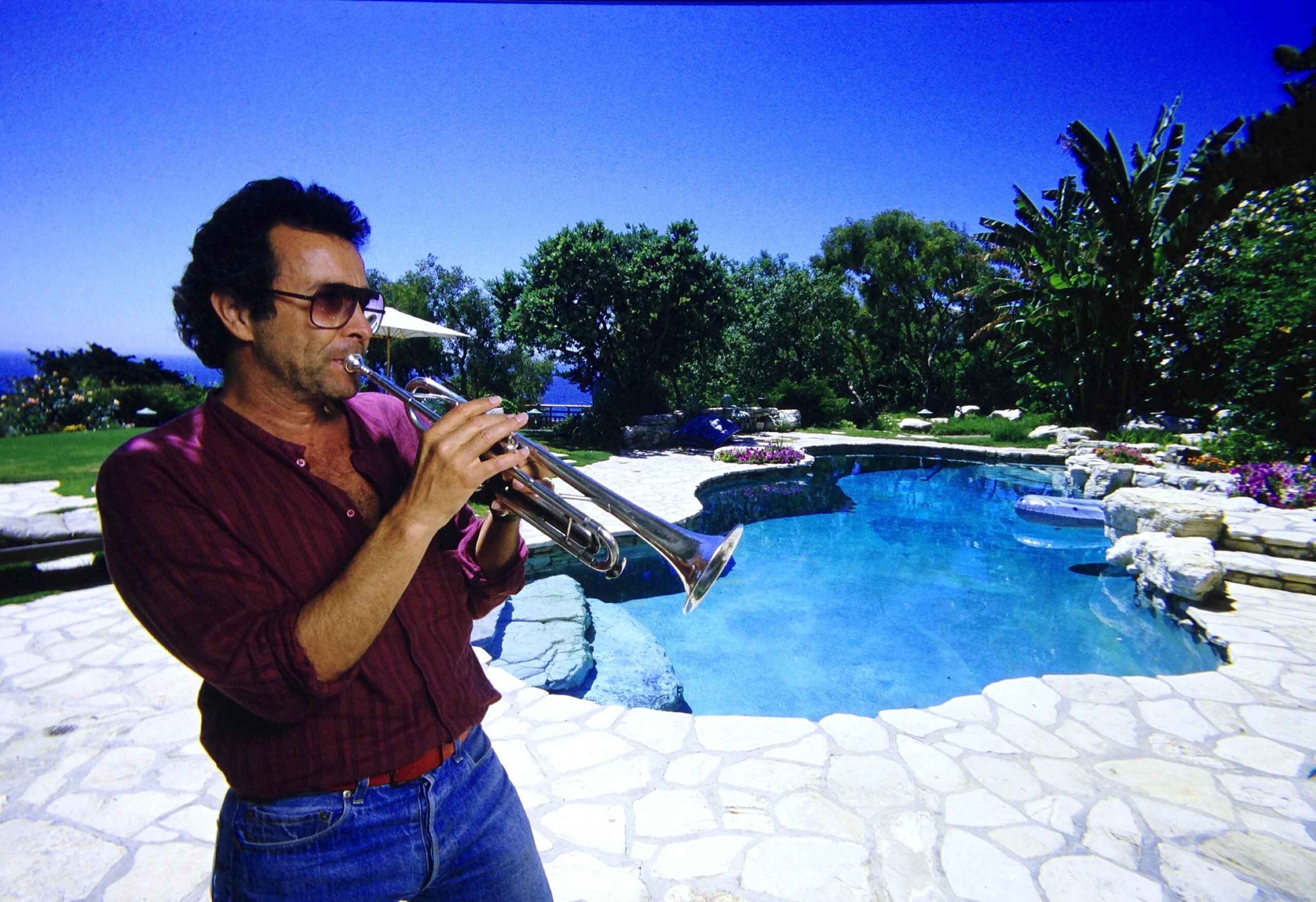

If you belong to the generation born after 1980, you might not be familiar with Herb Alpert—a name that should be on your radar. This remarkable individual has carved out a unique legacy as both a musician and an entrepreneur.
Alpert, a gifted trumpet player, was the frontman of the band Herb Alpert and the Tijuana Brass. The group was known for creating instrumental tracks characterized by catchy and funky melodies. Their music was all about the vibe, eschewing lyrics for pure instrumental groove.
Consider giving a listen to Alpert’s 1979 track “Rise.” If you start at the three-minute mark, you might hear something that stirs your memory, a detail we’ll delve into shortly:
In those few seconds, you might catch a familiar sound—a quick percussive synth stab that’s difficult to convey in words. It’s a striking musical “pow!” that punctuates the rhythm.
For those born after 1980, that distinctive “pow!” might be instantly recognizable as the sample that forms the foundation of Notorious B.I.G.’s 1997 hit “Hypnotize.”
Indeed, the entire rhythm structure of “Hypnotize” is intricately woven around the essence of “Rise,” showcasing Alpert’s enduring influence on music across generations.
In fact, the entire backbone of “Hypnotize” was built around “Rise.”
And yet, that connection to hip-hop is just a tiny footnote in Herb Alpert’s career.
In 1966, The Beatles were at the absolute zenith of their global cultural dominance. They had just released Revolver, they were selling out stadiums across the world, and “Beatlemania” was a recognized international phenomenon.
But The Beatles were not the highest-selling musical act in America that year. That honor went to Herb Alpert.
In 1966, Herb Alpert & the Tijuana Brass outsold The Beatles, moving more than 13 million albums. At one point in April of that year, Herb Alpert had four different albums in the Top 10 of the Billboard Pop charts simultaneously—a Guinness World Record that has never been broken.
Over his lifetime, Herb has sold more than 70 million records. He released 28 albums. Fourteen went Platinum. Fifteen went Gold. He is the only artist in history to hit #1 on the Billboard Hot 100 as both a vocalist and an instrumentalist.
He’s won multiple Grammys, a Tony Award, been inducted into the Rock and Roll Hall of Fame, and received the National Medal of Arts.
And yet, Herb’s musical accomplishments are actually just a small sliver of his career. A career that has made him the richest celebrity you’ve never heard of. Here is the story of how a $200 investment in a Hollywood garage turned a trumpet player into an $650 million tycoon.
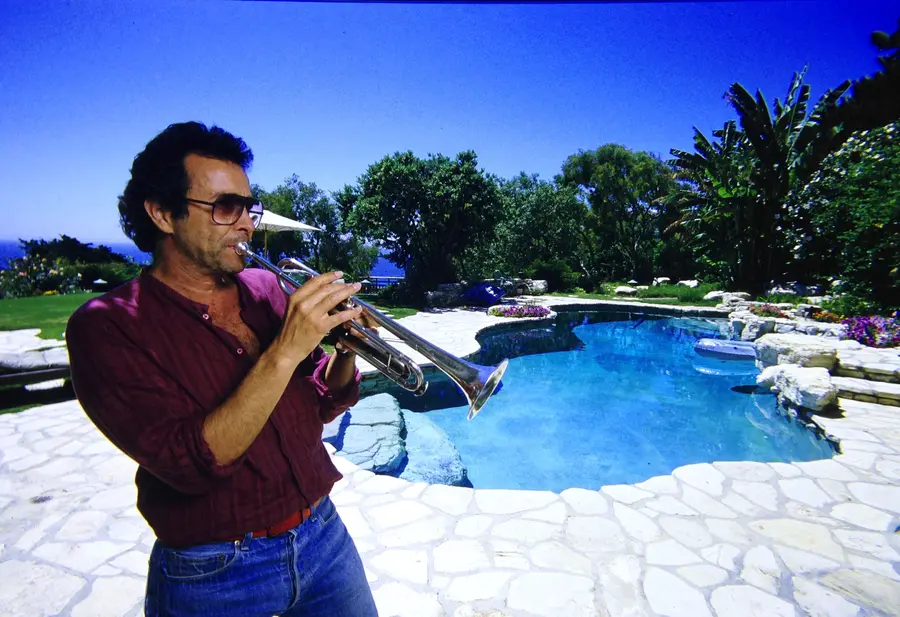
Herb Alpert in his Malibu yard in 1982 (Photo by Paul Harris/Getty Images)
Rise
Born in Los Angeles to Jewish immigrants from Ukraine and Romania, Herb Alpert grew up in a family of musicians. He picked up the trumpet at age eight, played at teenage dances, and even performed during his stint in the U.S. Army. After returning home and attending USC, where he played in the Trojan Marching Band, his career in the music business began in earnest, but not as a star performer.
In the late 1950s, Herb found work as a staff songwriter for Keen Records. Along with his collaborators, he co-wrote several Top 20 tracks, including “(What A) Wonderful World,” which became a signature song for Sam Cooke.
Around this time, a young music promoter named Jerry Moss arrived in Los Angeles. When Moss and Alpert crossed paths, they bonded over a shared frustration: major labels controlled everything. Artists had little leverage, little ownership, and little upside.
They decided to build their own system.
In 1962, the two men went into business together. They emptied their pockets, contributing exactly $100 each.
That was the entire startup capital.
With $200, they set up a makeshift office and recording studio in Herb’s West Hollywood garage and launched a label called Carnival Records.
Their first release, “Tell It to the Birds,” was a modest local hit. But before they could build on that momentum, they received a cease-and-desist. The name “Carnival Records” was already taken.
So they pivoted. Using the first initials of their last names, they rebranded as A&M Records (Albert & Moss). They even designed the now-iconic trumpet logo themselves, right there in the garage.
The First Big Bet
Around this same time, Herb attended a bullfight in Tijuana, Mexico. He was captivated by the sound of the brass band echoing through the arena. Back in his garage, he began experimenting, overdubbing his trumpet to simulate a full band.
The result was an instrumental track called “The Lonely Bull.”
To get it into stores, Herb and Jerry took a major risk. They borrowed $35,000 from a local record manufacturer to press 350,000 copies.
It worked. “The Lonely Bull” became a Top 10 hit. The Tijuana Brass was born
A Very Unusual Business Model
This is where Herb Alpert’s real genius kicked in.
Because he was both the star artist and the co-owner of the record label, the economics were completely different from a typical musician’s career. Instead of earning a small royalty, he controlled the entire profit stream.
Every record sold didn’t just pay him as an artist. It fed directly back into his own company.
And those records were selling in massive quantities.
Their 1965 album “Whipped Cream and Other Delights” became the number-one album of the year and stayed on the Billboard charts for more than three years.
At the peak of his success, Herb wasn’t just a hit musician.
He was a hit musician who owned the label printing the hits.
From Garage Label To Global Empire
Herb and Jerry Moss took that wave of cash and reinvested it into signing other artists.
They eventually moved out of the garage and purchased Charlie Chaplin’s old movie studio lot in Hollywood, converting it into their headquarters.
Over the next two decades, A&M Records grew into the largest independent record label in the world.
They signed the Carpenters. They signed The Police and helped launch Sting’s solo career. They released “Frampton Comes Alive!” by Peter Frampton, one of the best-selling live albums ever. They worked with Janet Jackson, Cat Stevens, and Sheryl Crow.
What started as a $200 garage experiment had become one of the most powerful music companies in the world.
The $700 Million Exit
By the late 1980s, corporate consolidation was sweeping the music industry. Major conglomerates were buying up independent labels, and A&M was one of the most valuable prizes on the market.
In 1989, Herb and Jerry finally decided to cash out.
They sold A&M Records to PolyGram for $500 million in cash. That’s the same as around $1.3 billion in today’s dollars.
They stayed on for a few years, but the relationship eventually broke down due to corporate interference. So Herb and Jerry did something most founders never get the chance to do.
They fought back.
In 1998, they sued PolyGram for violating the terms of the original sale agreement.
They won.
The result was an additional $200 million payout.
Between the original sale and the lawsuit, the two partners extracted roughly $700 million in cash from the company they started in a garage for $200.
The Overlooked Goldmine: Publishing
But even that wasn’t the full story. While A&M handled recording and distribution, Herb and Jerry had quietly built a second business alongside it.
Whenever a song is created, there are two copyrights: the recording itself and the underlying composition. Most artists focus on the first.
The real long-term money is often in the second. To capture that, they co-founded Rondor Music.
Over the years, Rondor accumulated the publishing rights to tens of thousands of songs. Every time one of those songs was played on the radio, licensed to a movie, or covered by another artist, Rondor got paid. It was a passive revenue machine.
In 2000, they sold Rondor Music to Universal Music Group for approximately $400 million in stock. That’s the same as around $750 million today.
If you combine the A&M sale, the lawsuit payout, and the Rondor sale, Herb Alpert and Jerry Moss generated roughly $1.1 billion in total exits. And that’s on top of the hundreds of millions they made while they owned the businesses and from his own career.
The Real Lesson
Today, Herb Alpert is in his 90s, and his fortune isn’t just sitting idle.
Through the Herb Alpert Foundation, he has given away tens of millions of dollars to support arts and music education. He donated $10.1 million to Los Angeles City College to provide tuition-free education for music majors. He gave nearly $15 million to the Harlem School of the Arts to eliminate its debt and upgrade its facilities.
Most artists spend their careers hoping a record executive will give them a chance.
Herb Alpert realized early on that the real opportunity was to become the executive.
He didn’t just play the trumpet.
- He owned the label the music was released on.
- He owned the studio it was recorded in.
- And he owned the publishing rights to the notes themselves.
And that is how you turn a $200 garage project into an $650 million legacy.
(function() {
var _fbq = window._fbq || (window._fbq = []);
if (!_fbq.loaded) {
var fbds = document.createElement(‘script’);
fbds.async = true;
fbds.src=”
var s = document.getElementsByTagName(‘script’)[0];
s.parentNode.insertBefore(fbds, s);
_fbq.loaded = true;
}
_fbq.push([‘addPixelId’, ‘1471602713096627’]);
})();
window._fbq = window._fbq || [];
window._fbq.push([‘track’, ‘PixelInitialized’, {}]);