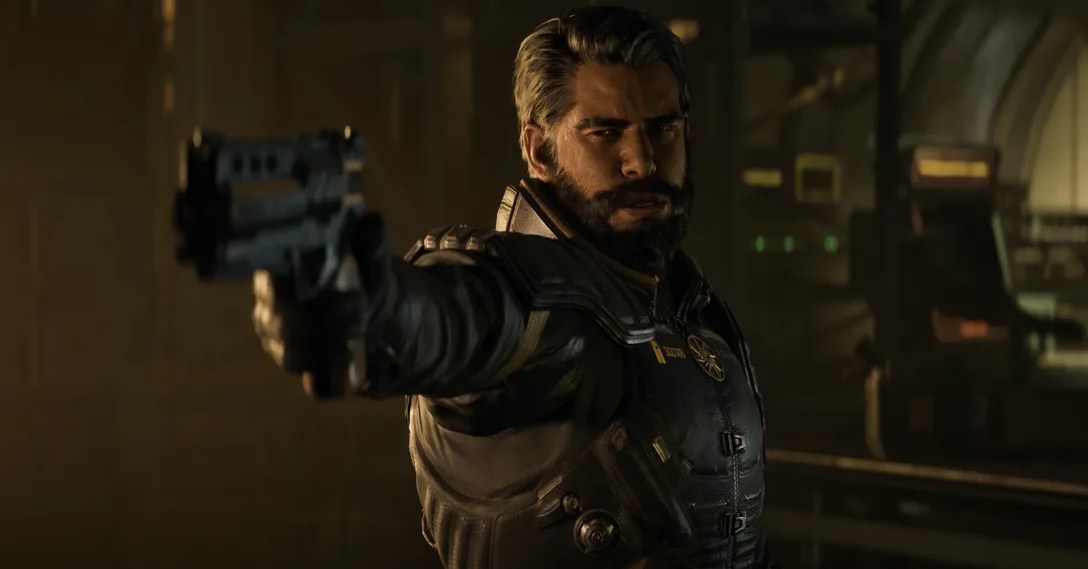

In the extraordinary universe of Saros, it’s as if the legendary King Midas himself has left his mark. The skies glow with a golden hue following frequent solar eclipses, while rocks containing the valuable Lucenite ore shine with a rich amber light. Our intrepid protagonist, Arjun Devraj—portrayed by Rahul Kohli—may find his own skin taking on a deep gold as he delves deeper into the untamed landscapes of Carcosa. Death is an all-too-common occurrence for Arjun, prompting the game to shift to enigmatic, dreamlike images, including a striking vision of a bed draped in gold silk sheets.
This opulent visual style aligns perfectly with the current era in gaming, where luxury seems abundant—evident in the hefty price tag of consoles like the PlayStation 5. Beyond this superficial parallel, the golden glow of Saros underscores a game where each frame dazzles with vibrant light. As a third-person bullet-hell shooter, it relentlessly bombards players with a mix of slow and fast-moving projectiles, ranging in color from gold to red and blue. Each projectile lights up the vast, 3D arenas as players fire off their own mystical ammunition, creating a hypnotic spectacle akin to a divine fireworks display.
While playing Saros, the latest offering from Finnish developers Housemarque exclusive to the PS5, players often find themselves in an elevated, almost transcendent state. Despite its otherworldly elements, the game’s sci-fi narrative keeps the experience grounded. Arjun is part of a mission to rescue a human colony on the desolate yet resource-rich planet of Carcosa. However, he soon becomes trapped in a time loop, reminiscent of the protagonist in Housemarque’s acclaimed title Returnal. Throughout the game, Arjun can initiate eclipses that plunge the world into darkness and unleash terrifying, organic-meets-mechanic entities, echoing the menacing machines of The Matrix.
Although the influences behind Saros may seem familiar, they are artfully woven together to breathe new life into the game. The massive, bio-synthetic structures recall the work of H.R. Giger, while references to “Ancients” evoke Ridley Scott’s Prometheus. The colossal portals bring to mind Stargate, while the overarching cosmic horror is reminiscent of Event Horizon. Housemarque’s depiction of a massive, burning sun conjures the chilling atmosphere of Danny Boyle’s underrated film Sunshine.
The game’s haunting environment is further amplified by its soundscape: the unsettling noises of Blighted Marsh, the mechanical whirring, and Sam Slater’s intense soundtrack, which shifts effortlessly between doom metal and pulsating club beats. This sonic blend harmonizes with the growls of the creatures Arjun unwittingly awakens, creating a symphony of dread.
As I navigated the enthralling world of Saros, there were numerous instances where I found myself whispering in awe, “This is incredible.” Such an experience occurred just the other night, but to truly convey what made that gaming session remarkable, a deeper dive into the game’s structure is necessary.
Saros, like Returnal, is a roguelite, meaning that it possesses a slightly less punishing run-based structure than Rogue-descending siblings such as Spelunky and Rogue Legacy. That’s not to say Saros isn’t hard — it can be. But the challenge is offset a little by the generous permanent upgrades purchased between runs, bolstering either your health, firepower, or ability to hoover up resources.
Over the first 10 hours of Saros, I died maybe 25 times making my way from a stunning mountain region to a gigantic citadel. Along the way, I discovered the joys of arm-length handguns with ricocheting bullets and space-age crossbows that fire bolts of raw energy. The game is split into various areas, but you’re able to teleport back to any one of them once you reach it, thus starting Arjun slightly further along his journey each time.

Image: Sony Interactive Entertainment
The other night, I decided to start a run in the very first area. With my plethora of enhancements, I tore through early-game foes, barely taking a hit. Regardless of your meta-progression, Arjun moves with liquid-mercury smoothness and impossible speed. Dashes essentially make you invincible for a split second. Picking up new and more powerful weapons, I blasted through bosses that had previously stumped me for hours. As the run went on for longer, I became exponentially more powerful: Arjun, maker of eclipses and wielder of alien technology, started to feel like a god. When it came to the boss I had yet to best, an ominous floating eye surrounded by wraith-like orbs, I took it down with ease, supercharged from the cumulative exploits of the total session.
I’m not typically good at such dexterously demanding games. But Saros gives even a player like me ways to progress. I typically lean on weapons with forgiving auto-aim, such as the Smart Rifle, whose red spectral bullets curve elegantly toward the game’s many Lovecraftian enemies. One power-up sees Arjun unloading what look like mini eclipses, dealing fatal damage to anything that veers near it.
Over the past 30 years, Housemarque has garnered a well-earned reputation for punishing bullet-hell shooters (see also Nex Machina and Resogun). Yet with Saros, you can feel the studio, now owned by Sony, wrestling with a conundrum: how to make the genre more accessible without diluting its essential, thumb-punishing essence.
The game largely nails this balance, though its most arresting moments remain the deadliest. I’ve had battles with hordes of foes who seem to occupy every inch of space from the floor to the sky, raining down polyrhythmic volleys of orbs. If Arjun stands still, he is toast, so you keep him moving — bobbing and weaving, ducking and diving through spirograph-like configurations of immaterial light to find the constantly repositioning pockets of safety.
Arjun has his own reasons for pressing forward with such bloody-minded intent: namely, a lost romantic partner on Carcosa. Yet this narrative thread inevitably fades during all the psychedelic shootouts. By the end, I saw him less as a person than as a kind of phosphorus energy force. Arjun, and by extension the player, is the catalyst for a game whose kaleidoscopic chain reactions are as beautiful as they are brutal. He is the match that sets this world afire.
Saros launches on the PS5 on April 30th.