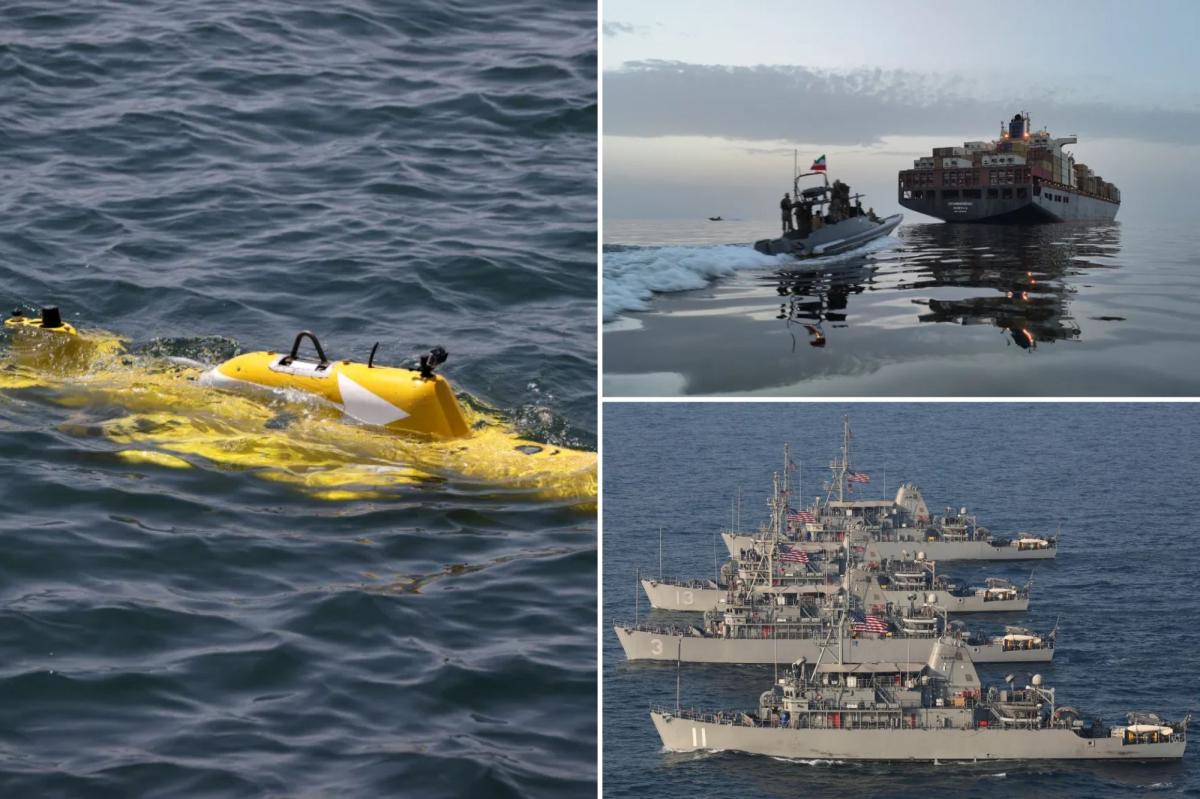


The United States is urgently working to reopen the Strait of Hormuz, a vital maritime passage, amid escalating threats from Iran. This situation is testing the U.S. Navy’s capabilities, as it has recently phased out many of its specialized minesweepers, instead relying on a smaller, more technologically advanced fleet of unmanned systems to tackle the challenge.
President Donald Trump has issued stern warnings to Tehran, cautioning against further provocations. He emphasized America’s readiness to ensure the strait remains accessible, even as Iranian forces have reportedly laid mines and disrupted commercial shipping in the crucial corridor, which is a conduit for a substantial portion of the world’s oil supply.
This tense confrontation highlights a vulnerability in the Navy’s approach to mine warfare. As the U.S. endeavors to secure the Strait of Hormuz following Iranian threats, it faces the task with a diminished fleet of dedicated mine-clearing ships, now supplemented by a combination of older vessels and cutting-edge unmanned technologies, to maintain one of the globe’s most significant maritime routes.
Currently, efforts to clear mines are taking place amidst a volatile standoff in the region. The U.S. has implemented a naval blockade on Iranian ports, prompting Iran to retaliate with assaults on commercial shipping, detentions of vessels, and threats to completely shut down the passageway.
In recent days, multiple commercial ships have been targeted, with both nations intercepting vessels navigating the chokepoint. This underscores the peril involved in any operation aimed at restoring the free flow of maritime traffic.
Negotiations remain at a standstill, with Iran demanding the removal of the U.S. naval blockade as a precondition for further talks. Meanwhile, Washington remains firm on its requirements for security assurances and the reopening of the strait, leaving minimal room for an immediate resolution.
The operation comes after a major shift in how the Navy handles mine warfare. The service retired its four Bahrain-based minesweepers last year, ending a decades-long presence of dedicated mine-hunting ships in the Middle East.
At the start of the current crisis, the Navy’s remaining minesweepers were based in Japan, not the Persian Gulf, and newer littoral combat ships equipped for mine countermeasures were not all positioned in the region.
Multiple news outlets have reported Iran has laid at least a dozen mines in the strait, citing intelligence assessments, though some estimates put the number higher.
The shift has left the Navy relying on a mix of legacy ships being surged into theater and newer unmanned systems designed to detect and neutralize mines.
“To be honest, that the minesweepers retired was never a concern to me, because we had brought in newer technology,” retired Vice Adm. Kevin Donegan, who previously commanded the Navy’s 5th Fleet, told Fox News Digital.
But analysts say the Navy is still working through a transition as it replaces its older minesweepers with newer systems.
“We’re sort of at this nadir of the Navy’s mine sweeping capacity,” Bryan Clark, a defense analyst at the Hudson Institute, told Fox News Digital.
Clark said the Navy has spent years developing unmanned systems to replace legacy ships, but currently has a limited number of those systems available for large-scale operations.
U.S. forces are not sending ships blindly into minefields. Instead, the operation begins with a wave of unmanned systems scanning the seabed to identify potential threats.
Underwater drones — some torpedo-shaped — are deployed in grid patterns to map the ocean floor and detect objects that could be mines, using high-resolution sonar to distinguish them from debris.
“They kind of look like torpedoes and they map the bottom,” Donegan said.
In parallel, surface drones tow sonar systems through narrow lanes, while helicopters equipped with sensors scan for mines closer to the surface, allowing the Navy to build a detailed picture of what is actually in the water.
But identifying mines is only the first step.
“The mine neutralization part is really the long leg of the process,” Clark said.
Once a mine is located, operators deploy remotely controlled systems to disable it — either by detonating it in place or puncturing it so it sinks. Even then, the danger is not fully removed.
“You’ve got to then retrieve this thing with EOD personnel,” Clark said, referring to explosive ordnance disposal teams tasked with clearing debris that can still pose a hazard to passing ships.
Clearing mines remains a slow and methodical process that can stretch timelines depending on how many devices are in the water and how they are deployed.
The Pentagon has told Congress the effort could take as long as six months, according to a Washington Post report.
Clark said recent war-gaming suggests U.S. forces could identify and begin neutralizing mines within weeks, but fully removing them from key shipping lanes could take significantly longer.
“The finding part, you could do within a couple of weeks,” he said, adding that neutralizing mines could take additional time and that removing debris and ensuring lanes are completely safe could extend operations into months.
Donegan cautioned that timelines are difficult to predict, in part because U.S. forces must first confirm whether mines are actually present in the areas Iran has claimed.
“When somebody says they mined it, you have to go validate if that’s even true, and that takes time,” he said.