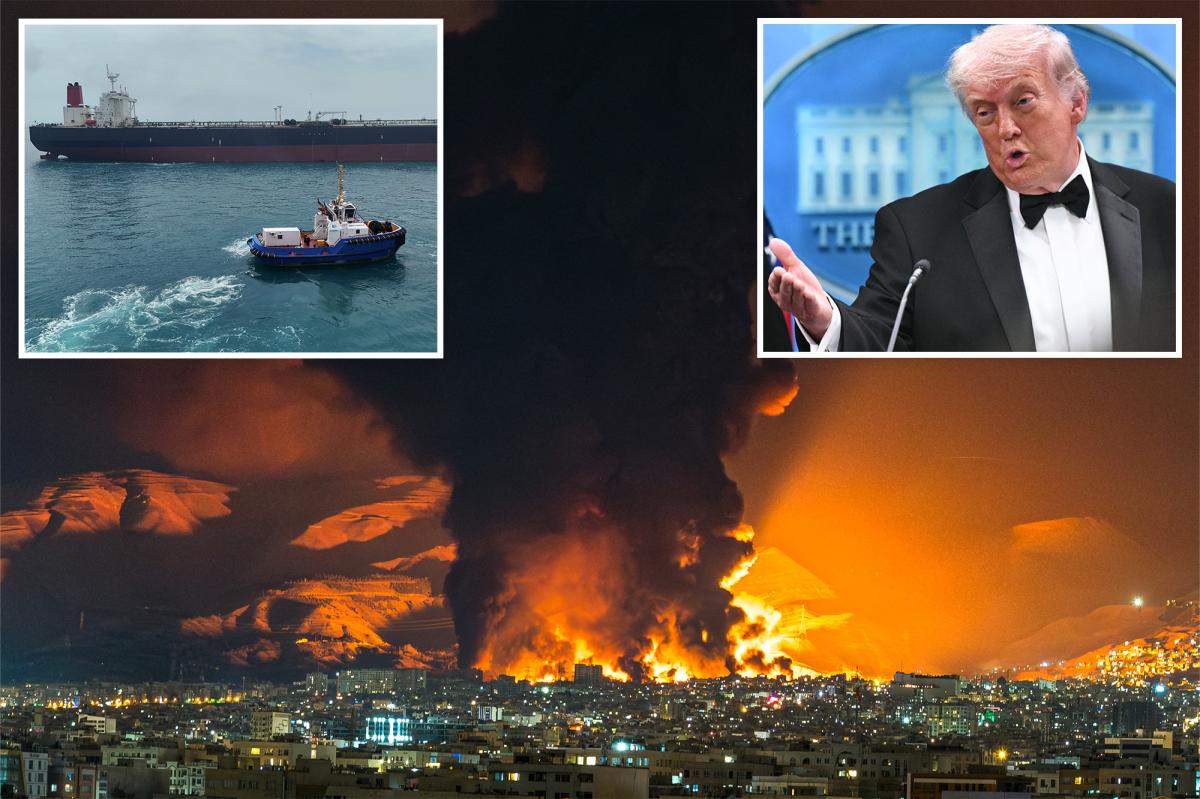

On Sunday, former President Trump suggested that within roughly three days, Iran’s oil facilities might face catastrophic failures due to mechanical challenges intensified by the US-imposed blockade on Iranian shipping.
During an appearance on Fox News’ “The Sunday Briefing,” Trump explained, “When significant volumes of oil move through your infrastructure, any disruption—like being unable to load it onto ships due to the blockade—can lead to internal and geological explosions. This is their current predicament, with no ships available to transport their oil.”
He further noted, “It’s a scenario where everything just blows up. They predict they have about three days to prevent such a disaster, and once it occurs, restoring the system to its original state becomes impossible.”
Industry specialists have cautioned that Iran might need to halt its oil production as soon as April 29, as the naval blockade threatens to inflict prolonged damage on their oil output capabilities.

The crux of the issue is that Iran is nearing the capacity of its onshore storage facilities, which had to be employed after export routes were blocked, leaving limited space for further oil storage.
Both the Critical Threats Project at the American Enterprise Institute and Energy Aspects, a UK-based energy analysis firm, have projected that Iran will reach its storage limit within the week.
“Once the tanks are filled, Iran would have to shut down its oil fields, which risks long-term damage to the fields,” said Annika Ganzeveld, the Middle East portfolio manager for the AEI’s Critical Threats Project, previously to The Post.
Sudden and long-term halts at oil-production plants risk permanent damage to a fuel reservoir and make it increasingly difficult to restart operations and reach the same level of output as before.
Such a situation would serve as a major blow to Tehran’s already weakened economy.

But it also would likely lead to soaring fuel prices to a global market already reeling from a missing 12 million barrels a day due to the war.
Iran may attempt to lower production even more for the remainder of the month or deploy oil tankers along its ports as temporary storage space to delay the production cuts, analysts noted.
It would be a short term solution for a country that is currently producing about 2 million barrels per day.
FGE NextantECA, an energy and chemicals advisory company, estimates that Iran has about 122 million barrels of storage space, giving Tehran less than seven weeks before it has to shut down production.