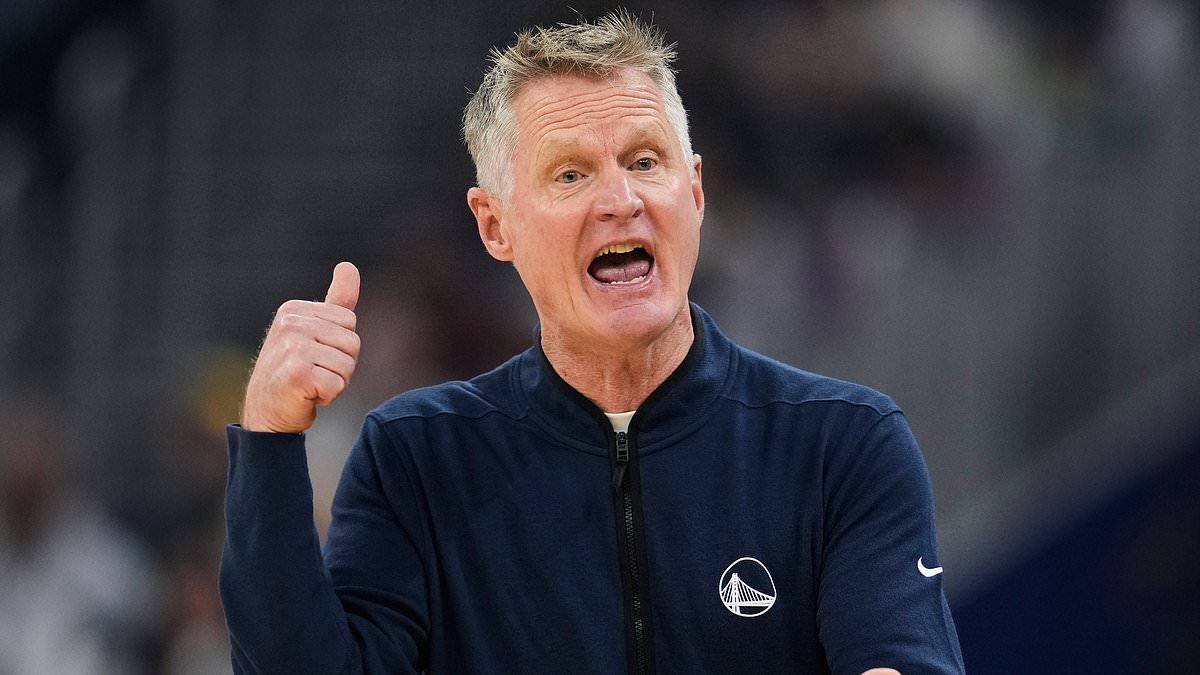

Steve Kerr, head coach of the Golden State Warriors, has recently retracted his previous harsh remarks about former President Donald Trump, acknowledging that he regrets labeling Trump a “buffoon.”
During an expansive conversation with The New Yorker, Kerr, a figure known for stirring opinions, shared insights into his political perspectives while also delving into his own history, the current state of the NBA, and his potential career trajectory.
Speculation has been swirling around Kerr’s possible departure from the Warriors this season. The interview touched on a candid outburst he once had during a press conference, held a day after Trump’s 2016 election victory.
Kerr, who has consistently expressed his political stances, reflected on that time, saying, “He was setting a new tone of communication in the country, and I was so appalled that I didn’t hold back.”
Years down the line, Kerr acknowledges he might have handled his emotions with more restraint.


Kerr’s Reflection on Tone and Public Responsibility
“I’ve realized I need to improve in how I represent our organization, allowing my views to be expressed without becoming overly personal,” he confessed. “I’m a representative of a large group of people.”
Kerr then noted how political communication has changed since Trump’s election, but admits: ‘I don’t think it’s all Trump’s fault. I think it was happening before Trump: the forces in social media, the forces in our country, the division.’
The coach added: ‘He definitely has taken advantage of that to gain and to consolidate power. And he’s using it to drive a wedge between all of us. He’s not the only one who’s done that, but he’s the President. He’s got the most power.
‘But calling the President a buffoon, I kind of regret that, even though I felt it in my heart. It’s better to point out policy decisions, but also American values. What’s wrong with the things that he does.’
In terms of those policy decisions, Kerr took particular issue with the war in Iran and Israel’s incursion into southern Lebanon.

Personal Tragedy Shaping Kerr’s Perspective on Conflict
It’s a subject that the coach knows well considering Kerr’s father, Malcolm Kerr, was an expert in the Middle East. Malcolm was the president of the American University of Beirut in 1984 when members of the Islamic Jihad Organization, a group with close ties to Hezbollah, shot and killed him in his office.
While he expresses a desire to depose the Iranian regime, Kerr takes issue with the manner in which the United States has carried itself.
‘My dad was killed by Iranian proxies forty-two years ago. I have no regard for the Iranian regime whatsoever. But the answer does not lie in starting a war and killing innocent people,’ Kerr explained.
‘Imagine being a parent of one of the one hundred and seventy-five girls who died when their school was bombed. Their loss, their suffering . . . How are they going to feel about America? Violence begets violence.
‘We’ve seen it in Israel and Lebanon as well. There was an opening for Israel to handle their business with the Palestinians diplomatically that would have solidified the Abraham Accords and allowed stronger alliances with Arab countries that would have really cornered Iran.


Criticism of Israeli Actions and Impact on Peace Efforts
‘Instead, Israel sought revenge for October 7th and now seventy-two thousand Palestinians have been killed and Israeli settlers are taking over the West Bank illegally, with the approval of Israel’s government and the U.S. Ambassador, Mike Huckabee. That’s not a path to any sort of peace or security for Israel or the rest of the Middle East.’
Kerr generally summarized his opinion on the American political sphere as such: ‘I think we’re as weak as we’ve ever been as a country, at least in a long time, because our leadership is so misguided.
‘There’s a lack of humility, a lack of dignity, a lack of understanding of the world, a lack of embracing other perspectives. The belligerence.
Despite his outspoken nature and his family’s history with foreign relations, Kerr feels no desire to explore a role in government.
‘I don’t have any desire to go into politics,’ he said. ‘I love basketball. This is my world. All of my friends and my people are in this world. And whether I keep coaching the Warriors or not, I imagine I’ll be involved in basketball.’