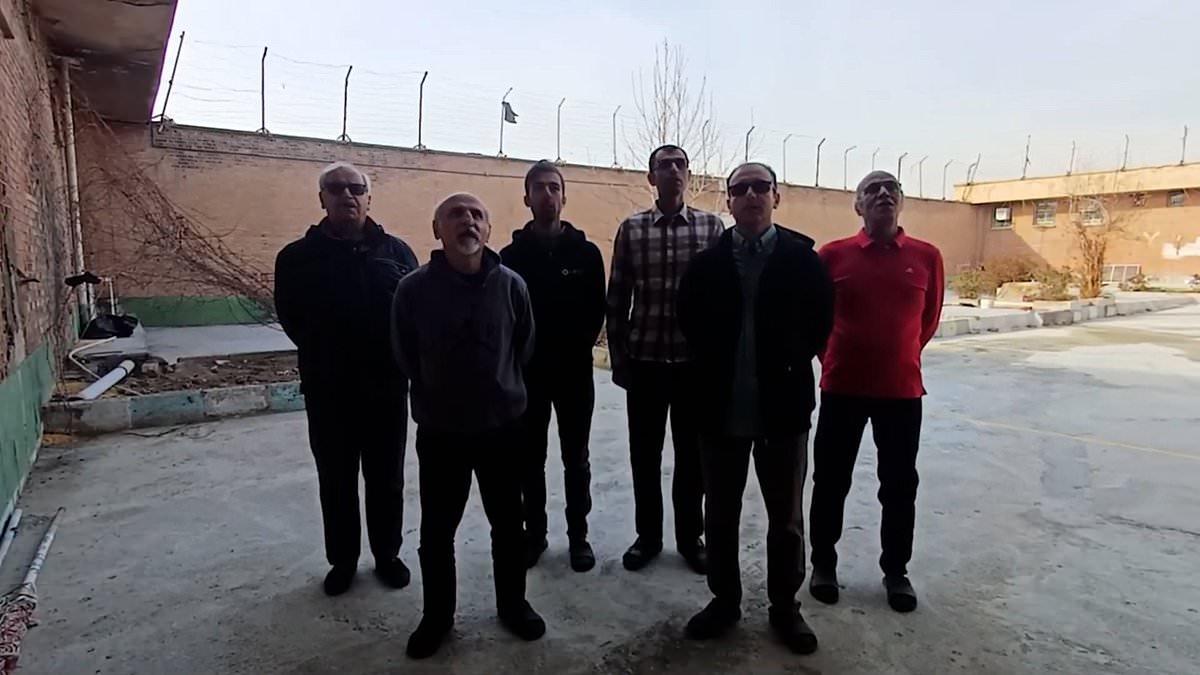

A poignant video has emerged, depicting six Iranian dissidents defiantly singing a song of resistance just before facing execution by their government.
This clandestine footage, secured by The Sunday Times, shows the men gathered in the courtyard of the infamous Ghezel Hesar prison, making a bold stand against the Islamic Republic.
In the video, recorded in February, the men sing passionately in Farsi: “Your rival stands before you now, hardened in the flame — I am the faith, I am revolt, with belief I take my stand — I’ve sworn an oath upon my blood, the tyrant’s throne shall shatter.”
The individuals have been identified as Vahid Baniamerian, Babak Alipour, Abolhassan Montazer, Pouya Ghobadi, Ali Akbar Daneshvarkar, and Mohammad Taghavi.
Among them, Pouya Ghobadi, a 33-year-old electrical engineer from Sonqor in western Iran, reportedly endured torture before being executed by hanging on March 31, Amnesty International has reported.
Ghobadi, alongside Vahid Baniamerian, who was executed on April 4, faced charges of armed rebellion against the state and involvement with a banned organization.
Baniamerian appeared in another smuggled video, speaking directly to then-Ayatollah Ali Khamenei.
‘To the Supreme Leader who wants to execute us to create fear in society. I want to remind you that I and those like me rose from the blood of freedom-loving youth,’ the 33-year-old said.

The smuggled video, obtained by The Sunday Times, captures the men in the courtyard of the notorious Ghezel Hesar prison, making a final stand against the Islamic Republic

The six political prisoners were identified as (from left) Vahid Baniamerian, Babak Alipour, Abolhassan Montazer, Pouya Ghobadi, Akbar Daneshvarkar and Mohammad Taghavi
‘It is time for the world to correct the failed and disruptive policies of the past decades, policies which have only fuelled massacre and devastation in Iran,’ he said in the footage.
‘Spreading war and terrorism throughout the region and the world. How much more suffering must there be before the world moves beyond words of concern to decisive action?’
Executed the same day was Abolhassan Montazer, a former political prisoner who had spent 11 years behind bars under the Shah and was then imprisoned under the current regime.
Babak Alipour, a 34-year-old law graduate had spent three years on death row in Iran’s notorious detention centres before his execution on March 31.
On March 12 he made a short video on a phone smuggled into his cell, saying: ‘Dictators have come, been overthrown, died, and been killed, and now it is the turn of Khamenei-the-son’s dictatorship.’
Ali Akbar Daneshvarkar was a civil engineer and the father of a 12-year-old son. The 57-year-old was hanged on March 25.
He had been imprisoned for over two years and subjected to months of torture and interrogation in Tehran’s notorious Evin prison.
His charges, included ‘armed rebellion’ and ‘collusion against the security of the miserable clerical regime.’
On the same day, 66-year-old Mohammed Taghavi was executed, ending a life marked by years of imprisonment as a political dissident.
In a letter from Fashafouyeh Prison dated August 7, 2025, he defiantly wrote: ‘I will not bargain with anyone over my life.’
‘I swear to fight valiantly until my last breath and to die standing, and to the last step.’
The video of the singing prisoners emerged as it was revealed earlier this month that Iran hanged at least 1,639 people in 2025, making it the highest number in 37 years, according to two NGOs.
The number of executions represented an increase of 68 per cent on the 975 people Iranian authorities put to death in 2024, and also included 48 women who were hanged.
‘If the Islamic Republic survives the current crisis, there is a serious risk that executions will be used even more extensively as a tool of oppression and repression,’ Norway-based Iran Human Rights (IHR) and Paris-based Together Against the Death Penalty (ECPM) said in their joint annual report.
IHR – which requires two sources to confirm an execution, the majority of which are not reported in Iranian official media – said that the figure represented an ‘absolute minimum’ for the number of hangings in 2025.
The figure amounted to an average of more than four executions per day.
The report said the number of executions was by far the highest since IHR began tracking it in 2008, and was the most reported since 1989, in the earlier years of the Islamic revolution.
The NGOs also warned that ‘hundreds of detained protesters remain at risk of death sentences and execution’ after being charged with capital crimes over January 2026 protests against the authorities, quashed by a crackdown that rights groups say left thousands dead and tens of thousands arrested.
‘By creating fear through an average of four to five executions per day in 2025, authorities tried to prevent new protests and prolong their crumbling rule,’ said IHR director Mahmood Amiry-Moghaddam.
Even during the war against Israel and the US that began on February 28, Iran has hanged seven people in connection with the January protests: six convicted of membership in the banned opposition group People’s Mujahedin of Iran (MEK), and one dual Iranian-Swedish citizen charged with spying for Israel.
Raphael Chenuil-Hazan, executive director of ECPM, said: ‘The death penalty in Iran is used as a political tool of oppression and repression, with ethnic minorities and other marginalised groups disproportionately represented among those executed.’
Earlier this month, Iran hanged a teenage musician in the notorious Ghezel Hesar prison outside the capital, despite hopes he would be spared because of his age.
Amirhossein Hatami, 18, was arrested on January 8 and accused of committing arson against the feared Basij paramilitary’s base in Tehran during anti-regime protests.
Amirhossein was convicted of ‘Moharebeh’ (‘Enmity Against God’) and sentenced to death on February 7.
On April 2, the judiciary announced he had been ‘hanged at dawn’.

Earlier this month, Iran hanged a teenage musician in the notorious Ghezel Hesar prison outside the capital, despite hopes he would be spared because of his age
Two days later, Mohammadamin Biglari, 19, and Shahin Vahedparast Kalour, 30, were executed at Ghezel Hesar Prison.
Biglari and Kalour’s family were not granted final visits or allowed to say goodbye before they were put to death.
The young men had been seized during the protests on January 8 and accused of arson over a fire at the base of the feared Basij paramilitary base.
They ‘confessed’ after weeks held in prison, where there are extensive reports of torture, before being brought before the feared Revolutionary Court in Tehran on February 6.
Both were also convicted of ‘Moharaebeh’ and sentenced to death by ‘Death Judge’ Abolghassem Salavati.
Also convicted of the capital charge by Salavati that day were Abolfazl Siavashani, 51, Shahab Zohdi, 38, Ali Fahim, 23, Yaser Rajaifar, and Hatami.
The report also noted that the Kurdish minority in the west and the Baluch in the southeast – both of whom largely adhere to the Sunni strain of Islam rather than the Shia branch dominant in Iran – are particularly targeted.
Almost all hangings were carried out inside prisons, but public hangings more than tripled to 11 in 2025, the report said.
Iran’s penal code allows for other methods of capital punishment, but in recent years, all known executions have been carried out by hanging.


