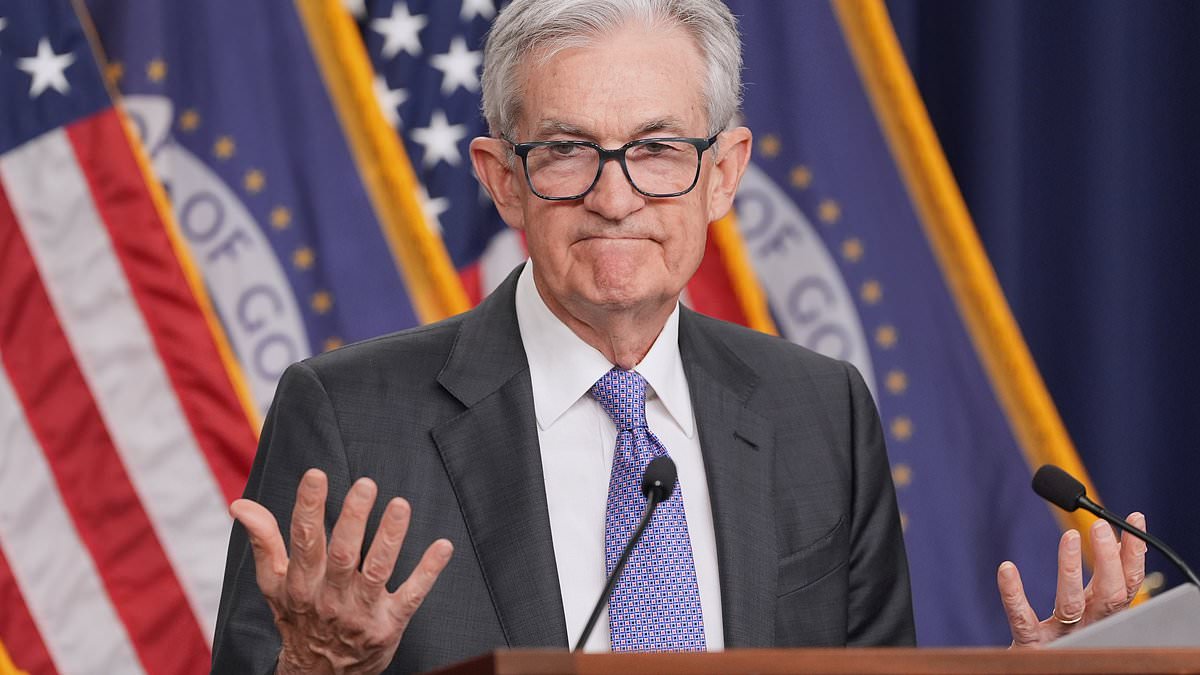

History often has a way of repeating itself, and investors are currently concerned about the unsettling trend in stock market performance when a new leader takes charge at the helm of America’s central bank.
Next month, Kevin Warsh is expected to assume the role of chair at the Federal Reserve, succeeding Jerome Powell, the current Fed chair.
A chart circulating on social media highlights a worrying trend: the stock market tends to decline in the months following the appointment of a new Fed leader, sometimes quite dramatically.
Research by financial powerhouse Barclays reveals that since 1930, the S&P 500 index has typically fallen by about 5 percent in the first month after a new Fed chair’s installment, with losses often deepening in the months that follow.
Three months into a new chair’s term, the market has historically dropped around 12 percent, and by the six-month mark, it has decreased by approximately 16 percent.
Susannah Streeter, the chief investment strategist at Wealth Club, informed the Daily Mail that investors should brace themselves for market volatility rather than expecting a seamless transition.
‘This is a well-worn pattern that’s shown up in previous transitions,’ warned Streeter.
‘Investors should brace for some volatility ahead as uncertainty is set to cascade in about the future direction of policy at the Fed,’ she said.

Fed Chair Jerome Powell’s current term runs until May 15, unless a successor is named earlier
Fed chairs are typically appointed for four-year terms by the President and confirmed by the Senate, and they lead US monetary policy by setting interest rates, managing inflation, and overseeing financial stability through the Federal Reserve system
Powell was sworn in as the 16th chair of the Federal Reserve back in February 2018 and reappointed for a second term in 2022, and his current term runs out on May 15, unless a successor is named earlier.
Some commentators have taken the Barclays data as a warning that a market sell-off is almost inevitable, framing the transition as a major risk event for investors – but analysts say the viral interpretation may be overstating the case.
The key issue lies in what the data actually measures: The Barclays data track the largest drop at any point during those time periods rather than overall returns.
In other words, they capture the worst moment of volatility, not where the market ends up.
Research shows these drawdowns are often just part of normal market behavior rather than something directly caused by a new Fed chair.
Markets experience multiple pullbacks of 5 percent to 10 percent in any given year, meaning some level of turbulence after a leadership change may be coincidental rather than causal.
There are also examples where market swings were driven by entirely different forces – from financial crises to hedge fund sell-offs – rather than the individual stepping into the Fed’s top job.

Posts currently doing the rounds on platforms like X and Threads point to historical data suggesting that whenever a new Fed leader takes over, markets tend to stumble – sometimes sharply
Still, the transition can create uncertainty: Investors often reassess expectations around interest rates, inflation policy and liquidity when there’s a new chief at the Fed, especially if the incoming chair is seen as more ‘hawkish’ or ‘dovish.’
That uncertainty alone can lead to short-term volatility, even if longer-term market performance remains intact.
Streeter noted that while a policy shift is possible, it would likely be gradual rather than abrupt, with broader committee decisions and political pressure also shaping the path forward.
The bottom line: while history suggests markets often wobble after a new Fed chair takes office, it’s far from a guaranteed downturn – and may say more about normal market swings than any single person running the central bank.
In late January, President Trump nominated Kevin Warsh to take over from Fed Chair Powell.
Warsh, a Stanford scholar, served on the Fed’s Board of Governors from 2006 until 2011, playing a crucial role in rescuing Wall Street during the financial crisis.
He was appointed at age 35, making him the youngest governor in the bank’s history.
Some analysts speculate Warsh’s nomination is a welcome one due to his Fed experience and Wall Street’s view that he won’t always do Trump’s bidding.

In late January, President Trump nominated Kevin Warsh to take over from Fed Chair Powell

While Powell’s term as Fed chair expires in May, his term as a member of the Federal Reserve’s board of governors runs through January 2028
Streeter said that Warsh has recently talked about the possibility of lower interest rates, but cautioned any moves would likely be delayed by fallout from the Iran war.
‘His belief that AI could boost productivity and ease price pressures may open the door to looser policy over time,’ she said.
‘However, with decisions shaped by the broader committee and political pressure lingering, change is expected to be gradual, with credibility and independence firmly in focus.’
While Powell’s term as Fed chair expires in May, his term as a member of the Federal Reserve’s board of governors runs through January 2028.
Powell has not said whether he intends to remain at the central bank beyond this year.


