
Share this @internewscast.com
In brief
- India, England, China, New Zealand and the Philippines are the top five countries of birth for those born overseas.
- India narrowly overtook England in 2025 to become the top overseas country of birth for the first time.
For the first time in recorded history, England is no longer the leading country of origin for Australia’s overseas-born population.
According to recent statistics, individuals born in India now constitute the largest group of foreign-born residents, slightly surpassing those from England as of 2025.
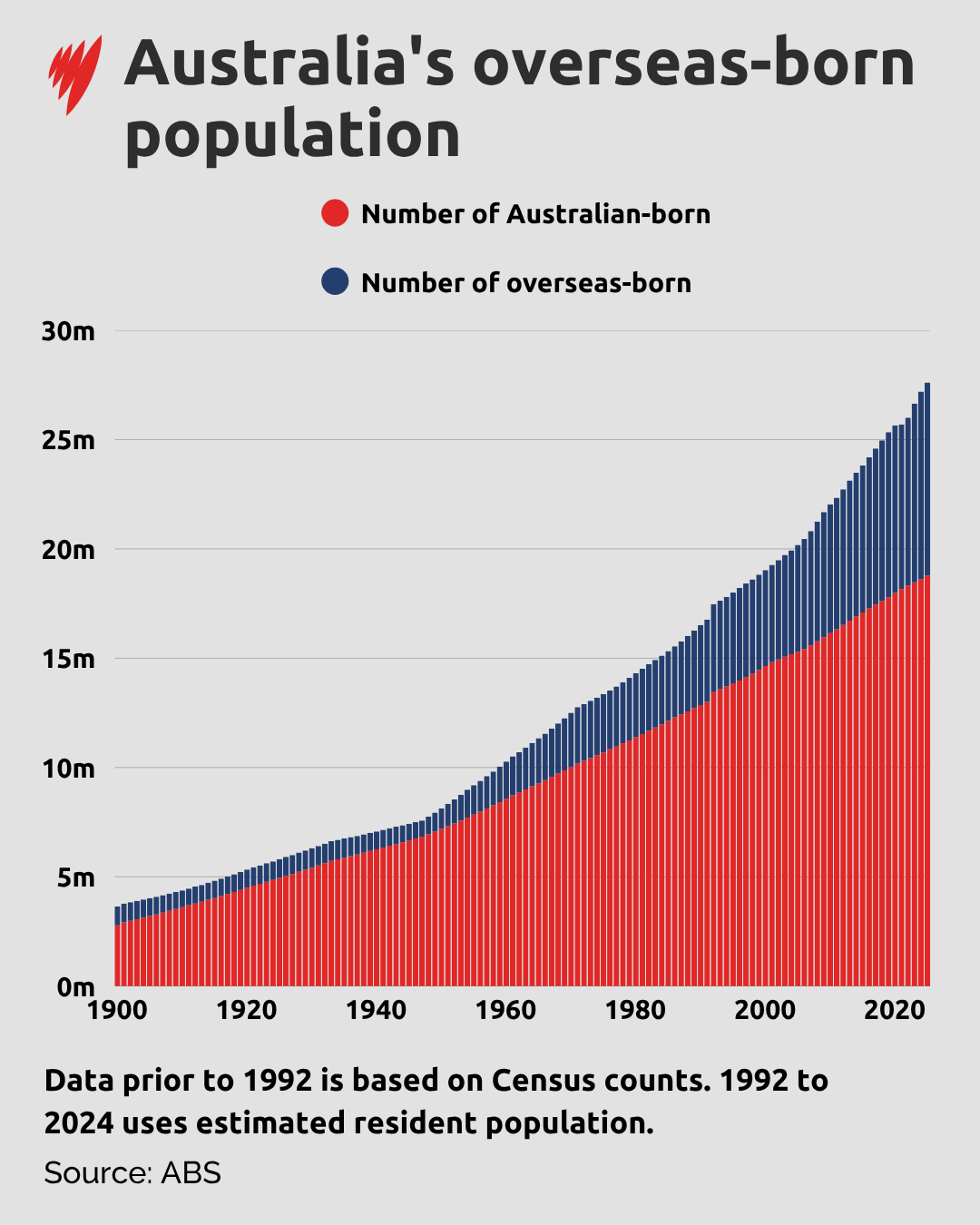
The latest figures from the Australian Bureau of Statistics reveal that by 30 June of the previous year, Australia’s estimated population had reached 27.6 million, with 8.83 million individuals born outside the country.
Over the last ten years, the nation has experienced significant growth, expanding by approximately 3.8 million people from the 23.8 million recorded in 2015.
Currently, 32 percent of Australia’s population is composed of individuals born overseas.
The last time such a high percentage was observed dates back to 1891, during the peak of migration in the late gold rush period.
Those levels fell sharply during severe economic downturns, hitting a low of 9.8 per cent in 1947, from which it has climbed ever since.
Where is everybody from?
Of the 8.83 million born overseas, 971,020 were born in India, a country that has seen an increasing proportion of migrants over the past four years.
An estimated 970,950 people were born in England, making 2025 the second year in a row that has seen an increase in migrants from this country. Over the past decade, migration from England has been steadily falling from a peak of just over a million in 2013.
The third largest group of non-Australian-born residents were those from China, made up of 732,000 people. This is another peak in Chinese-born migrants, which climbed by 32,000 people from its previous 2024 high.
New Zealand migrants are the fourth largest population group, increasing from 618,000 in 2024 to 638,000 in 2025.
Finally, people from the Philippines round out the top five, with 412,530 migrants estimated in the country in 2025. This is a figure that has almost doubled since 2015.
The next most significant countries of origin for foreign-born residents are Vietnam, South Africa, Nepal, Sri Lanka, and Malaysia.
The ABS statistics show that people born in Italy and England saw the largest decreases in their populations since 2015.
Both groups have a median age of 60 or over, reflecting high levels of migration to Australia from these countries after World War II.
The median age for Australia’s overseas-born population is now 43, down from 46 in 2005. By comparison, the median age of the Australian-born population is 35, up from 33 two decades ago.
The migration debate
The figures put Australia eighth in the world for the number of migrants in its population.
The United States has more international migrants than any other country, with 52.38 million residing there.
Australia’s 2025-26 permanent migration program seeks to allow 185,000 migrants into the country during the period, mostly through the “skilled worker” stream.
Net overseas migration for 2025-26 is forecast to be 260,000, a decline from its 2022-23 post-COVID peak.
Minister for Immigration, Tony Burke, made an impassioned defence of migration after the recent announcement of the Coalition’s plan to reform Australia’s migration policy.
“Modern Australia and multicultural Australia are the same thing,” he told reporters on 15 April.
“When people say they love Australia — and I do, and almost everybody on this continent does — modern Australia is what they’re loving, and we are a multicultural nation.”
Opposition leader Angus Taylor outlined his first major policy platform as party leader to decry “declining immigration standards”, and outline a new system based on subscription to “Australian values”.
“Immigration numbers are too high,” Taylor said. “Putting Australian values at the heart of immigration policy is crucial to protecting our way of life.”
Australia’s population is expected to grow 1.3 per cent in 2025-26 and is projected to reach 31.5 million by 2035-36.
For the latest from SBS News, download our app and subscribe to our newsletter.