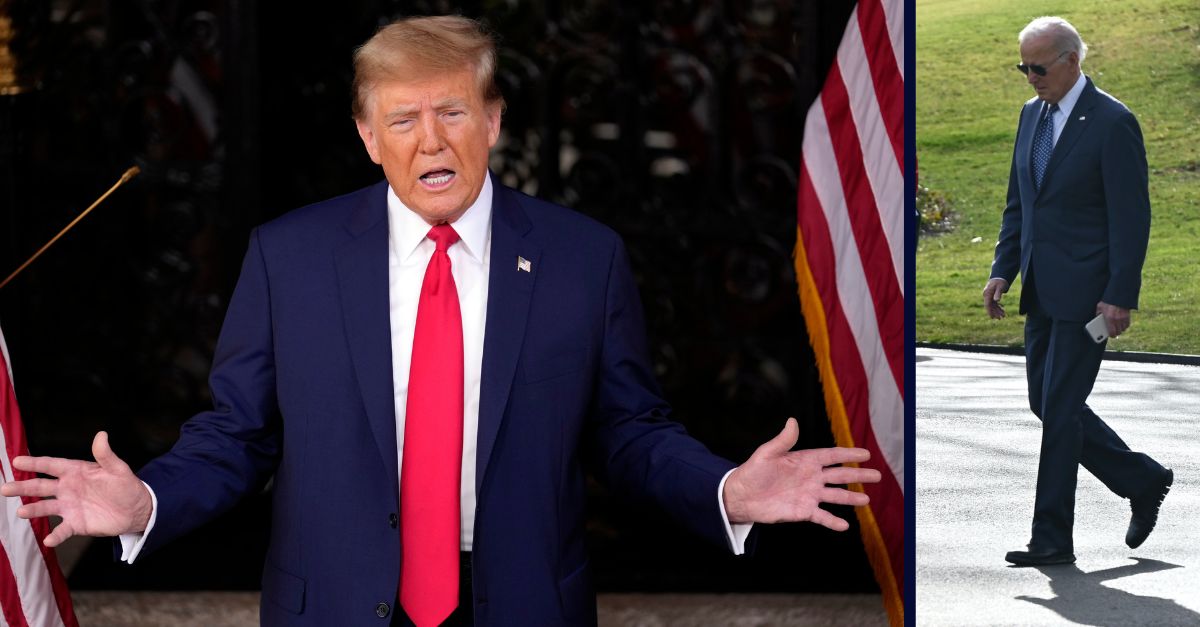

Left: Former President Donald Trump speaks at his Mar-a-Lago estate Thursday, Feb. 8, 2024, in Palm Beach, Fla. Right: Then-President Joe Biden is departing the South Lawn of the White House in Washington, D.C., United States, on February 8, 2024 (AP Photo/Rebecca Blackwell; Photo by Kyle Mazza/NurPhoto via AP).
In a closely watched First Amendment case, a federal court ruled on Friday against a Vietnam War veteran who challenged restrictions on political expression at a federally administered retirement home in Mississippi.
The lawsuit, brought by Johnny Fuselier, centered on the Armed Forces Retirement Home—Gulfport, where Fuselier alleged that his rights were curtailed when he was prohibited from wearing political apparel in the facility’s common areas.
Presiding over the case, Chief U.S. District Judge Halil Suleyman “Sul” Ozerden, appointed by President George W. Bush, issued a 33-page memorandum opinion and order siding with the government. The judge concluded that the restrictions on political speech were “reasonable in light of the nature and purpose of the forum.”
Fuselier’s dissatisfaction with the retirement community arose after a series of weekly bulletins in the summer of 2023 reminded residents of the existing ban on political clothing and signs. The Armed Forces Retirement Home (AFRH), described as a “unique federal entity” under the Secretary of Defense’s control, enforces policies that prevent residents from displaying clothing or signs that support or oppose any current political candidate.
In response to these policies, Fuselier insisted that the AFRH allow him to wear and display political slogans. However, his request was ultimately denied by the agency, prompting the legal battle that culminated in this recent court decision.
Fuselier, in turn, “demanded that AFRH permit him to wear and display political slogans,” but the agency denied the request.
So, he waged a small protest.
The court recalls what happened next:
In late June 2023, Fuselier “affixed two printed signs to his orthopedic walker while in the common areas” of the retirement home. One sign stated “2024 – Make Us Great Again” and the other stated “Let’s Go To Brandon MS.” According to Plaintiff, the Resident Officer “ordered him to remove the signs” and informed him that refusing to comply could result in an “administrative hearing,” and possible eviction. Fearful, Fuselier complied.
In July and August 2024, bulletins again referenced the ban on political speech. In August 2025, the AFRH held a meeting where staff “reiterated that residents are prohibited from wearing political apparel at any time in the areas of campus that are generally accessible to residents.” Again, Fuselier “demanded” the AFRH allow him to express himself as a “passionate supporter of President [Donald] Trump and other Republican political candidates and officials.” Again, the AFRH denied the plaintiff’s request – so he sued later that month.
Ruling on dueling motions, the court found the residential common area at the retirement home to be a limited public forum.
The U.S. Supreme Court’s public forum doctrine centers around the notion that certain places — either physical or digital — have, by tradition or practice, been used for First Amendment purposes and should remain free of government interference. Under high court jurisprudence, there are three types of forums: traditional or quintessential, designated or limited, and closed or nonpublic.
Here, the court determined the space in question was public in the sense that it is for open to all residents but that it has “unique characteristics” that make it “incompatible with political speech.”
In reaching this conclusion, Ozerden explicitly rejected the plaintiff’s efforts to liken the common area to a public university.
“Its purpose is to provide ‘residences and related services’ to veterans, not to foster a rich educational environment,” the court observes. “These services are primarily mental and physical health services to assist aging veterans. And the AFRH-G is a gated and guarded federal facility that employs active-duty military personnel.”
The judge elaborates on this distinction, at length:
Permitting political expression, such as allowing Fuselier to don apparel with political slogans like “Let’s Go Brandon,” a well-known euphemism for the phrase “F*** Joe Biden,” might disrupt the AFRH-G’s unique environment which seeks to provide residences for veterans and foster resident physical and mental health, while preserving an environment suitable for active-duty military personnel. Such political speech disrupts that environment because it is adverse to the AFRH-G’s mission and undermines the military’s long-standing historical tradition of promoting the appearance of political neutrality among the active-duty personnel working at the Home.
Ozerden further determined the regulation in question was “reasonable in light of the purpose served by the forum.”
“The Government has a legitimate and reasonable interest in promoting harmony among residents, visitors, and employees at the AFRH-G because of the unique nature of the forum,” the opinion goes on. “The AFRH-G’s purpose is to provide residences and related services, primarily mental and physical health services, to veterans.”
And, though the regulation targets political speech, the court notes that the ban on political speech does “not discriminate against speech on the basis of viewpoint” and “is viewpoint neutral because it bans all ‘political’ apparel and signage.”
The order goes on to reject Fuselier’s claims that the regulation “is unconstitutionally vague” by explaining how the government “has provided an interpretation clarifying its scope.”
“Plaintiff remains free to exercise—and indeed should exercise—his First Amendment rights in parks, on sidewalks, and in other public spaces,” the opinion concludes. “Our Republic is healthiest when the public is exposed not only to ideas they ascribe to, but also, and especially, to those they do not.”