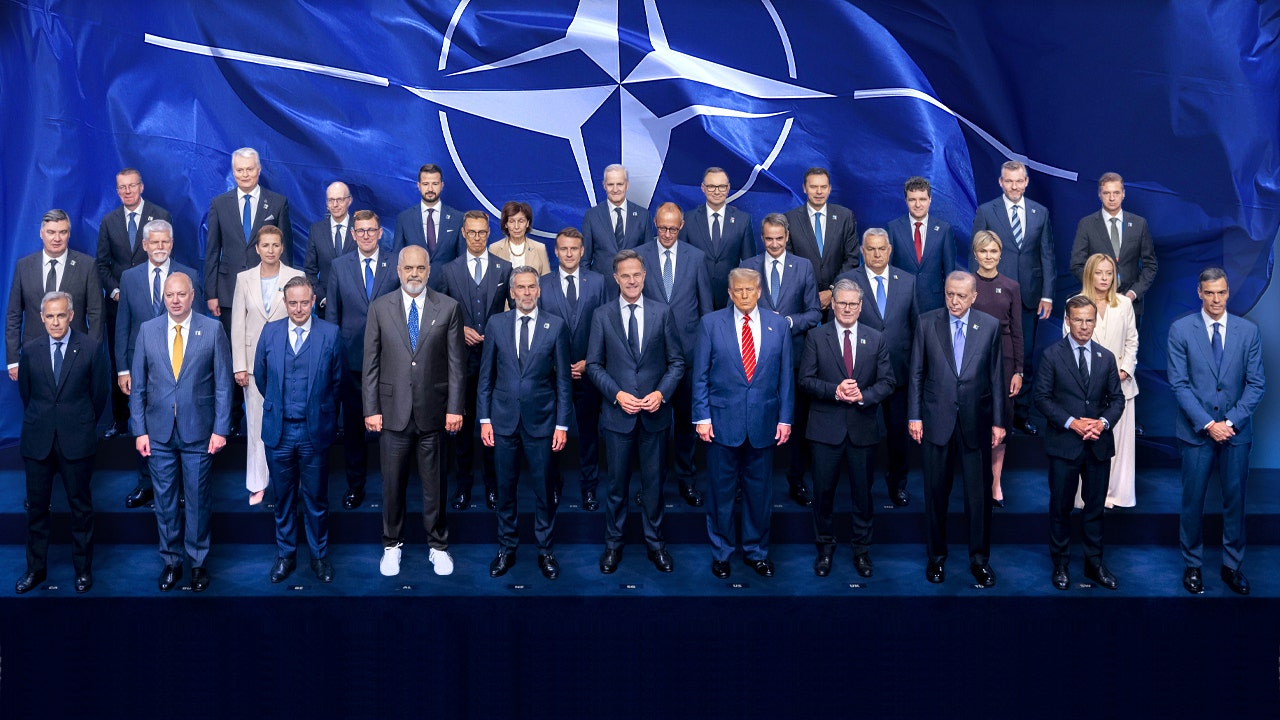

This article is the first in a series exploring the challenges facing the NATO alliance.
As pressure mounts from President Donald Trump for NATO allies to boost their defense spending, and with his directive to pull 5,000 U.S. troops out of Germany over the next six to twelve months, a critical issue comes into sharper focus: even with increasing budgets among allies, NATO remains heavily reliant on American military strength to operate effectively.
This imbalance within NATO is neither speculative nor new, according to retired Lt. Gen. Keith Kellogg, who shared insights with Fox News Digital. “I suggested to the president that perhaps we should consider a tiered relationship with NATO,” Kellogg recounted from discussions during Trump’s initial term about the alliance’s direction. “We need to establish a revamped NATO—a new defensive alignment with Europe.”
Kellogg, who held a senior national security role during Trump’s first term, expressed concerns that while NATO has expanded politically, its military capabilities have not kept pace, resulting in what he perceives as a widening gap between its commitments and actual capacities.
NATO Secretary General Mark Rutte, U.S. President Donald Trump, and Britain’s Prime Minister Keir Starmer gathered with leaders from NATO countries during the NATO Heads of State and Government summit in The Hague, Netherlands, on June 25, 2025. (Ben Stansall/Pool/Reuters)
“NATO began with 12 members and has grown to 32, and in doing so, I believe its impact has been diluted,” Kellogg argued, describing the current state of NATO as “a very bloated architecture.”
“They haven’t put the money into defense. Their defense industry and defense forces have atrophied. When you look at the Brits right now, they could barely deploy forces: they have two aircraft carriers, both under maintenance. Their brigades are like one out of six that work. And you just look at the capability, it’s just not there. So I think we need to realize that and say, well, we need something different,” Kellogg, who is the co-chair of the Center for American Security at the America First Foreign Policy Institute, told Fox News Digital.
But not everyone agrees the alliance is losing relevance.
“It has never been more relevant,” said John R. Deni, a research professor at the U.S. Army War College, who says NATO remains central to U.S. national security.
“The reason for that is twofold,” he said. “One, it’s our comparative advantage versus the Chinese and the Russians… they don’t have anything like this.”
“And the second reason… NATO underwrites the security and stability of our most important trade and investment relationship,” he added, referring to economic ties between North America and Europe.
NATO Chiefs of Defense hold a hybrid meeting in Brussels on Aug. 20, 2025, with screens displaying allied leaders joining remotely to discuss Ukraine. (Fox News)
Dependence: Design or Weakness?
By around 2010, the United States accounted for roughly 65% to 70% of NATO defense spending, according to analysis provided by Barak Seener from the Henry Jackson Society, a London-based think tank.
“They’ve always been dependent on the U.S.,” Kellogg said of the European allies.
“The allies overall rely upon one another for deterrence and defense by design,” Deni said, explaining that alliances exist to “pool their resources” and “aggregate their individual strengths.”
Deni pointed to ground forces as a clear example of what the U.S. gains from the alliance, noting that “there are far more allied mechanized infantry forces on the ground than there are Americans.”
Still, he acknowledged that reliance has at times gone too far.
“In the past… it was fair to say that the European allies were overly reliant upon the Americans for conventional defense,” he said, pointing to the 2000s.
That, he said, was partly driven by U.S. priorities — as Washington pushed European allies to focus on wars in Afghanistan and Iraq rather than territorial defense.
A Polish Army soldier sits in a tank as a NATO flag flies behind during the NATO Noble Jump VJTF exercises on June 18, 2015, in Zagan, Poland. (Sean Gallup/Getty Images)
Seener describes NATO as “formally collective, but functionally asymmetric,” with the U.S. providing a disproportionate share of “high-end capabilities.”
That asymmetry is most visible in nuclear deterrence.
Seener said the U.S. provides the overwhelming majority of NATO’s nuclear arsenal — including intercontinental ballistic missiles, submarine-launched systems and strategic bombers — meaning deterrence ultimately relies on the assumption of U.S. retaliation.
A NATO official told Fox News Digital that, “The U.S. nuclear deterrent cannot be replaced, but it is clear that Europe needs to step up. There’s no question. There needs to be a better balance when it comes to our defense and security. Both because we see the vital role the U.S. plays around the world and the resources that it demands, and also because it is only fair.”
“The good news,” the official added, “is that the Allies are doing exactly that. They are stepping up, working together — and with the U.S. — to ensure we collectively have what we need to deter and defend one billion people living across the Euro-Atlantic area.”
Boeing CH-47 Chinook helicopters of the U.S. Army 12th Combat Aviation Brigade fly over a Lithuanian Vilkas infantry fighting vehicle during the Allied Spirit 25 military exercise near Hohenfels, Germany, on March 12, 2025.
The Systems NATO Cannot Replace
Beyond nuclear weapons, the dependence runs through the alliance’s operational backbone.
Seener pointed to U.S.-provided intelligence, surveillance and reconnaissance — as well as logistics and command systems — as essential to NATO operations.
“Without U.S. intelligence and surveillance, NATO loses situational awareness and early warning capabilities,” Seener said, adding, “So that means that Russia, for example, can attack Europe. And theoretically, if there’s no NATO and the U.S. is not involved, Europe would not be aware, or it would take it too long to be able to defend itself.”
Kellogg also says that much of Europe’s military capability falls short of top-tier systems.
“For the most part, their equipment, if you had to grade it A, B, C, D, E, F, they’re kind of like B players or C players,” he said. “It’s not the first line of work.”
He pointed to air and missile defense as a key gap, noting that while European countries rely on U.S.-made systems such as Patriot and THAAD, “they don’t have a system that’s comparable.”
Kellogg attributed that to years of underinvestment, saying European defense industries “have atrophied,” adding that the United States is also now “relearning that as well.”
NATO Secretary General Jens Stoltenberg looks on as President Donald Trump and Poland’s President Andrzej Duda talk during a working lunch at the NATO leaders summit in Watford, Britain, on Dec. 4, 2019. (Kevin Lamarque/Reuters)
Deni said the picture today is more mixed.
“Alliance defense spending has been up… and has spiked far more after 2022,” he said, pointing to Russia’s invasion of Crimea in 2014 as a turning point.
But he cautioned that capability gains take time, noting that many improvements are still years away from full deployment.
Deni pointed to recent European purchases of U.S. systems as evidence of growing capability, noting that countries including Poland, Romania, Norway and Denmark are acquiring the F-35 fighter jet from the U.S.
“You can’t build an F-35 overnight,” he said, adding that many of these improvements will take years to fully materialize.
A NATO official told Fox News Digital the alliance “needs to move further and faster” to meet growing threats, pointing to new capability targets agreed by defense ministers in June 2025.
Keith Kellogg speaks during the Warsaw Security Forum 2025 on Sept. 30, 2025, in Warsaw, Poland. (Marek Antoni Iwanczuk/NurPhoto via Getty Images)
The official said priorities include air and missile defense, long-range weapons, logistics and large land forces, noting that while details remain classified, plans call for a fivefold increase in air and missile defense, “thousands more” armored vehicles and tanks, and “millions more” artillery shells. NATO also aims to double key enabling capabilities such as logistics, transportation and medical support.
The official added that allies are increasing investments in warships, aircraft, drones, long-range missiles, as well as space and cyber capabilities, while boosting readiness and modernizing command and control.
“These targets are now included in national plans,” the official said, adding that allies must demonstrate how they will meet them through sustained defense spending and capability development.
The NATO official also noted that European allies lead multinational forces across Central and Eastern Europe, while the U.S. and Canada serve as framework nations in Poland and Latvia, alongside ongoing air policing missions and NATO’s KFOR operation in Kosovo.
One of three Swedish Air Force JAS 39 Gripen fighter aircraft takes off from the Blekinge Wing F17, based in Kallinge southern Sweden for a base in Sardinia to join the Nato-led operation in Libya, on Saturday, April 2, 2011. As Sweden joins NATO, it bids a final farewell to more than two centuries of neutrality. (AP Photo/Scanpix/Patric Soderstrom, File)
What happens if the U.S. is stretched?
Kellogg’s warning is direct: NATO’s deterrence depends on U.S. presence.
“The one you always have to worry about… is Russia,” Kellogg, who was Trump’s special envoy for Ukraine and Russia in 2025, said.
If U.S. forces are tied down elsewhere, NATO could face serious strain — particularly in areas like intelligence and logistics.
For Kellogg, the danger is delay. “We won’t know until it happens,” he said. “And then you won’t be able to respond to it.”
Deni, however, said the alliance remains a strategic asset — not a liability.
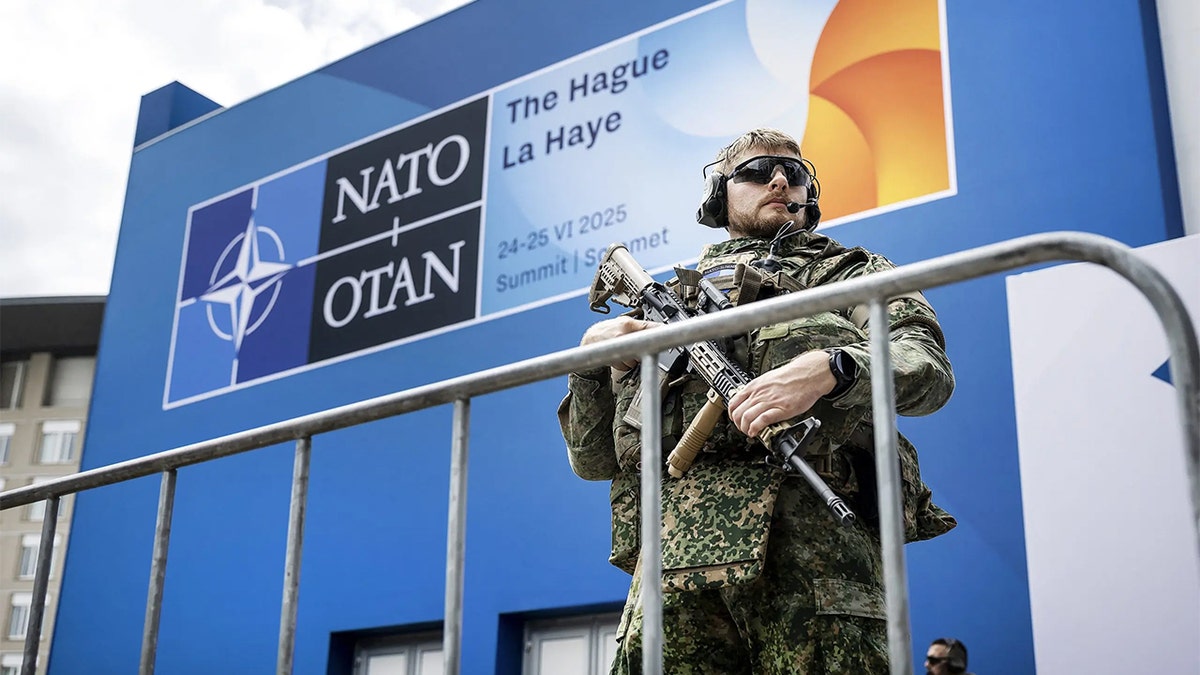
A NATO military force stands guard outside the World Forum in The Hague ahead of the two-day NATO summit on June 22, 2025. (Remko de Waal/ANP/AFP)
The question, he suggests, is not whether NATO still works. It is whether allies can adapt fast enough to keep it working.