
On Tuesday, Armenia marked a significant diplomatic milestone by hosting its inaugural bilateral summit with the European Union. This event highlights Armenia’s aspiration to join the EU, as the nation cautiously distances itself from its long-standing ally, Russia.
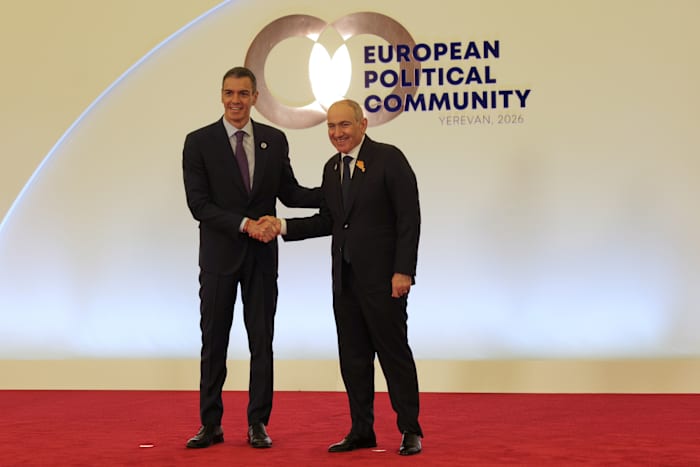
Held in Yerevan, the EU-Armenia summit followed the eighth meeting of the European Political Community, which attracted numerous European leaders to the Armenian capital. The discussions centered on European security concerns and the ongoing U.S.-Israeli conflict in Iran, as noted in remarks from Monday.
These gatherings exemplify Armenia’s strategic pivot towards Western alliances, signaling a shift away from Russian influence. Tensions with Moscow, a traditional ally, have been rising since 2023. This friction coincides with Azerbaijan’s complete reclamation of the Karabakh region, ending a prolonged period of control by ethnic Armenian separatists.
Armenian officials have criticized Russian peacekeepers for their inaction during Azerbaijan’s advances. In response, Moscow, preoccupied with its conflict in Ukraine, denied the allegations, stating that its forces were not authorized to intervene.
Richard Giragosian, the director of the Regional Studies Center in Yerevan, conveyed to The Associated Press that the war served as a “belated demonstration” of Russia’s unreliability as a partner.
Armenia continues to pursue stronger ties with Europe, seeking to redefine its geopolitical stance.
Since then, Prime Minister Nikol Pashinyan’s government has pursued closer ties with the West, a move welcomed by the EU.
In remarks to the EPC conference on Monday, EU Council President Antonio Costa thanked Pashinyan for “the courageous political decisions he has taken to bring Armenia closer to the European Union.”
“The direction of travel is unmistakable,” Costa said, stressing that it was “vital to strengthen Armenian democracy and fight external interference and misinformation.”
Ursula von der Leyen, president of the EU Commission, stressed in remarks to the EPC that Armenia played an important role for European supply chains, “specifically on the connectivity to the South Caucasus and Central Asia.”
Armenia joined the International Criminal Court in 2023, a move Moscow condemned as an “unfriendly step.” The court has issued an arrest warrant for Russian President Vladimir Putin. accusing him of personal responsibility for the abductions of children from Ukraine.
Armenia also froze its participation in the Moscow-led Collective Security Treaty Organization in 2024.
The following year, the Armenian parliament passed a law formally declaring the country’s intention to seek EU membership.
It is the EU, rather than the United States, that has stepped into the vacuum left by Russia, Giragosian said.
“EU engagement is much more prudent and much more productive than the U.S. becoming involved, simply because European engagement is less provocative to Russia over the longer term,” he added.
However, Armenia remains a member of the Russia-led Eurasian Economic Union — a single market allowing the free movement of goods, capital and labor. The organization also includes Belarus, Kazakhstan and Kyrgyzstan — and Putin has made the trade-offs plain.
Speaking at talks with Pashinyan in Moscow earlier this year, Putin warned that Armenia could not simultaneously belong to both the EEU and the EU, noting that Yerevan currently receives Russian natural gas at prices far below European market rates. Pashinyan acknowledged the incompatibility but said Armenia could, for now, combine EEU membership with deepening EU cooperation.
Giragosian described Tuesday’s summit as “a focus on deepening the preexisting relationship” rather than a step toward candidacy, referencing the Comprehensive and Enhanced Partnership Agreement that has governed EU-Armenia ties since coming fully into force in 2021.
“The symbolic significance is much greater as a message to Russia,” he said.
Benefits for Armenia and its prime minister
Yet some concrete results are expected, Giragosian said. Financing for domestic reform and military assistance through the European Peace Facility — a fund created primarily to support Ukraine — is among the anticipated announcements. An EU monitoring mission has been deployed along Armenia’s border with Azerbaijan for several years, and a new mission targeting hybrid threats has recently been approved.
Pashinyan, who has been in office since 2018 and faces parliamentary elections in June, stands to benefit politically from the international profile the European meetings confer. Giragosian noted that Pashinyan’s government is likely to be returned largely by default, with the opposition unable to offer a credible alternative program.
But Giragosian warned against framing Armenia’s foreign policy as purely a pivot from Russia to the West.
“Armenia is also pivoting beyond the black and white zero-sum game paradigm,” he said, pointing to significant diplomatic investment in Asia, including with Japan, South Korea and China. “This is not about replacing Russia with the West. This is much more innovative, much more sophisticated.”
Heightened tensions
The summit also comes at a moment of heightened tension between Azerbaijan and the EU. Azerbaijan’s Ministry of Foreign Affairs summoned the EU ambassador last week to protest a European Parliament resolution demanding the release of Armenian prisoners of war and criticizing the treatment of Armenians in Karabakh. Lawmakers in Azerbaijan subsequently voted to suspend all cooperation with the European Parliament.
Azerbaijan President Ilham Aliyev, who addressed the EPC conference via video link, accused the European Parliament and the Parliamentary Assembly for the Council of Europe (PACE) of “double standards” for placing sanctions on Azerbaijan’s PACE delegation.
There were also protests outside the EPC summit venue, which was surrounded by tight security. Demonstrators held photos of Armenian prisoners being held in Azerbaijan.
Opposition leader Aram Sargsyan, head of the Democratic Party of Armenia, told the Armenian Press Agency that the European officials were voicing support for Pashinyan ahead of the election and have “forgotten about the Armenians in prison in Azerbaijan.”
___
Morton reported from London. Katie Marie Davies in Manchester, England, and Avet Demourian in Yerevan, Armenia, contributed.