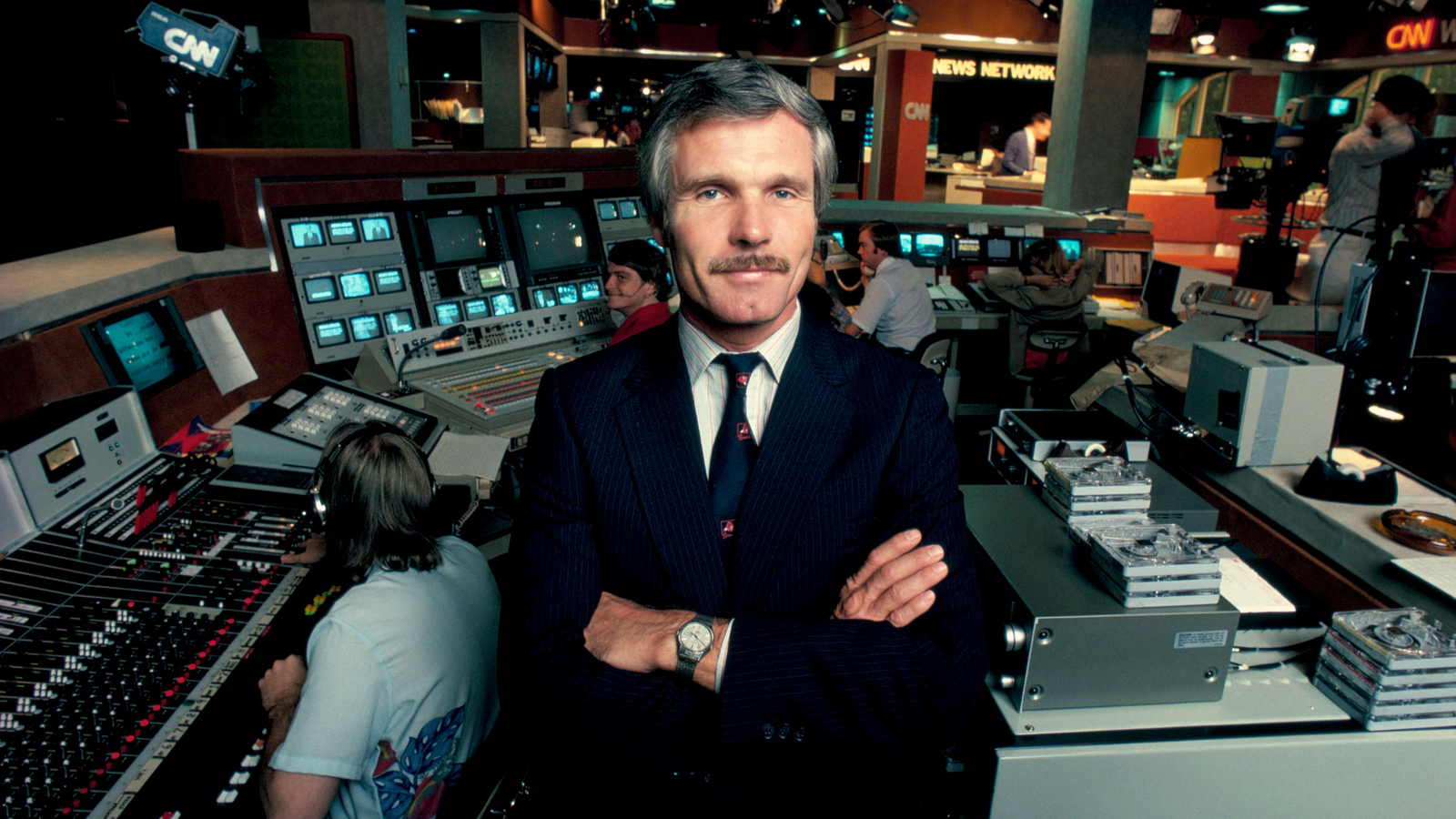

Ted Turner, the visionary media mogul and philanthropist known for founding CNN, passed away peacefully on Wednesday, with his family by his side, as announced by Turner Enterprises. He was 87 years old.
Hailing from Ohio and later establishing his empire in Atlanta, Turner, often dubbed “The Mouth of the South” for his candid demeanor, carved out a significant niche in the media world. His ventures included the launch of cable’s first superstation, alongside popular channels dedicated to movies and cartoons. He also owned professional sports teams such as the Atlanta Braves.
Beyond his media achievements, Turner was globally recognized as a yachtsman and a philanthropist who established the United Nations Foundation. He was a passionate activist for nuclear disarmament and a conservationist who became one of America’s largest landowners, playing a pivotal role in the reintroduction of bison to the American West. Additionally, his commitment to environmental education led to the creation of the Captain Planet cartoon series for children.
However, it was Turner’s bold concept of delivering news around the clock from across the globe that truly cemented his fame, a vision that transformed how news was consumed once it gained traction.
In 1991, Time magazine honored Turner as Man of the Year for his profound impact on global events and for making historical moments accessible to audiences in 150 countries.
Although Turner eventually sold his networks to Time Warner and stepped away from the media business, he remained proud of CNN, often describing it as the “greatest achievement” of his life.
“Ted was an intensely involved and committed leader, intrepid, fearless and always willing to back a hunch and trust his own judgement,” Mark Thompson, Chairman and CEO of CNN Worldwide, said in a statement. “He was and always will be the presiding spirit of CNN. Ted is the giant on whose shoulders we stand, and we will all take a moment today to recognize him and his impact on our lives and the world.”
Just over a month before his 80th birthday in 2018, Turner revealed that he had Lewy body dementia, a progressive brain disorder. In early 2025, Turner was hospitalized with a mild case of pneumonia before recovering at a rehabilitation facility.
Turner is survived by his five children, 14 grandchildren, and two great-grandchildren.
Launching a TV news revolution
Turner began his media career at the age of 24 when he took over his father’s billboard company, Turner Outdoor Advertising, in the wake of the elder Turner’s suicide. He buried his shock and grief in work – but Turner wasn’t content to push other people’s products forever.
He bought up radio stations, then branched into television in 1970 by acquiring a struggling station in Atlanta known as Channel 17. He tried to boost the ratings by airing old sitcoms and classic films, at one point even hosting “Academy Award Theatre” himself.
Turner wasn’t interested in news yet. He decided to invest in sports instead, acquiring the rights to Atlanta Braves baseball games. Viewers and advertisers flocked to the channel, and as Turner turned a profit, he started to think bigger about TV.
In 1976 he beamed Channel 17’s signal up to a satellite and it became cable TV’s first superstation, reaching cable subscribers across the country.
Turner bought the Braves, and then the Atlanta Hawks basketball team, partly to keep the long-term rights to the TV programming, and partly because it was just plain fun.
As he built the Superstation WTBS, he set his sights even higher – a 24-hour news channel.
Turner was harshly critical of broadcast TV and establishment news judgments. “Part of the reason America had so many problems, he believed, was because his fellow Americans were so ill-informed,” former CNN journalist Lisa Napoli wrote in “Up All Night,” a book about the creation of CNN. Turner recognized “there was no better place to promote a variety of opinions than on allmighty television. With a news channel, he could quite possibly help save the world.”
A lot of people thought Turner’s idea was crazy. But he saw a huge opening in the marketplace.
“I worked until 7 o’clock, and when I got home the news was over,” he once said, referencing the 6:30 evening newscasts on the big networks. “So I missed television news completely. And I figured there were lots of people like me.”
Turner wanted to dramatically widen the aperture of television news, envisioning shows about business, health, sports and other subject matter. He admitted he knew “diddley-squat” about the news business, but he recruited the right people who did, like Reese Schonfeld, CNN’s founding president.
On June 1, 1980, CNN – the first 24-hour news channel – went live and has been on the air ever since.
Turner quickly expanded, adding a second 24-hour news network CNN2 (later renamed Headline News, then HLN) in 1982 and CNN International, which broadcast around the world, in 1985. He later added non-news cable channels including Turner Network Television (TNT), Turner Classic Movies (TCM) and the Cartoon Network.
In the mid-1980s, he acquired MGM’s library of more than 4,000 old films and stirred up controversy in the film community for colorizing many black-and-white movies, including “Casablanca.”
Out of all his networks, CNN was always his “baby,” but the network’s early years were marked by technical snafus during its long stretches of live broadcasting. Some critics dubbed it “Chicken Noodle News.”
Yet, Turner and his deputies knew they were creating something revolutionary.
“I lived for 20 years in my office,” Turner said. His office was inside CNN’s broadcast building in Atlanta. “I lived on a couch in my office the first 10 years.”
Longtime employees recall Turner sauntering into the newsroom wearing a bathrobe.
“He was one of us,” former CNN president Tom Johnson recalled. “He would be in his housecoat down having breakfast in the Hard News Café (the company’s cafeteria).”
When the Persian Gulf War broke out in 1990, the importance of a 24-hour news channel became clear. It was the first time a war was broadcast live – and it was only on CNN.
“What Ted made happen was just as important as the Internet revolution,” said former Turner Broadcasting CEO Terry McGuirk.
Turner was hailed as a visionary and earned TIME Magazine’s “Man of the Year” in 1991.
In 1996, Turner sold his networks to Time Warner for nearly $7.5 billion. He stayed on as a vice-chairman of Time Warner, heading up the company’s cable TV networks.
Shaped by family tragedies
Robert Edward Turner III was born in Cincinnati, Ohio, on November 19, 1938. At the age of 4, shortly after his sister’s birth, his parents sent young Ted to a boarding school, which he didn’t like.
“I wanted to be home,” he said.
Turner had a difficult relationship with his father, who had a weakness for alcohol and disciplined his son with a leather strap or a wire coat hanger.
“It wasn’t dangerous or anything like that,” Turner once recalled. “It just hurt like the devil.”
The family later moved to Savannah, Georgia, and his sister Mary Jean contracted a rare form of lupus when she was 12. The illness left her with brain damage and in severe pain for years until her death.
“She was sick for five years before she passed away. And it just seemed so unfair, because she hadn’t done anything wrong,” Turner said. “What had she done wrong? And I couldn’t get any answers. Christianity couldn’t give me any answers to that. So my faith got shaken somewhat.”
Turner was sent to several strict Southern military schools and his father had hopes of him getting accepted to Harvard. He attended another Ivy League school – Brown University – but his father cut off his tuition because he disapproved of his major, as he made clear in a letter he wrote to his son.
“My dear son, I am appalled, even horrified, that you have adopted Classics as a major,” the elder Turner wrote. “I am a practical man, and for the life of me I cannot possibly understand why you should wish to speak Greek. With whom will you communicate in Greek?
“I think you are rapidly becoming a jackass, and the sooner you get out of that filthy atmosphere, the better it will suit me.”
Before long, the money ran out and he dropped out, returning to Georgia to work for his father’s billboard company in Macon.
Turner was just 24 when his father shot himself and died in the upstairs bathroom at the family’s home near Savannah. It was March 5, 1963, and the elder Turner was under the influence of alcohol and pills, battling depression and worried he had overextended himself with a $4 million purchase that expanded his company, Turner Outdoor Advertising, into the South’s largest billboard company.
“He went against everything he taught me: ‘Be courageous and hang in there,’” Turner said.
Ted meets Jane
At the peak of his career, Ted Turner – twice divorced with five grown children – began dating actress Jane Fonda in 1989. The two would marry in 1991 and become one of the nation’s most storied couples.
“At first they didn’t get along at all,” recalled friend and former President Jimmy Carter. “In fact, they didn’t like each other. I heard this from both of them. It was months later before they decided to try again. And they evolved into one of the nicest romances that I’ve ever known about.”
Ted and Jane stayed together for 10 years and, when they split, his anger at her conversion to Christianity was blamed, but the truth was more nuanced. She simply could no longer take a back seat to his larger-than-life personality or sustain his need for her constant companionship as they shuttled between his 28 properties. She was pushing 60 and no longer interested in living out of a suitcase.
“I would never love anyone like I love him,” she said. “But I just couldn’t keep moving in his world, along the surface for the rest of my life. I knew that I would get to the end of my life and regret not doing the things that I also needed to do for me.”
He was devastated when she left him and, as his marriage ended, Turner’s media empire began slipping away.
Time Warner had agreed to be purchased by Internet provider AOL in 2000 with the hopes that the merger would help the legacy media company survive and prosper during the dot-com boom.
But the Internet bubble burst in 2001 and the following year the new AOL-Time Warner sustained a record $99 billion loss, resulting in countless job cuts. It soon became known as the biggest mergers and acquisitions failure in corporate history.
Turner resigned as AOL Time Warner’s vice-chairman in 2003, and three years later announced he would not seek reelection to its board of directors.
He lost control of Turner Broadcasting, CNN, the Atlanta Braves, the Hawks – and his fortune, consisting mostly of company stock, was hemorrhaging – more than $7 billion in three years.
“I lost Jane. I lost my job here. I lost my fortune, most of it. Got a billion or two left. You can get by on that if you economize,” he told CNN’s Piers Morgan in May 2012. He said he was “brokenhearted.” He tried to win her back, but it was obvious the relationship was beyond repair. “We were so far apart philosophically, we couldn’t do it.”
Despite the breakup, Fonda and Turner always maintained a close friendship, speaking on the phone regularly and showing up at each other’s charity events.
“Just because people get divorced doesn’t mean they stop loving each other,” she said. “It may be hard for two people to live together, but I can’t ever forget the reasons that made me fall in love with him.”
Turner explained that he had “loved many people” but only been “in love” twice – once with Fonda and once with someone he wouldn’t name. Being “in love” implies permanence, he said – something he hadn’t experienced in all of his relationships.
A media mogul turned philanthropist
Turner always had a philanthropic streak, but it began to move to the forefront in 1997, the year after he sold Turner Broadcasting to Time Warner. That’s when he pledged $1 billion to the United Nations. Making good on that pledge took a while longer than he had anticipated – he made his final payment to the UN in 2015 – thanks to the beating his fortune took after the 2001 merger with AOL.
When it was over, he was still a billionaire, but just barely.
Turner didn’t do anything in a small way, including reinventing himself. He was the second biggest landowner in North America, with 2 million acres spread over 28 properties, including 19 ranches in Nebraska, Colorado, Kansas, Montana, New Mexico and South Dakota, as well as in Argentina. The first of his Ted’s Montana Grill restaurants opened in 2002, and now there are more than 40 in 16 states. He managed to bring bison back from the brink of extinction; he had the world’s largest private bison herd, with approximately 51,000 head.
His five children – Rhett Turner, Laura Turner Seydel, Jennie Turner Garlington, Teddy Turner and Beau Turner – serve on the board of the Turner Foundation. His other foundations include his United Nations Foundation, Nuclear Threat Initiative, Captain Planet Foundation and the Turner Endangered Species Fund.
Half a century ago, his father’s suicide thrust a $1 million billboard company into his hands. He often said that his father, who was 54 at the time he died, ran out of things to work toward. As a result, Turner was driven – relentlessly moving forward, never looking back.
Yet no matter how successful he became, Turner was often still trying to prove himself.
Fonda recalled how she cried when Turner told her about his childhood on their second date. They were driving around his 60,000-acre ranch in Montana, and he was passing the time, talking as he drove. Tears ran down her face.
“He literally couldn’t understand why I was crying when he told me stories about what his father did to him,” she said. “Children can’t blame their parents. ‘It’s always my fault; it’s being done for my own good. I must not be good enough.’”
“Given his childhood,” Fonda said, “he should’ve become a dictator. He should’ve become a not nice person. The miracle is that he became what he is. A man who will go to heaven, and there’ll be a lot of animals up there welcoming him, animals that have been brought back from the edge of extinction because of Ted. He’s turned out to be a good guy. And he says he’s not religious. But he, the whole time I was with him, every speech – and he likes to give speeches – he always ends his speech with ‘God bless.’ And he’ll get into heaven. He’s a miracle.”
CNN’s Elise Zeiger, Kimberly Arp Babbit and Dan Q. Tham contributed to this story.