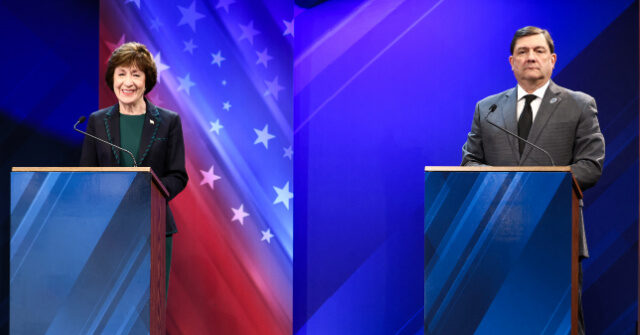

Sen. Susan Collins (R-ME) opposed expanding the Supreme Court during a Senate debate Thursday, after Democratic candidate Troy Jackson said he was open to adding justices because the court “obviously is not working.”
Jackson said he supported Supreme Court term limits and stronger ethics requirements. He also criticized justices for accepting gifts and travel from individuals with business before the court:
Jackson argued that the lifetime appointments envisioned by the founders had been undermined by what he described as ethical failures on the modern Supreme Court. He pointed to justices accepting trips and gifts from people whose interests could come before them and said the system was not operating as the founders intended. Jackson called for enforceable ethics reforms and term limits, adding that he was open to increasing the number of justices because he believes the court is serving former President Donald Trump and wealthy donors rather than the public. He specifically mentioned funding linked to Justice Clarence Thomas and Justice Samuel Alito.
Collins said protecting the Supreme Court’s independence must come first. She rejected expanding the court as a means of changing its ideological balance, saying:
Collins said the Supreme Court should remain insulated from partisan politics as one of the three branches created to preserve the Constitution’s system of checks and balances. She argued that increasing the number of seats to influence the court would conflict with the founders’ vision and amount to court-packing. Collins also noted that she was the only Republican senator to vote for Justices Sonia Sotomayor, Ketanji Brown Jackson and Elena Kagan—all liberal women appointed by Democratic presidents. In her view, the founders intended the Supreme Court to operate differently from Congress, rather than mirror its political divisions.
The Constitution does not specify how many justices must serve on the Supreme Court. Congress created a six-member court in 1789, and lawmakers altered its size several times before establishing the current nine-member structure in 1869.