Topline
Despite President Donald Trump’s assertion that a ceasefire has been in effect since April 7, conflicts between the United States and Iran have continued unabated. U.S. forces have engaged Iran at least four times, resulting in the destruction of over ten vessels. In response, Iran has launched at least eleven attacks against the U.S. since the ceasefire was supposedly initiated. This has not stopped Trump from claiming last week that the war has been “terminated,” a move seen as a way to bypass the requirement for congressional approval to extend military action beyond 60 days.
On May 8, the U.S. Central Command reported that a U.S. Navy super hornet used precision munitions to strike two Iranian-flagged oil tankers as they approached an Iranian port in the Gulf of Oman. Concurrently, Iranian state media released a video showing Iranian forces capturing an oil tanker loaded with Iranian oil. According to TankerTrackers, a maritime data company, the vessel was identified as the Ocean Koi, which is owned by a Chinese entity, as reported by The New York Times.
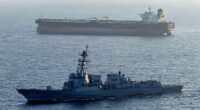
The day before, on May 7, President Trump announced that the U.S. had engaged in a firefight with Iran after the latter attempted to attack three American destroyers using missiles and drones while they navigated out of the Strait of Hormuz. Trump assured that no damage was inflicted on the U.S. destroyers but claimed significant damage was incurred by the Iranian attackers, which he described as being “completely destroyed” alongside numerous small boats. Despite these exchanges, Trump continued to insist that the ceasefire remained intact, referring to U.S. counterstrikes as “love taps.”
On May 6, U.S. Central Command stated that a super hornet fired several rounds at an Iranian-flagged vessel trying to reach an Iranian port in the Gulf of Oman. This was part of the ongoing tension in the region.
General Dan Caine of the U.S. military reported on May 5 that Iran had attacked U.S. forces more than ten times since the start of the ceasefire. Additionally, Iran had fired at commercial vessels on nine separate occasions and seized two container ships.
On May 4, U.S. Central Command confirmed the destruction of six Iranian military speedboats in the Strait of Hormuz. In addition, the U.S. forces intercepted missiles and drones that Iran had launched at both military and commercial vessels being escorted out of the strait. President Trump also mentioned that Iran had targeted vessels from other nations, including a South Korean cargo ship.
U.S. Central Command said it destroyed six Iranian military speedboats in the Strait of Hormuz and shot down missiles and drones Iran fired at ships and commercial vessels the U.S. was helping exit the strait. Trump said Iran took “some shots at unrelated Nations,” including a South Korea cargo ship.
Tangent
Iran has also launched a series of attacks against the United Arab Emirates since the ceasefire began. The strikes restarted on May 4, when Iran launched missiles and drones at the UAE, striking a major oil port and oil tanker, according to Emirati authorities. The UAE also said Friday Iran launched two ballistic missiles and three Iranian drones, injuring three people.
What To Watch For
Secretary of State Marco Rubio said the U.S. expected a response on Friday from Iran to its proposal to end the war. The tentative deal is the closest the two sides have come to reaching an agreement since the conflict began, Axios reported Thursday, citing unnamed sources familiar with the plan. The agreement would reportedly require Iran to commit to pausing its nuclear enrichment program in exchange for the U.S. lifting sanctions. Both sides would also agree to reopen the Strait of Hormuz, according to Axios. Iranian Foreign Ministry spokesman Esmail Baghaei told Iranian news outlet Tasnim the plan was “under review” and the two sides were still engaged in a “nominal cease-fire situation.”
Key Background
Iran has alleged the U.S. naval blockade of vessels traveling in and out of Iran is a violation of the ceasefire. The U.S. implemented the blockade in mid-April in retaliation for Iran’s refusal to reopen the Strait of Hormuz. Trump has repeatedly given contradictory characterizations of the conflict. He told Congress a week ago that the war had been “terminated,” noting in a letter to lawmakers there has been no exchange of fire since the war began. Trump sent the letter on the 60-day deadline to require authorization from Congress to continue the military operation, arguing he didn’t need approval since the war had stopped. Trump on Monday described the conflict as a “mini war” and a “little detour.” He’s said previously he won’t refer to it as a war, because a “war” requires congressional approval, yet he’s continued to use the term.
Further Reading
U.S. Fighter Jet Fires On Iranian Tanker After Trump Touts Peace Proposal (Forbes)
Trump Tells Congress Iran War Is ‘Terminated,’ Arguing He Doesn’t Need Approval To Continue (Forbes)
Iranian Leaders Reportedly Still Discussing Trump’s Peace Proposal After Top Negotiator Mocked ‘Operation Trust Me Bro’ (Forbes)