
On Friday, Alabama Republicans greenlit a strategy to hold fresh primary elections, contingent on judicial approval of GOP-redrawn House districts for the upcoming midterms. This maneuver could potentially eliminate one of Alabama’s two Democratic congressional seats.
The move follows legislation swiftly passed by state lawmakers and signed off by Republican Governor Kay Ivey. This action is part of a broader response by southern Republicans to counteract the recent Supreme Court decision in the Louisiana v. Callais case, which diminished the Voting Rights Act’s strength.
The newly enacted Alabama statute enables the annulment of the May 19 primary outcomes for certain congressional seats. It empowers the governor to schedule new primaries if judicial rulings permit changes to the district boundaries.
Currently, an injunction mandates Alabama to retain its existing congressional map until post-2030 census. This map comprises five districts favoring Republicans and two Democratic-leaning districts with significant Black voter populations. It was established in 2023 by a court-appointed official after the Supreme Court and a lower court invalidated two previous maps from state legislators for infringing on the Voting Rights Act.
However, the Supreme Court’s recent decision has curtailed Section 2 of the Voting Rights Act, which traditionally mandated the creation of majority-minority districts under certain conditions.
In response, Alabama Republicans are pushing to reinstate a 2023 map featuring just one Democratic-leaning district with a Black plurality. To facilitate this, Governor Ivey convened a special legislative session to devise plans for new primaries.
“With this special session successfully behind us, Alabama now stands ready to quickly act, should the courts issue favorable rulings in our ongoing redistricting cases,” Ivey said in a statement.
Alabama Attorney General Steve Marshall on Friday asked the Supreme Court to halt last year’s lower court injunction and allow the state to use its 2023 map. Justice Clarence Thomas asked the other side for a response by Monday. Also on Friday, the court that issued the injunction rejected a request to stay the ruling.
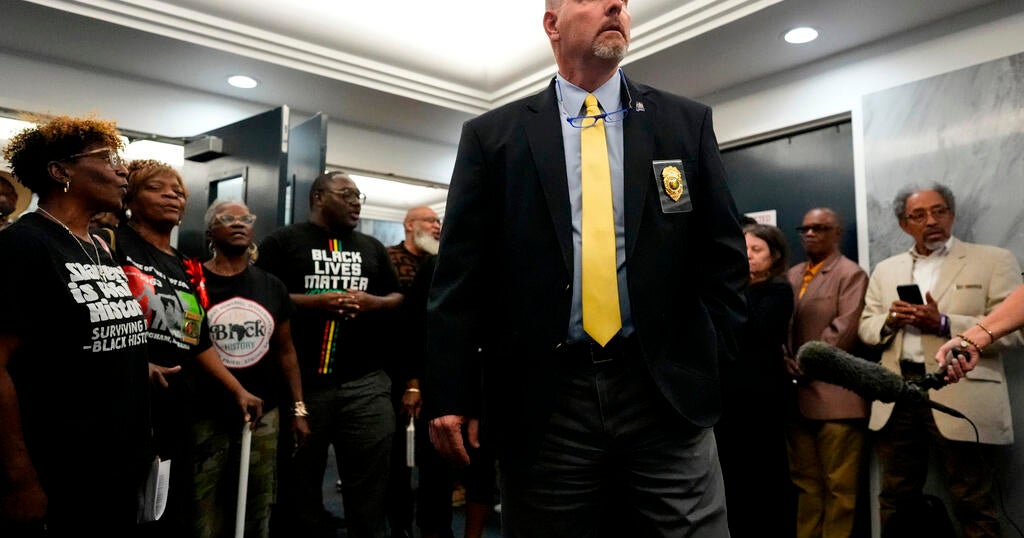
At the Alabama Statehouse, a chaotic scene erupted as one protester was dragged from the packed House gallery by security officers. Demonstrators outside the Statehouse on Friday shouted “fight for democracy” and “down with white supremacy.”
Mike Stewart / AP 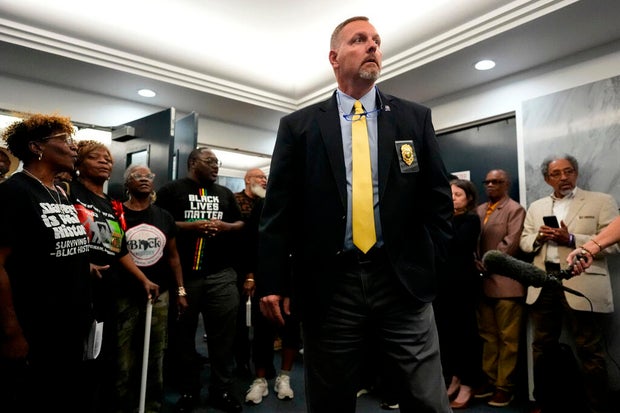
During debate inside, Black lawmakers argued the Republican legislation harks back to the state’s shameful Jim Crow history. Senate Democrats shouted “hell no” and “stop the steal” as senators voted.
“What happened here today is that we were set back as a people to the days of Reconstruction,” Democratic state Sen. Rodger Smitherman said after the vote.
Republican lawmakers in Louisiana and South Carolina also faced staunch opposition from civil rights activists and Democrats as they presented plans Friday to redraw their congressional districts.
The action came just a day after Tennessee enacted new congressional districts that carve up a Democratic-held, Black-majority district in Memphis. The state Democratic Party sued on Friday, seeking to prevent the districts from being used until after this year’s elections because of the tight time frame.
Even before last week’s Supreme Court ruling on Louisiana’s congressional maps, Republicans and Democrats already were engaged in a fierce redistricting battle, each seeking an edge in the midterm elections that will determine control of the closely divided House. That battle tilted further toward Republicans when the Virginia Supreme Court ruled Friday that Democratic lawmakers had violated constitutional requirements when placing a redistricting amendment on the ballot.
Democrats had hoped to gain as many as four additional U.S. House seats under new districts narrowly approved by Virginia voters in April. But the state’s highest court invalidated the measure because it said the Democratic-led legislature violated procedural requirements.