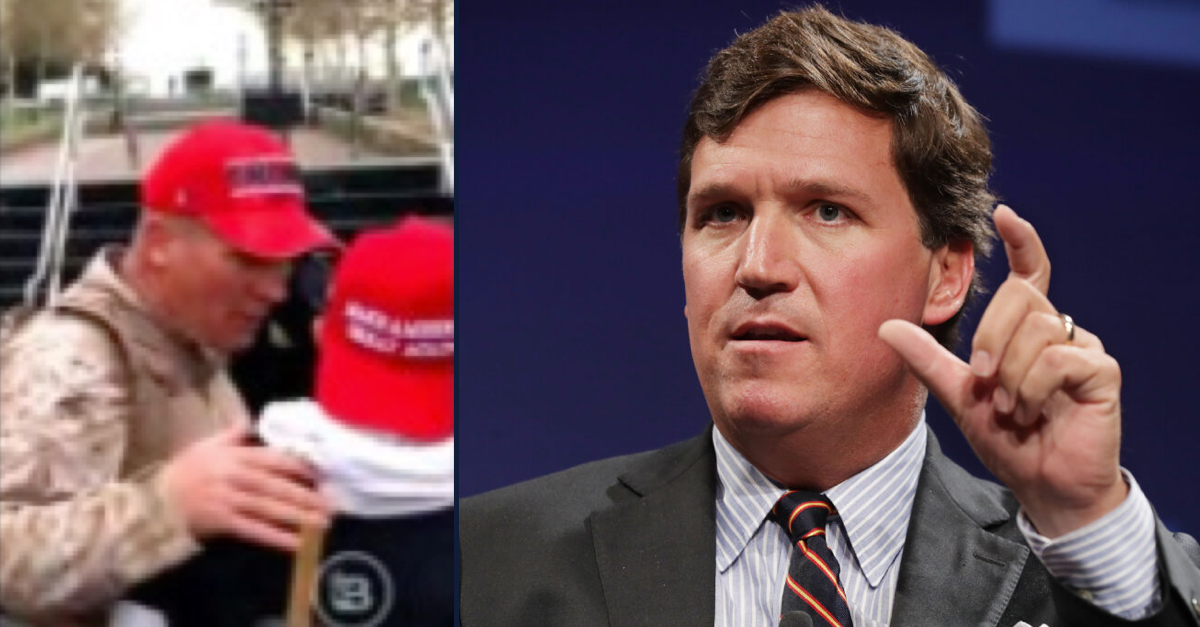

Left: Ray Epps is seen talking with accused Jan. 6 rioter and Proud Boys member Ryan Samsel near the Peace Circle monument (FBI court filing). Right: Tucker Carlson (Chip Somodevilla/Getty Images).
In a favorable turn for Fox News, a Delaware federal court dismissed a defamation lawsuit concerning comments made by Tucker Carlson about an Arizona man’s alleged role in the January 6th riots.
James Ray Epps had engaged in a series of escalating legal actions, accusing the network’s former host of wrongly portraying him as an instigator who “helped stage-manage” the failed insurrection at the behest of federal authorities.
Epps’ legal efforts hit a roadblock in November 2024 when a federal district court sided with Fox News, granting their motion to dismiss the case. Epps sought another opportunity by requesting permission to file an amended complaint.
However, this renewed attempt has also been thwarted, as U.S. District Judge Jennifer Hall, appointed by Joe Biden, upheld the dismissal in favor of Fox News.
“I previously granted Fox’s motion to dismiss the original Complaint and allowed Plaintiff James Ray Epps, Sr., the opportunity to amend,” states the memorandum opinion. “I find that the [amended complaint] does not present a plausible claim and must be dismissed.”
Despite the quick and intense legal maneuvering following the resubmission of the lawsuit, the court has been deliberating on the matter for over a year, as detailed in the case.
In early January 2025, Fox News filed its motion to dismiss. Epps then fired back with his answering brief. Later that same month, Fox News filed its reply in support of its motion to dismiss. A hearing and one additional filing by Epps followed through the spring and summer of 2025. Through it all, the network maintained the plaintiff simply had not alleged enough to resuscitate his case.
The major dispute was whether or not the network acted with “actual malice.” Or, more specifically, whether the amended complaint contains the proper combination of facts and analysis to sustain an argument that Fox News acted with actual malice.
Actual malice is the most exacting and hardest-to-prove standard in defamation law. The standard typically becomes operative when the person claiming to be defamed is a public figure.
“Plaintiff fails to provide any basis to salvage the Amended Complaint,” Fox News argued. “He does not identify any new factual allegations to alter the holding that he has failed to plead actual malice.”
While the court did not entirely agree with that framing of the amended complaint, Epps’ second effort did little to change the calculus.
“The [amended complaint] contains a number of new allegations that Epps says are relevant to actual malice,” the opinion goes on. “I note at the outset that many of the new allegations are conclusory statements and/or legal assertions that the Court need not credit when assessing whether the complaint states a plausible claim.”
To that end, Epps brought attention to a certain amount of “skepticism expressed by former Fox employees” about “certain things that were said on” Carlson’s then-running talk show, the court explains.
“Plaintiff asks the Court to infer that Carlson and/or Fox knew that Carlson’s statements were false because [those employees] thought Carlson’s stories were off base,” the opinion continues.
But, the court says, those claims do not really speak to actual malice – and highlights two “fundamental problems” here.
“[T]he [amended complaint] does not allege any facts suggesting a plausible inference that [those employees] had reason to know that Carlson’s statements about Epps were inaccurate,” Hall goes on. “That is not surprising because whether Epps was in fact acting as a federal government informant on January 6 would likely have been—at the time the challenged statements were made—a confidential piece of information known only to government officials.”
The court elaborates here:
The AC pleads no facts plausibly suggesting that any of the former Fox News employees had access to that information. Rather, Epps’s actual malice allegations are primarily based on the opinions of individuals who had no more reason than Carlson to know whether Epps was a federal informant. That is not enough to proceed.
The second problem, the court notes, is that Epps’ revamped lawsuit contains “no facts plausibly suggesting” the employees “were responsible for the content of” Carlson’s since-shelved program.
The judge notes that one of the employees, then-and-since-fired producer, Abby Grossberg, was a staff member, but says that Epps’ pleadings actually suggest “that she had no responsibility for the show’s content and that her suggestions were ignored.” This, the court jabs, is “the opposite” of what the plaintiff claims.
The court goes on to say there is “no suggestion” two other employees cited by Epps “had any involvement” in the show’s content.
“Nor does the [amended complaint] allege facts plausibly suggesting that [those employees] shared their concerns with Carlson or others responsible for [the show’s] content before publication,” the judge says.
Overall, Hall found Epps’ allegations “insufficient.”
From the opinion, at length:
Taken together, the allegations do not give rise to a plausible inference that Carlson or anyone else responsible for [the show] subjectively knew that their statements were false or that they possessed a reckless disregard for the truth. The statements were not so objectively implausible or internally inconsistent that they cast doubt on Carlson’s (or Fox’s) state of mind. [The other employees] were not responsible for the statements and had no way to know whether the statements were false.
“Defendant Fox News Network, LLC’s Motion to Dismiss the Amended Complaint Pursuant to Federal Rule of Civil Procedure 12(b)(6) for Failure to State a Claim will be GRANTED,” the opinion concludes.