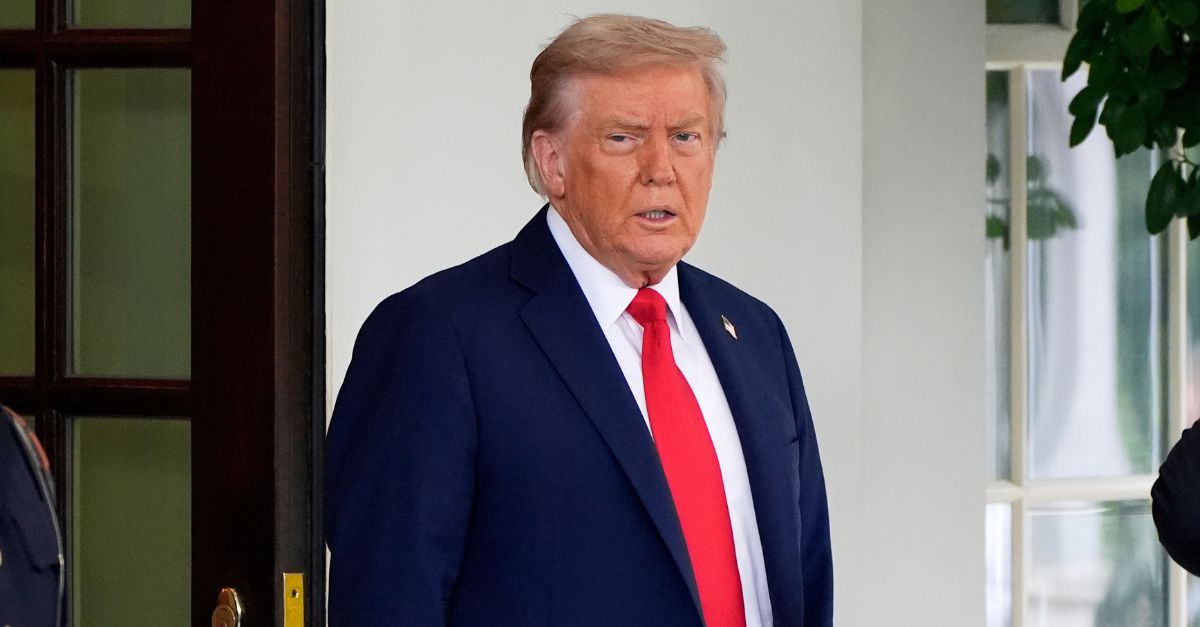

President Donald Trump stands outside the White House, Monday, Aug. 18, 2025, in Washington. (AP Photo/Alex Brandon).
In a recent development, a federal judge in Florida is revisiting his previous support for the Trump administration’s policy on the indefinite detention of certain immigrants, prompted by emerging legal precedents.
U.S. District Judge Raag Singhal, appointed by former President Donald Trump, has previously sided with the government in several habeas corpus cases. These cases hinged on a new interpretation of the Immigration and Nationality Act (INA) put forth by the administration.
The policy, initiated by Immigration and Customs Enforcement (ICE) in July 2025, mandates that certain immigrants be held “for the duration of their removal proceedings” unless they are granted parole—a release option that is increasingly rare.
The Trump administration has indicated that under this policy, such detentions are effectively indefinite.
This policy is based on a long-standing section of the INA, which states that specific immigrants “shall be detained for a proceeding.” Traditionally, this statute was applied only to those apprehended at the border. However, the administration extended it to include immigrants detained within the United States, asserting that they “may not be released from ICE custody.”
Since the policy’s implementation last summer, numerous district courts have been examining the relationship and relevance of two distinct statutes that define the government’s detention powers. Judges are referencing language from a 2018 U.S. Supreme Court ruling to navigate these legal waters.
The government claims ICE has the authority to subject immigrants to mandatory detention under 8 U.S.C. §1225(b), which applies to “aliens seeking entry into the United States.”
Advocates for immigrants — as well as most judges who have ruled on the matter — have instead turned to 8 U.S.C. §1226(a), which applies to “aliens already present in the United States.”
Notably, 425 district court judges, including many appointed by Trump himself, have flatly rejected ICE’s position about its detention authority, according to a rolling analysis of court rulings by Politico’s Kyle Cheney.
Singhal, for his part, has rejected habeas petitions under a §1225(b) analysis on at least three separate occasions.
Once, the judge rejected release in the case of a detained Honduran national. A bond hearing was rejected for a detained Mexican national. And again, Singhal ruled against a detained El Salvadoran national.
The judge has also, in various other cases, delayed decisions – or found specific reasons why §1225(b) does not apply. But, those other cases read more like exceptions to accepting the government’s rule.
Now, however, Singhal is abiding by that rule no more. Or, rather, is abiding by a different kind of rule altogether.
That is, now that the U.S. Court of Appeals for the 11th Circuit rejected the government’s interpretation of the INA, the judge says he is bound by precedent to reject ICE’s newfound detention authority.
The terse Friday order begins:
CHARACTERISTIC of the undersigned’s upbringing, surrounded by law-abiding immigrants who left oppressive conditions in search of a rule-following citizenry in a country that offered a better life, there was one maxim that rang true above all others. One respected and followed his parents even when they were wrong.
In the order, Singhal also makes clear he would have rather been guided by the dissenting judge on the 2-1 panel.
“Today that same principle applies with the concept of vertical precedent,” the order goes on. “Despite the superior, well thought out plain meaning analysis of the dissenting judge…this Court is duty bound to follow the majority opinion authored by its parent court. The Eleventh Circuit ruled that aliens, like Petitioner, who are detained within the country rather than upon arrival at the border, are entitled to a bond hearing under 8 U.S.C. §1226.”
Singhal then remarks on the role of district courts.
“This Court has authority and jurisdiction to grant writs of habeas corpus when aliens are unlawfully held in immigration detention,” the order concludes. “Under Eleventh Circuit precedent, Petitioner is being held in violation of the Immigration and Nationality Act.”