
Passengers recently evacuated to the UK from a cruise ship experiencing a hantavirus outbreak are now settling into an isolation facility after being flown back from Tenerife.
On Sunday evening, a special Titan Airways flight brought the MV Hondius passengers from the Canary Islands to Manchester Airport. According to Spain’s health minister, the operation to evacuate passengers of various nationalities will conclude on Monday, with additional flights arriving from Australia and the Netherlands.
In the UK, the former Covid quarantine site at Arrowe Park Hospital in Wirral, Merseyside, is accommodating 20 British passengers who underwent hantavirus testing before their flight. Additionally, one German national residing in the UK and a Japanese passenger are under observation at the same facility.
The Japanese passenger, taken in at the request of the Tokyo government, will complete their quarantine in accordance with guidance from the UK Health Security Agency (UKHSA).
Officials have stated that a flight from Australia will carry six passengers from Tenerife, while another from the Netherlands will transport 18 passengers. These flights will also include individuals from countries that have not arranged their own repatriation services.
The World Health Organization reported on Friday that eight individuals, no longer aboard the ship, have fallen ill, with six confirmed cases of the virus. Sadly, three people have passed away: a Dutch couple and a German national.
On Sunday, the US Department of Health and Human Services said one of the 17 Americans being repatriated had tested positive for the Andes strain of the virus while a second had mild symptoms. The French health minister said a French passenger had tested positive for the virus, and that their health was deteriorating. It was unclear whether these two cases were included in the six reported by the WHO.
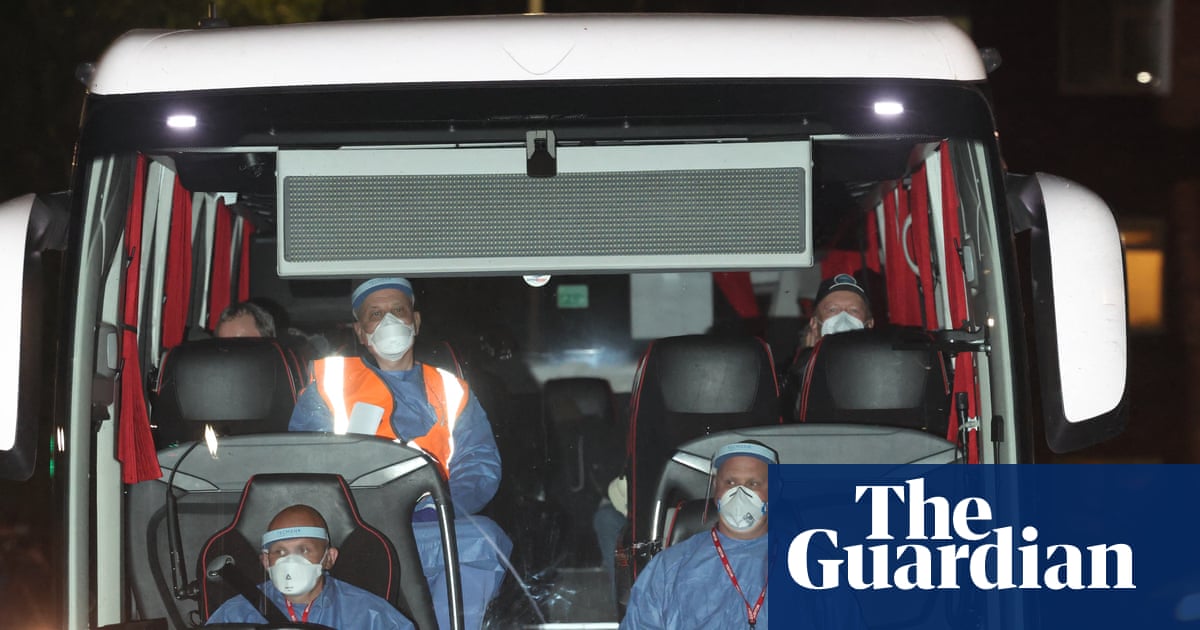
For those on the journey back to the UK, strict infection control measures were in place, with passengers, crew, drivers and medical teams all wearing personal protective equipment such as face masks.
Within a 72-hour period, the passengers are to receive clinical assessments and testing at the isolation facility, which has six floors of self-contained flats with their own bedrooms, en suite bathrooms, kitchen and lounge facilities.
Janelle Holmes, the chief executive of Wirral university teaching hospital NHS foundation trust, told the media that Arrowe Park would carry out “welfare checks on each individual”. She said: “There’s nobody being transferred to us that has been symptomatic in any way. There’s no impact on the hospital. Services are running as normal, patients should still attend their appointments.”
Holmes said that if passengers developed symptoms, they would be taken to Royal Liverpool university hospital, which houses the regional tropical and infectious diseases unit.
She said hantavirus was “very different” to Covid and that the risk to the general public was “really low”. She added: “You’ve got to have really, really close contact. It’s not like Covid or flu or those types of viruses.”
During the period passengers are at Arrowe Park, public health specialists will assess whether they can isolate at home or at another location, based on their living arrangements.
Those returning to the UK will stay in self-isolation for 45 days and will not be allowed to take public transport to their homes. During their isolation period, passengers will have daily contact with UKHSA health protection teams to check on their wellbeing and ensure they are supported to isolate safely.
The public health minister, Sharon Hodgson, said: “None of the passengers are symptomatic, but we will monitor them closely over the next 72 hours at the hospital, as part of a precautionary isolation period. With no cases or symptoms among them and both our stringent monitoring and isolation measures, the risk to the public remains extremely low.”