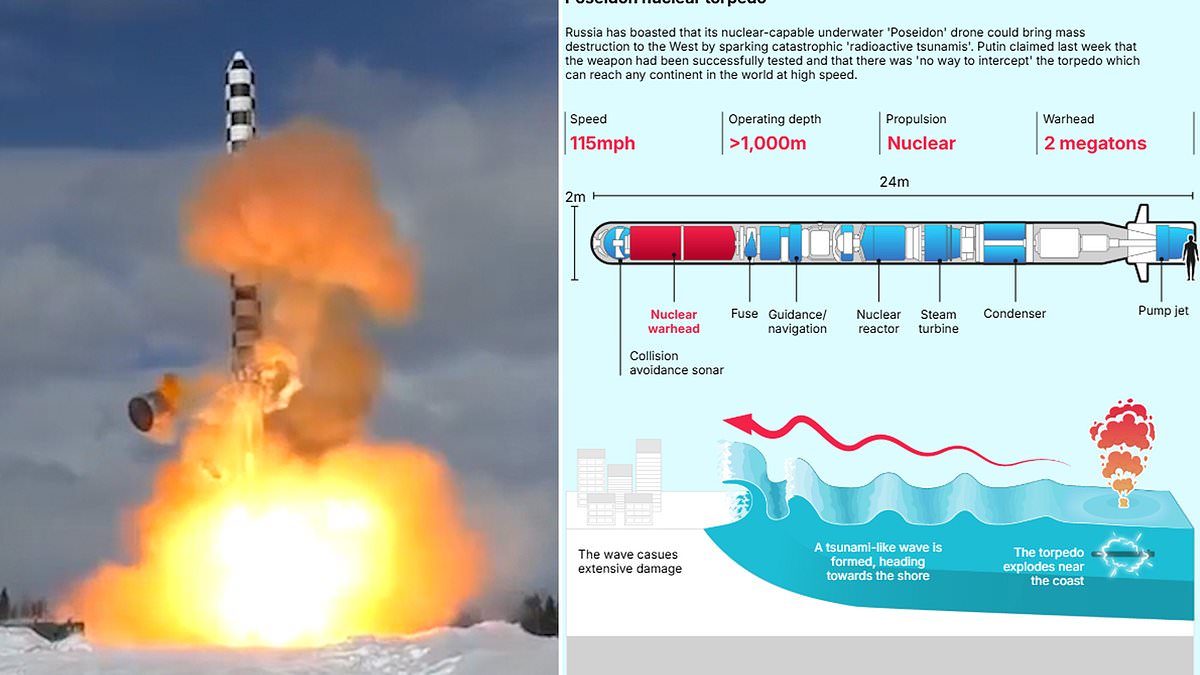

In a notable stride for its defense capabilities, Russia has successfully carried out a test of its new intercontinental ballistic missile, known as Satan-2. This was confirmed by Sergei Karakayev, commander of Russia’s strategic missile forces, during a briefing with President Vladimir Putin on Tuesday.
President Putin announced that the advanced missile, formally named Sarmat, is expected to be operational and on combat duty by the end of the year. This development marks a significant milestone in Russia’s military advancements.
Additionally, the Kremlin has provided updates on other military projects, revealing that the development of the ‘Poseidon’ and ‘Burevestnik’ small nuclear propulsion systems is nearing completion. These systems represent a strategic enhancement of Russia’s defense arsenal.
Russian media outlets have reported that Karakayev assured President Putin that the missile tests have conclusively demonstrated that the Satan-2 meets all designed performance criteria.
The missile tests were part of a broader military exercise involving intercontinental ballistic missiles (ICBMs), which took place until May 10. These exercises are crucial for testing the readiness and capability of Russia’s strategic forces.
Further details emerged indicating that between May 9 and 11, 2026, a Russian Notice to Air Missions (NOTAM) suggested the launch of an SS-N-23 missile from the Barents Sea targeting the Kura test range. This test is an integral part of Russia’s ongoing efforts to bolster its national security infrastructure.
To monitor this and a potential simultaneous Sarmat ICBM test, two USAF Cobra Ball aircraft were deployed on an overnight reconnaissance mission.
Two US RC-135S Cobra Ball aircraft, designed to track ballistic missile tests, had been active on patrols from Alaska in recent days.
Sarmat missile tested by Russia
According to local media, the Russian leader noted that the Sarmat is the most powerful missile system in the world, and the total yield of the warhead delivered by this missile is four times greater than that of any Western analogue.
He said: ‘The missile can travel not only along a ballistic trajectory, but also along a suborbital trajectory, which allows for a range of over 35,000 km while simultaneously doubling its accuracy and the ability to penetrate all existing and future missile defense systems.’
Karakayev added: ‘The positive results of the Sarmat missile system launch will allow us to deploy the first missile regiment armed with this missile system to combat duty in the Uzhur formation of Krasnoyarsk Krai by the end of this year.’
‘The deployment of launchers with the Sarmat missile system will significantly enhance the combat capabilities of the ground-based strategic nuclear forces to reliably destroy targets and fulfill strategic deterrence missions.’
The Sarmat is a 208-ton, silo-launched ‘apocalypse’ rocket the size of a 14-storey building capable of reaching 15,880mph.
Tuesday’s reported successful launch of the RS-28 Sarmat is the missile’s first achievement since a test in April 2022.
In September 2024, the monster hypersonic missile exploded on the launchpad at Plesetsk cosmodrome leaving a 200ft wide crater.
Satellite images showed the destruction left behind by the blast at the Plesetsk test site in northern Russia, which partially wrecked an observation building close to the launch site.
Fires raged for six-to-twelve hours after the catastrophic incident, according to NASA FIRMS, and several fire trucks were seen at the blitzed site.
The Putin-controlled Russian state media was censored from reporting the explosion at Plesetsk – or the reason behind it.
And a test launch in November 2025 near Yasny, Orenburg region when a rocket flipped soon after takeoff and crashed triggering a giant explosion was reported as being a Sarmat, despite no official confirmation.
Meanwhile, the Poseidon is said to be 20 metres long and nearly two metres wide. Reports indicate that it weighs 100 tons.
It is capable of travelling up to 6,200 miles with a speed of 115 miles per hour deep underwater.
Putin’s propaganda machine has repeatedly claimed that the Poseidon could ‘sink’ Britain under ‘radioactive tidal waves’.
Jeffrey Lewis, a scholar at the Middlebury Institute of International Studies, wrote in Foreign Policy last year of the weapon: ‘It’s downright terrifying.
‘We’re talking about a massive, megaton-sized thermonuclear weapon designed to produce significant, long-lasting radiation effects.’
Other officials have also warned that the weapon could be fired from unexpected directions.

Russia has successfully tested its new Satan-2 intercontinental ballistic missile, Sergei Karakayev, the commander of the strategic missile forces, told Putin
Putin also mentioned the Oreshnik missile system on Tuesday, saying it can be equipped with nuclear warheads.
Putin’s TV propagandists previously threatened to use the Satan-2 missile to hit the west.
Earlier this year, a hardline Russian MP warned that it is ‘inevitable’ Russia will strike Britain to wipe it off the earth.
Andrey Gurulev, a reservist general and pro-Putin MP, insisted that the Kremlin would avenge the Ukrainian use of British Storm Shadow missiles against his country.
He told Kremlin-controlled state television: ‘There’s still going to come a point where we’re going to strike. It is inevitable.