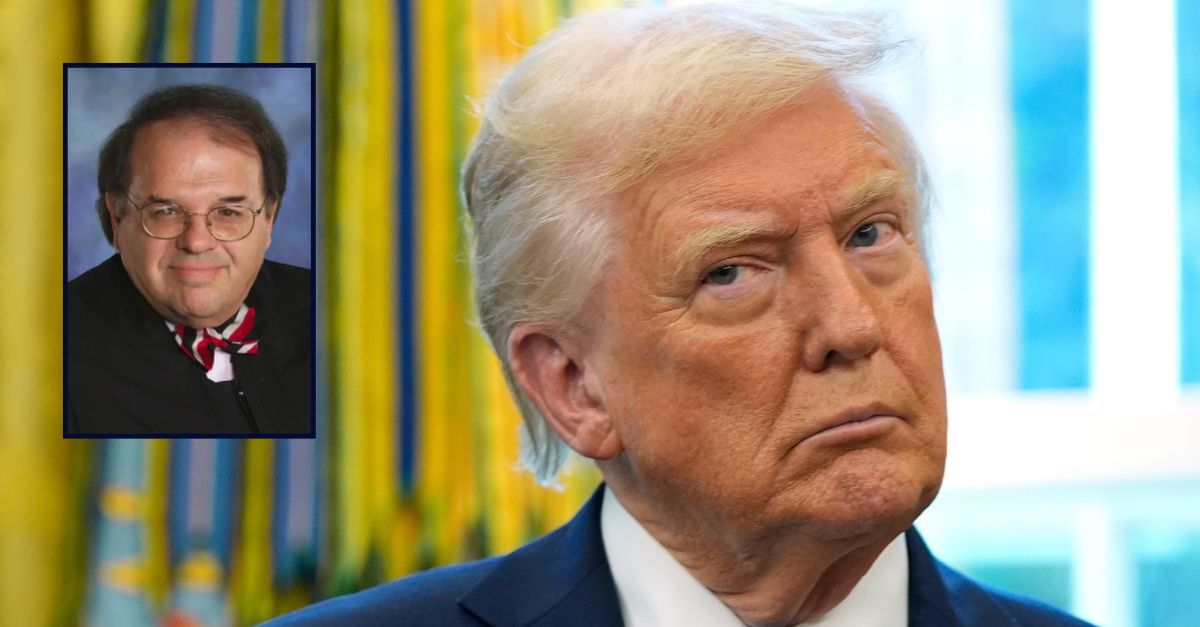

Inset: Senior U.S. District Judge Richard Leon (U.S. District Court). Background: President Donald Trump listens during a ceremonial swearing in of Paul Atkins as chairman of the Securities and Exchange Commission, in the Oval Office of the White House, Tuesday, April 22, 2025, in Washington (AP Photo/Alex Brandon).
The bar authorities in Washington, D.C., are embroiled in a legal battle initiated by the federal government over a significant disciplinary proceeding. This high-stakes case will be presided over by one of the president’s most vocal critics within the judiciary.
On Thursday, the U.S. District Court for the District of Columbia began proceedings for the case known as U.S.A. v. Fox, named after the D.C. Bar’s chief disciplinary counsel, Hamilton P. Fox.
The lawsuit, filed by the Trump administration, aims to overturn and prevent any disciplinary measures against former U.S. Department of Justice attorney Jeffrey Clark. Clark recently faced disbarment in Washington, D.C., due to his involvement in attempts to overturn the 2020 presidential election results in favor of Donald Trump.
In accordance with standard procedure, the case was assigned to a judge via the district’s random selection process. This method, however, may have inadvertently provided an advantage to the defendants in this unique legal battle.
The case landed on the docket of Senior U.S. District Judge Richard Leon, appointed by George W. Bush, due to the district’s multi-layered “assignment deck” within a comprehensive “automated system.”
Nationwide, there isn’t a unified system for assigning civil or criminal cases to federal judges. Instead, each court generally manages judicial selection locally, following published rules or standing orders to ensure randomness in initial case assignments.
In the District of Columbia, the general assignment rule is that “cases shall be assigned to judges of this Court selected at random.”
And that random assignment has already rankled some allies of the White House.
Earlier this year, Leon issued an expressive order — one featuring over a dozen exclamation marks — blocking construction of Trump’s much ballyhooed $400 million East Wing ballroom.
Last summer, Leon ruled the president had “likely” acted illegally by trying to appoint a lone member to an agency he gutted with the help of the Department of Government Efficiency (DOGE).
In a May 2025 order using at least 27 exclamation marks, Leon ruled against Trump’s efforts to target a disfavored law firm.
Now, the famous judge’s exclamatory diction may find a place in an eventual ruling on the propriety of certain attorney discipline.
On Wednesday evening, the U.S. Department of Justice sued the federal district’s bar association as well as several associated figures and entities – including the U.S. Court of Appeals for the District of Columbia Circuit – alleging multiple constitutional violations over the strict discipline various attorney licensing authorities meted out to Clark, culminating in his disbarment.
“The D.C. Court of Appeals’ disciplinary authorities are punishing a former Department of Justice official for preparing a deliberative and pre-decisional draft letter that was never issued,” the 26-page complaint begins. “No one disputes that the letter reflected the official’s sincere view of the law and facts; instead, Defendants are punishing him over an internal disagreement that remains the subject of litigation nearly six years later.”
The thrust of the DOJ’s lawsuit is that bar authorities at every level in Washington, D.C., have been captured and controlled by foes of the 45th and 47th president who have, in turn, waged an illegal effort to interfere with Trump, his allies, and the federal government writ large.
“As our complaint and history make clear, the DC Bar has long acted as a blatantly partisan arm of leftist causes,” Acting Attorney General Todd Blanche said in a statement announcing the lawsuit. “No more.”
The lawsuit filed Wednesday by the Trump administration is largely premised on the federal preemption doctrine — a legal concept sourced from the Supremacy Clause of the U.S. Constitution.
“D.C. courts have been treated as local, not Federal, institutions,” the filing reads. “States may not regulate agents of the United States in the lawful performance of their duties, and agents of the United States cannot be liable to answer to state courts for the performance of those duties.”
To hear the DOJ tell it, the government “is harmed by the “investigations, proceedings, and threats of discipline against Mr. Clark and other current and former” federal attorneys.
Clark was subject to such investigations based on an unsent draft letter falsely claiming the DOJ “identified significant concerns that may have impacted the outcome of the election in multiple states, including the state of Georgia.”
The specification of charges said that Clark violated D.C. Rules of Professional Conduct 8.4(a) and (c) (“in that respondent attempted to engage in conduct involving dishonesty, by sending the proof of concept letter containing false statements”) and Rules 8.4(a) and (d) (“in that respondent attempted to engage in conduct that would seriously interfere with the administration of justice”).
The so-called “proof of concept letter” is the draft Clark compiled that would have urged legislatures in states where Trump lost to “send an unauthorized slate of electors to Congress,” the charges note.
The lawsuit says the discipline here is something far afield — and focused entirely on lawyers who worked for the government.
“Defendants have treated Federal Government attorneys differently than non-Federal Government attorneys,” the filing goes on. “As far as the United States is aware, Defendants have never punished a non-Federal Government attorney for drafting or attempting to disseminate a deliberative and pre-decisional draft document, or in any comparable circumstances.”
The lawsuit further argues that punishing attorneys for their draft is likely to chill their work overall — including their “zealous advocacy and candor” on behalf of the government. Therefore, the lawsuit argues, such discipline interferes “with the President’s and Attorney General’s prerogatives.”
And the federal government does not have to countenance such interference under the preemption doctrine, the lawsuit argues.
“Weaponizing state bar discipline against Executive Branch attorneys in this way chills them from giving candid legal advice to others in the Executive Branch, including the President and Attorney General,” the lawsuit reads. “To permit these proceedings is to allow state bar authorities to control the Executive Branch. That is not the law.”


