
Today, a coroner delivered a sharp rebuke to an ambulance service for its disorganized rescue effort that tragically resulted in the death of a mother-of-six. Trapped upside down between sea defense rocks, Saffron Cole-Nottage faced rising tides in Lowestoft, Suffolk.
Cole-Nottage, 32, was enjoying a walk with her dog and daughter when she slipped on the slick concrete walkway, tumbling headfirst over the edge. Despite a passerby promptly calling emergency services, the inquest revealed a critical seven-minute delay before the operator grasped the urgency of the incoming tide.
The distress call, initiated at 7:52 PM on February 2 of last year, saw a further delay of 13 minutes before Suffolk Fire and Rescue were alerted to the emergency. This oversight highlighted significant flaws in the initial response.
Upon arrival, the first paramedic allegedly disregarded established protocols, which emphasize the importance of attempting rescue and resuscitation within 30 minutes of reaching such a scene. This procedural lapse was compounded by communication breakdowns among first responders.
The inquest also uncovered that both paramedics and Coastguard personnel hesitated to assist Cole-Nottage due to the absence of personal protective equipment, adding another layer of complexity to the already chaotic rescue attempt.
The two-week inquest has also heard how there was a lack of communication at the scene and paramedics and members of the Coastguard refused to go to Ms Cole-Nottage’s aid because they didn’t have personal protective equipment.
The 999 call was also hampered by the East of England Ambulance Service call handler having to slavishly follow set questions, the hearing was told, while the first paramedic on the scene should have had more support from the control room.
At a hearing today where he recorded a narrative conclusion, coroner Darren Stewart expressed concern that the call handler even told passers-by to stop trying to save Ms Cole-Nottage by pulling her from the rocks.
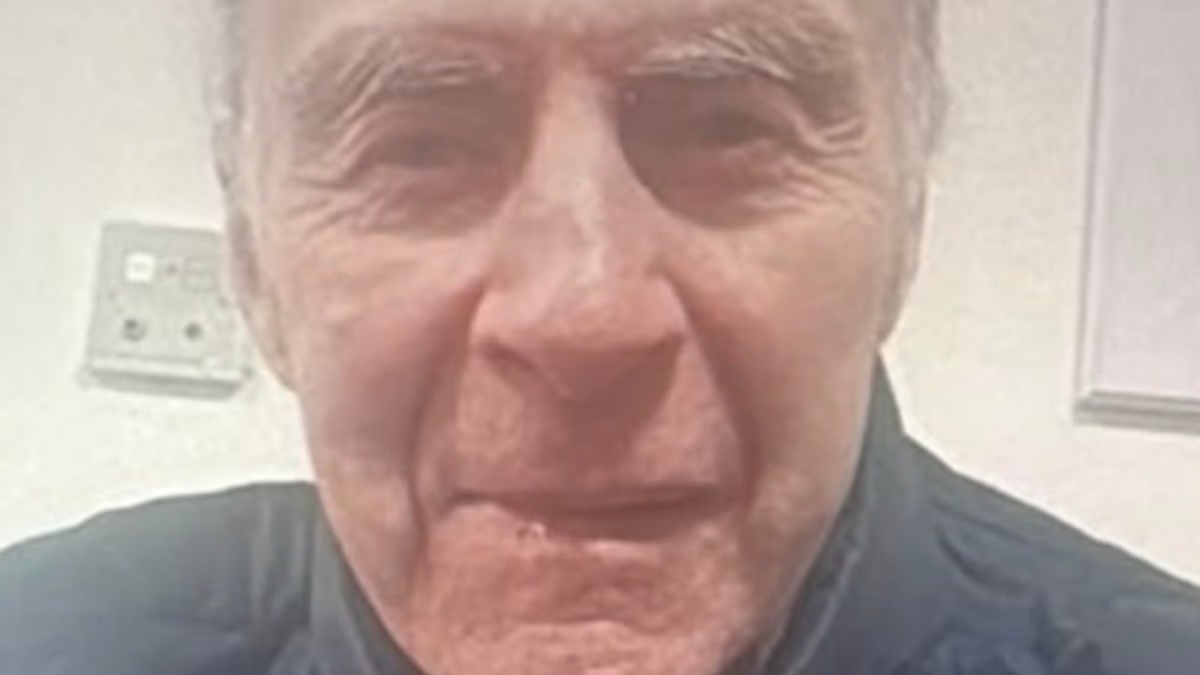
Saffron Cole-Nottage, 32, drowned after falling headfirst into sea defence rocks at Lowestoft, Suffolk
The mother-of-six had been out walking her dog with her daughter on February 2 last year
He said Ms Cole-Nottage ‘died from drowning which has come about due to accidental circumstances’.
Describing how the East of England Ambulance Service ‘didn’t immediately contact the fire service’, he added: ‘Had the Suffolk Fire and Rescue Service been immediately alerted to the incident… it’s possible that Saffron would have been extricated from the rocks sooner and survived.’
However, he added it was not ‘probable’ that she would have survived.
The chaotic response to Ms Cole-Nottage’s precarious situation began at 7.52pm, when a 999 call was made by a teenage girl who stumbled on the drama while out with two friends.
Her call was put through to East of England Ambulance Service and was dealt with by NHS emergency call handler Daniel Joy, who took four minutes to get an accurate location for the incident.
He also failed to check how quickly the tide was coming in and categorised it as an ‘entrapment’.
Call handler team leader Christopher Strutt told the inquest when Mr Joy ‘escalated the information’ to him, he ‘didn’t give a true sense of urgency’.
He also admitted that Suffolk Fire and Rescue Service should have been contacted by the ambulance service within seconds of learning Ms Cole-Nottage’s head was trapped.
Mr Strutt revealed an algorithm on the computer system used by operators meant they had to follow a strict set of questions before they could ask their own – a situation criticised by the coroner as ‘rather clunky’ that added to the ‘muddled response’.
It was only at 7.59pm – seven minutes into the call – that the level of the emergency became clear when the girl reported Ms Cole-Nottage’s head had gone in the water.
The disturbing recording of the conversation captured the increasingly exasperated girl saying: ‘How long is it going to be because I think she is going to die.’
Twelve minutes in, she added: ‘Can they come quickly as I think she has died.’
A two-person ambulance crew had been dispatched from Beccles, around ten miles away, at 7.57pm but a rapid response ambulance was sent at 8.02pm when the danger Ms Cole-Nottage was in finally became clear.
The ambulance service got around to contacting Suffolk Fire and Rescue at 8.05pm and mentioned someone was submerged but asked casually: ‘We are en route with the Coastguard and wonder if you’d like to come along?’
As the fire service didn’t routinely go into the sea for rescues, they ended up contacting Dover Maritime Rescue Co-ordination Centre at 8.06pm and then Coastguard Rescue HQ at 8.09pm, who informed them they were needed.
One minute later, the ambulance rapid response vehicle arrived at the seafront with paramedic Colleen Gibson on board.
The inquest has heard how there was a ‘muddled’ operation that followed a 999 call

Floral tributes were left to the tragic mother following her death
She told the inquest that her training had included learning about a 30-minute window to rescue someone after they had gone under water.
But she made the decision that she was ‘unable to make a rescue now… being 20 minutes submerged’.
Asked by inquest counsel Bridget Dolan KC why she didn’t inform the Coastguard or police that would still have left another ten minutes left in the crucial window, she said: ‘I don’t know.’
Police bodycam footage showed a police officer who arrived soon after asking her whether Ms Cole-Nottage could be saved and she told them: ‘No.’
Expert witness Professor Richard Lyon an emergency medicine consultant, told the hearing the rescue ‘clock’ should only have started from the moment Ms Gibson arrived, as bystander information can be unreliable.
Full recovery with resuscitation could be expected within five minutes, while survival – albeit with likely brain damage from oxygen starvation – extended well beyond that.
Another expert, Matthew England, a paramedic who sits on a group that advises the Home Office about combined emergency services responses, said Ms Gibson – who joined the ambulance service in 2018 and had attended four water incidents – should have taken control of the scene as the first responder there.
She should also have communicated with Coastguard officers, police and firefighters who arrived but the operation ‘did not seem very coordinated’.
‘I could not see any evidence of a huddle or briefing going on between the agencies,’ he told the inquest.
In the confusion, firefighters were unaware that the operation had been termed a body recovery and retrieved Ms Cole-Nottage from between the rocks in under a minute before starting CPR at 8.30pm.
When paramedics refused to bring life-saving equipment to where they lay her body, one firefighter swore at them.
The lack of preparedness was further exposed by Richard Lark, a watch manager at Suffolk Fire Service, who said ambulance crews hadn’t gone down to the rocks as they didn’t have personal protective equipment (PPE).
Two members of the Coastguard were also sent to the scene in overalls and no PPE, he added.
Efforts to resuscitate Ms Cole-Nottage – whose legs had still felt warm, according to Mr Lark, who added she may have been able to breathe after she was apparently submerged due to a possible gap in the rocks – were halted at 8.44pm.
Paramedic Billy Seaman, who arrived after Ms Gibson, described a ‘disjointed’ operation in which responders effectively ‘winged it’.
He revealed he had never been to a drowning incident before and was meant to have annual training ‘but it is not always delivered’.
Home Office advisor Mr England also referred to systemic failures, saying Ms Gibson should have had ‘more support… form the control room’.
Referring to the initial 999 call, where the catalogue of errors began, the coroner remarked that the words ‘trapped’, ‘jammed’ and ‘stuck’ were all mentioned by the teenager within four minutes.
He added: ‘You don’t need to be a rocket scientist to realise a single crew would not be able to do much about that.’
Ms Cole-Nottage had been drinking on the day of the incident and was the equivalent of around three times the drink-drive limit, the inquest heard.
Prof Lyon said this may have made her ‘more likely to stumble’ and her ability to ‘push herself out would have been impaired as well’.
But he accepted the alcohol levels may have been ‘irrelevant’ after Saba Naqshbandi KC, representing Ms Cole-Nottage’s family, pointed out the rocks were ‘smooth [meaning] there were no means by which she could have pushed herself out’.
The coroner described Ms Cole-Nottage, who worked as a cleaner, as a ‘loving mother completely devoted to her children’.
The hearing continues.