
LONDON: On Tuesday, the United Kingdom revealed plans to deploy military resources in a future mission aimed at safeguarding the freedom of navigation through the Strait of Hormuz. This strategic move is perceived as a step towards mending ties with the United States, yet Prime Minister Keir Starmer’s hesitance to participate in the U.S.-led “Operation Epic Fury” against Iran continues to cause tension, particularly with President Donald Trump.
President Trump has been vocal about his dissatisfaction, dismissing Starmer as “no Churchill.” During a recent conversation with Sky News, he expressed frustration over the perceived lack of support from the UK: “When we asked them for help, they were not there. When we needed them, they were not there… And they still aren’t there.”
In May 2022, British troops participated in the Swift Response 22 exercise at the Krivolak Military Training Center in North Macedonia. This operation, involving around 4,600 soldiers from several NATO countries including North Macedonia, Albania, Montenegro, Greece, Italy, France, the UK, and the US, highlighted the alliance’s capability to deploy forces worldwide and work seamlessly together.
In March, Trump also criticized the British Navy’s state of preparedness, making disparaging remarks during a White House meeting. He recounted a recent offer from the UK to send their aircraft carriers, adding that these vessels “aren’t the best aircraft carriers, by the way,” and likened them to “toys” compared to the American fleet, as reported by Sky News.
Trump also took aim at the British Navy’s readiness in March, ridiculing the fleet during a White House meeting.
“We had the U.K. say that, ‘We’ll send’— this is three weeks ago — ‘we’ll send our aircraft carriers,’ which aren’t the best aircraft carriers, by the way,” Trump said, according to Sky News. “They’re toys compared to what we have.”
Two recent reports by a leading military expert and a parliamentary committee may, in part, explain why the U.K. didn’t join the war in an offensive measure.
In a report titled, “Iran War Delivers a Tough Lesson in Hard Power to the U.K.,” Matthew Savill, director of military sciences at the Royal United Services Institute (RUSI), wrote, “The outbreak of a new war in the Middle East has led to questions about the U.K.’s relevance in international affairs. Alongside debates about legality and politics, there are some hard truths about military power and the reality of the readiness of the U.K.’s armed forces.”
FILE: Soldiers in action as the British Army demonstrate the latest and future technology used on operations across the globe on Salisbury plain training area on October 29, 2019 in Salisbury, England. (Finnbarr Webster/Getty Images)
While the report was written with the war still raging on, Savill stated, “Pressure is growing for the deployment of more U.K. forces to the region and direct involvement in strikes, but the government will need to answer difficult questions about prioritization and the effect that it might be trying to achieve. The consequence is that as much as intent and policy drive U.K. involvement, the practical realities will constrain what the U.K. can do.”
Savill added, “On the defensive side, the U.K. has not been idle… [U.K. assets] which also appear to have included some counter-drone units – have been involved in downing Iranian drones while defending Jordan and Iraq.”
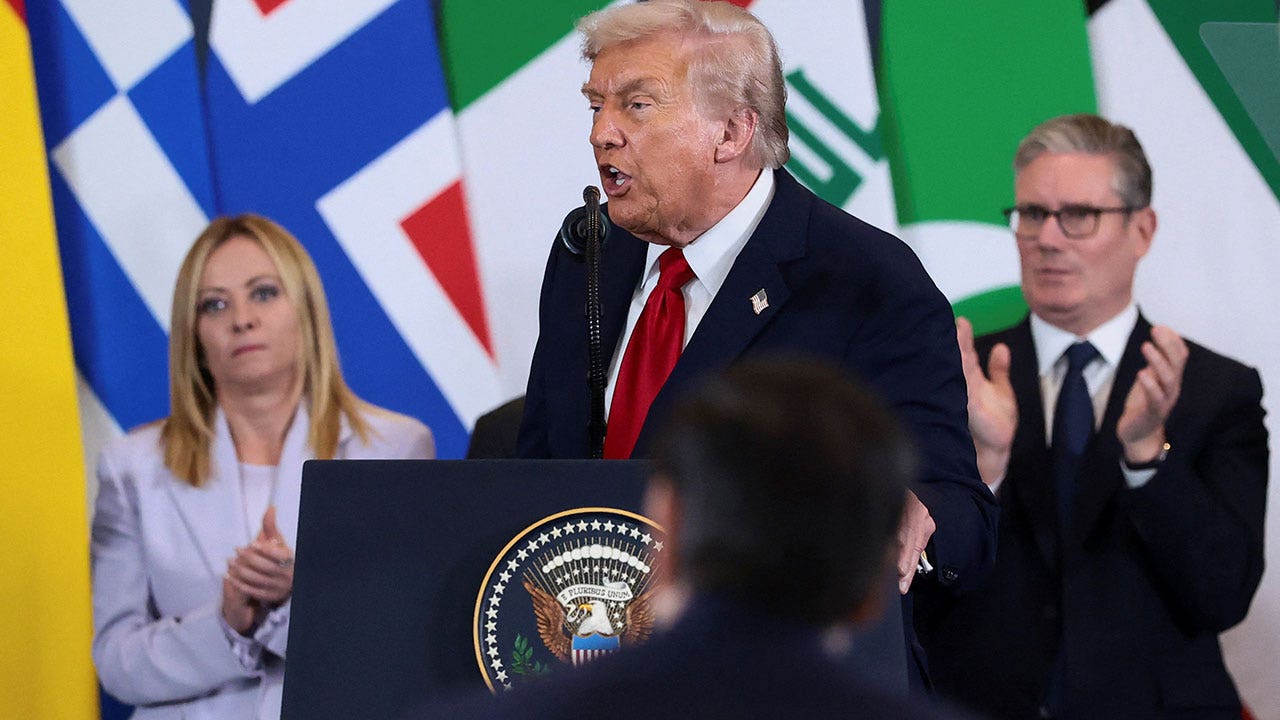
President Donald Trump delivers remarks as Italian Prime Minister Giorgia Meloni and British Prime Minister Keir Starmer applaud following the signing of the first phase of the Gaza ceasefire agreement in Sharm El-Sheikh, Egypt, on Oct. 13, 2025. (Evelyn Hockstein/Reuters)
Savill wrote that “The challenge for the U.K. is that in the past few years, the commitments and visible presence of U.K. Armed Forces in the region have been shrinking, as a result of the pressure on the military, and a conscious decision to prioritize elsewhere, most recently in the ‘NATO First’ approach of the Strategic Defense Review of 2025.”
While the Starmer government has committed to increasing defense spending to 2.5% of GDP by 2027, experts warn that this investment may be too late to restore the U.K.’s ability to project power globally in the near term.
John Hemmings, director of the National Security Center at Henry Jackson, told Fox News, “The U.K.’s military capabilities have been systematically underfunded over the past 15 years, with the Spending Review and cuts starting in 2009 and 2010 under Prime Minister David Cameron. The Strategic Defense and Security Review (SDSR) at the time stated that the world was headed in a much more dangerous state, but the fiscal devastation of the 2008 Financial Crisis pushed the Government into a series of cuts that were intended to be short-term. Instead, the Cameron Government sent the U.K.’s armed services into a spiral of terminal decline that has lasted until this day,” he said.
The Type 45 destroyer HMS Dragon is moored in the Royal Navy Dockyard in Portsmouth, England, on Oct. 28, 2024. Britain announced on May 12, 2026 that it will deploy autonomous mine hunting equipment, counter drone systems, along with Typhoon jets and HMS Dragon as part of a future defensive mission to secure freedom of navigation in the Strait of Hormuz. (Matt Cardy/Getty Images)
Hemmings added, “Consider the Royal Navy, the U.K.’s premier service and source of great power reach; only 25 out of 63 commissioned vessels are actual fighting ships. This force size is impossible to service Britain’s overseas responsibilities and has seen cuts of 50% in only 30 years. In 1996, there were 22 frigates, 17 submarines, 15 destroyers, and 3 aircraft carriers. Today’s First Sea Lord must attempt to carry out the same duties with seven frigates, 10 submarines, six destroyers, two aircraft carriers. In addition, the U.K. underfunded new capabilities like domestic air and missile defenses and advanced command and control systems.”
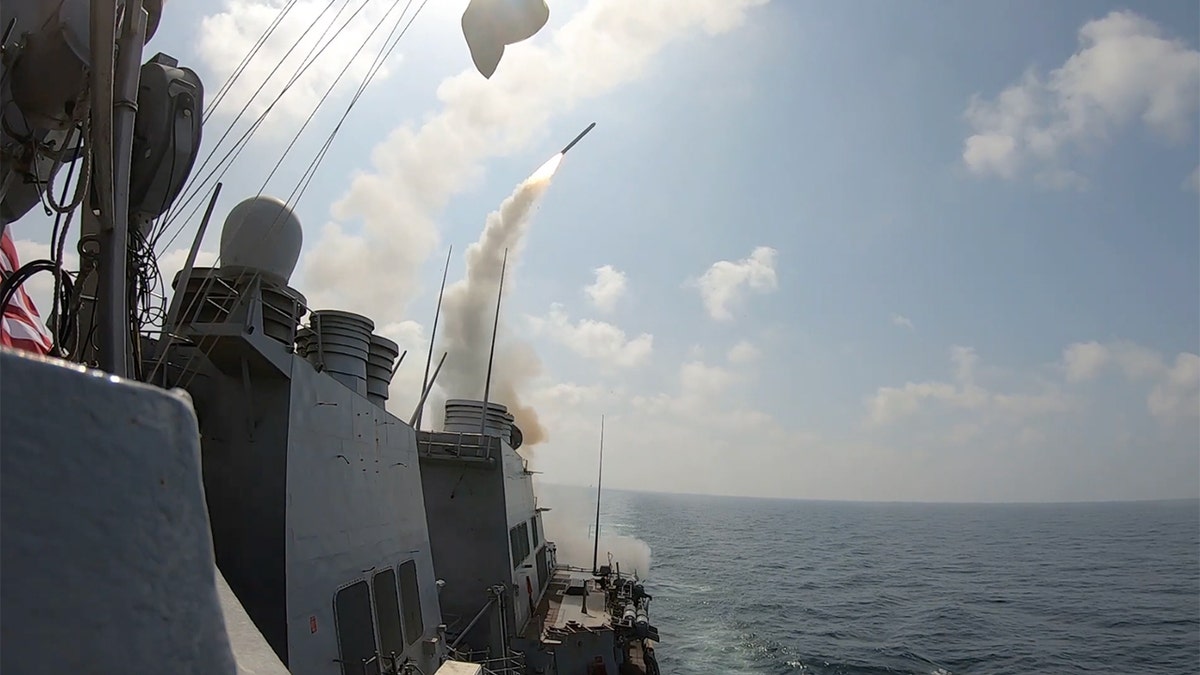
A U.S. Navy ship launches Tomahawk Land Attack Missiles in support of Operation Epic Fury. (U.S. Central Command Public Affairs)
A second report released last month, by the House of Lords International Relations and Defense Committee titled: ‘Adjusting to new realities: rebalancing the U.K.-U.S. partnership,’ presents several key recommendations where it warned of the over-dependence on the U.S. “Although the U.K. has benefited from closely collaborating with the U.S. on defense, this has fostered a dependency culture leading to a decline in U.K. capabilities and loss of U.K. credibility in Washington. The Government should provide a clear and costed pathway to achieving the commitment to increase defense spending to 5% of GDP.”
While the Ministry of Defense did not respond to several requests for comment over the state of forces, Fox News Digital recently reported that the U.K. government said it is reversing an attrition rate in the military, stating that total armed forces strength stood at 182,050 personnel as of Jan. 1, 2026, including 136,960 regular troops, an increase from the previous year.
The government has also pledged what it calls the largest sustained rise in defense spending since the Cold War, with military spending set to reach 2.6% of GDP by 2027, backed by an additional £5 billion (approximately $6.6 billion) this financial year and £270 billion (nearly $360 billion) in defense investment over the course of the current parliament. Britain has also said it aims to raise defense spending to 3% of GDP by the end of the next parliament.
Analysts say while some in the Trump administration see the U.K.’s absence as a betrayal of the special relationship, others may say it is a tough lesson in the limitations of a mid-sized power that has tried to maintain a global footprint on a shrinking budget.