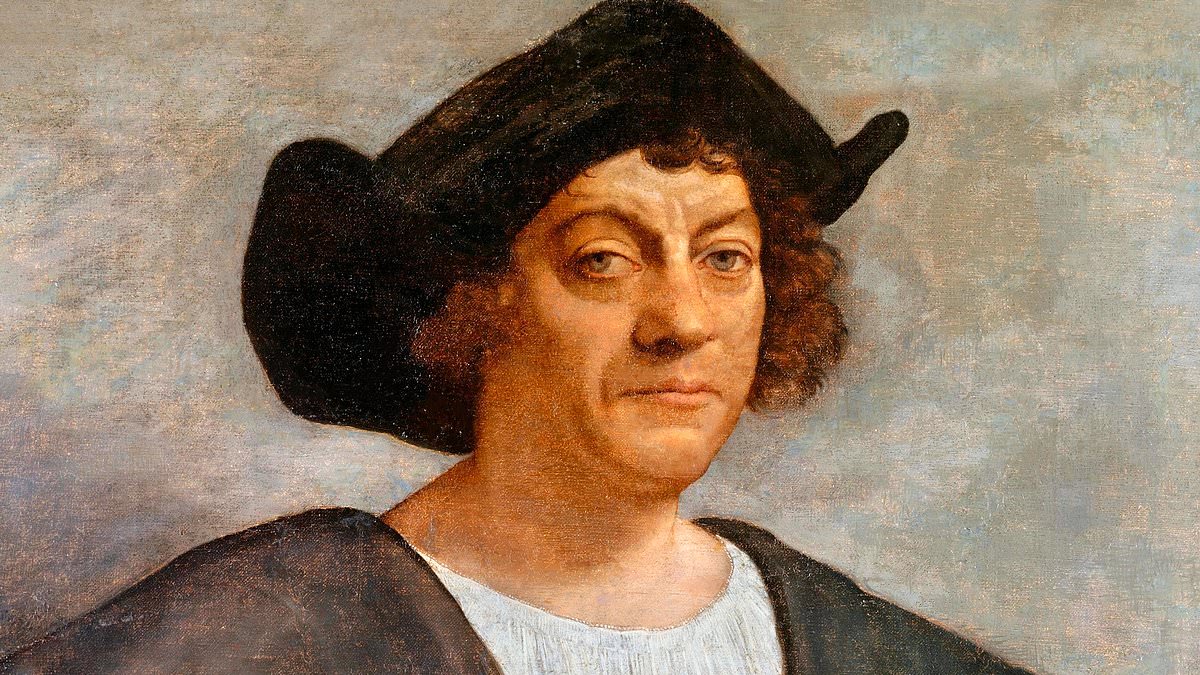

Former President Joe Biden often highlighted America’s identity as a nation of immigrants, and he didn’t miss the chance to do so again during Columbus Day in October 2022.
In what the White House dubbed ‘A Proclamation on Columbus Day,’ Biden offered Americans a historical insight into the origins of one of the country’s most notable explorers.
Christopher Columbus, who embarked on his historic journey in 1492 from the Spanish port of Palos de la Frontera under the patronage of Queen Isabella I and King Ferdinand II, “has roots tracing back to Genoa, Italy,” Biden noted.
Biden emphasized that Columbus’ journey is a source of pride for many Italian Americans, whose ancestors also ventured across the Atlantic. “His voyage inspired many others to follow and ultimately contributed to the founding of America, a beacon for immigrants worldwide,” the president said.
Biden highlighted that many of these immigrants were Italian, acknowledging that over generations, Italian immigrants have bravely left behind much, driven by their belief in the American dream to create a new life of hope and opportunity in the United States.
The president remarked that Columbus Day was established by President Harrison in 1892 in response to the xenophobic lynching of 11 Italian Americans in New Orleans the year before. Originally, Columbus Day was meant to celebrate Italian Americans in the U.S. Many in the community have appreciated this acknowledgment and have sought to distance themselves from the less favorable association with the Mafia.
But what if Columbus wasn’t Italian at all – and, like the king and queen who sent him, and the flag he sailed under, he was actually Spanish?
That would call for a drastic rewriting of the history books, to say nothing of setting off a new search for America’s biggest Italian success story. And this may yet have to happen – thanks to a scientific discovery more than 500 years after his death.
The ‘Columbus Question’, as the debate over his origins has been dubbed, has raged for years and has long had a nationalistic undertone
Christopher Columbus set off in 1492 on his momentous voyage from the Spanish port of Palos de la Frontera on behalf of the Spanish monarchs Queen Isabella I and King Ferdinand II
The first ever DNA analysis of the remains of several direct descendants of the seafarer indicates that he didn’t come from the once powerful city of Genoa in northern Italy but from Galicia in northwestern Spain.
And, further rocking the accepted ‘origins story’ that has inspired generations, it’s claimed Columbus wasn’t Cristoforo Colombo, the humble-born, self-educated son of a wool weaver – who worked on his father’s cheese stall as a boy – but actually a privileged member of the Galician nobility.
The news that could prompt a reappraisal of one of US history’s defining moments was comes courtesy of researchers at Spain’s Citogen laboratory and the Complutense University of Madrid who have published their draft results of their study before it is submitted for peer review.
The study links Columbus, who died aged 54 in 1506, genetically with Galicia’s mighty Sotomayor family which held considerable sway over northwestern Spain in the 15th century.
According to the scientists, the DNA evidence specifically points to Pedro Alvarez de Sotomayor, a powerful 15th-century Galician nobleman also known as Pedro Madruga (literally ‘Pedro the Early Riser’), as a direct ancestor of Columbus. Madruga was one of the strongest feudal lords of Galicia, a warrior ruler who fought in the Castilian civil wars, clashed with Spain’s monarchy and controlled extensive lands from the castle of Sotomayor on the banks of the river Verdugo.
Indeed, some have previously claimed that Madruga may even have been Columbus himself, citing how he mysteriously disappeared from historical records around 1486 – the same year that Columbus is recorded for the first time visiting the court of Ferdinand and Isabella and urging them to finance an Atlantic voyage widely viewed as suicidal.
The researchers behind the latest study don’t go so far as to say they are the same person. They came to the groundbreaking conclusion after examining the DNA from the skeletal remains of 12 people exhumed from the family crypt of the Counts of Gelves.
The crypt is located in a church, Santa Maria de Cracia, which is hundreds of miles from Galicia, near Seville in the southeastern Spanish province of Andalucia.
Two of the 12 were found to share genetic material despite no historical records indicating they had any connection. One was Jorge Alberto de Portugal, the third Count of Gelves and a well-documented descendant of Columbus.
The other was Maria de Castro Giron de Portugal, a 17th century countess by marriage of Galician origin.
The fact they had shared DNA indicated they had a common ancestor, which the researchers identified through further tests as early-rising nobleman Pedro Madruga.
The researchers feel sufficiently confident to say the family crypt houses the ‘largest concentration of Columbus’s direct descendants, at least seven, including his granddaughter.’
This is not the first time that Columbus’s origins have been located in Galicia – the theory was first posited more than a century ago – but it is the first time that the controversial theory has been backed by science.
There are other reasons – beyond the curious coincidence of Columbus appearing at court around the same time as Pedro Madruga apparently vanished – that are cited in support of the Galicia theory. And more specifically, the theory that Columbus was either the nobleman himself or his son.
Researchers came to the groundbreaking conclusion after examining the DNA from the skeletal remains of 12 people exhumed from the family crypt of the Counts of Gelves
It’s also been claimed that Columbus was Polish and even Scottish
Columbus’s writings are said to contain syntax typical of Galician-Portuguese. According to a linguistics expert at Georgetown University, Professor Estelle Irizarry, who examined his writing, Columbus’s primary language was Castilian – the language of northern and central Spain – and he never wrote anything in Ligurian, the spoken language of Genoa.
Others note that the coat of arms Columbus was later allowed to create for himself by the Spanish monarchy includes golden bands that are also found in the heraldic arms of the Sotomayor family.
Meanwhile some historians believe Columbus wasn’t treated like a complete stranger at the Spanish court – as the son of an Italian weaver surely would have been.
Supporters of the Galicia theory also point out that the surname Colón (Spanish for Columbus) is well documented in Galicia’s Pontevedra estuary, the region from where the Sotomayors hailed.
The authors of the DNA study admit it is not conclusive – largely because they didn’t compare their samples with Columbus’s own DNA and also because it has yet to be reviewed by other experts.
As the researchers acknowledge, the geographical and familial origins of Columbus has been a subject of ‘intense historiographical debate for over five centuries.’
However, they add, despite numerous theories about Columbus’ origins, ’empirical genetic evidence’ – such as theirs – has until now been singularly lacking an often-heated debate.
So why has the issue of Columbus’s origins been so contentious? Essentially because various countries – not only Italy and Spain but also Portugal and countries even further afield – would love to claim him as their own.
Columbus’ four Transatlantic voyages, which he conducted in the name of the Spanish monarchs between 1492 and 1504, are not only credited with discovering the New World (even if Vikings very likely got there 500 years earlier) but provided the first known contact between Europeans and the people of the Caribbean, Central and South America.
The ‘Columbus Question,’ as the debate over his origins has been dubbed, has raged for years and has long had a nationalistic undertone.
Spain certainly has its work cut out prying him away from Italy. According to historical accounts, including those by his son Ferdinand, Columbus left Genoa as a teenager.
He served in the Portuguese merchant navy and sailed as far as Iceland and West Africa. In Portugal, he married a woman from an aristocratic but financially modest background and went first to the Portuguese court to get funding for a Transatlantic journey. (These Portuguese connections fueled the theories that he was, in fact, Portuguese).
He was refused help by the Portuguese crown and moved to Spain in 1485 to try his luck there, his persistence with Ferdinand and Isabella finally paying off in 1492.
Supporters of the Genoa theory contend that one cannot argue with the details he provided on his own will, in which he gave his place of birth as the Italian city. Contemporary documents, letters and maps also all mention Columbus as Genoese. And while he was cagey about his origins, Columbus appeared to suggest that this was the case.
Yet critics note that other contemporaries of Columbus didn’t mention he was Italian when there was every reason for them to have done so.
Genoese ambassadors in Spain, for instance, didn’t claim him as Genoese in their letters while official Spanish government documents never referred to him as a foreigner, which they did of other non-Spanish explorers.
They have also questioned the authenticity of the supposedly all-important Columbus will, saying that it was produced in court during a legal dispute between his heirs.
And why, according to no less a source than his son Ferdinand, did Columbus try to obscure his true origins? Perhaps it was because they were humble but, alternatively, perhaps it was because he was a nobleman who wanted to escape his past? (There is another theory – propounded by Georgetown University’s Prof Irizarry and a few others – that he was actually Jewish, a discovery which would have put paid to any help from a Christian monarch.)

The crypt is located in a church, Santa Maria de Cracia, which is hundreds of miles from Galicia near Seville in the the southeastern Spanish province of Andalucia
The theory that he was Portuguese is not entirely based on the fact that he spent so much time there. Historians have argued that he wouldn’t have been able to marry into the country’s aristocracy had he been an obscure foreigner. A 2012 book by an engineering professor at the University of Lisbon claimed Columbus was really named Pedro Ataide, the illegitimate son of a Portuguese lord. He was believed to have died in a 1476 sea battle but actually survived and, anxious to distance himself from his family because they’d committed treason against the country’s crown, changed his name to Culon and started a new life.
It’s also been claimed that Columbus was Polish and even Scottish. According to the former theory, he was the son of a Polish king who, again, was presumed to have died but escaped to the Portuguese island of Madeira where Columbus was born in secrecy.
As for ‘MacColumbus,’ he was the son of a Scottish family living in Genoa whose real name was Pedro Scotto. He changed it to Columbus, taking the name from a pirate for whom he worked when he was younger.
If you look hard enough, you can also find claims that Columbus was Norwegian, Swedish, Greek Byzantine, Sardinian and Corsican – generally always a nobleman and never a commoner.
With most historians still convinced – at least until the new DNA study – that he was an Italian, the war over who owns Columbus will no doubt continue.
Italian-Americans don’t have to scrap their Columbus Day celebrations quite yet.