
The Justice Department has issued a new directive that could give President Donald Trump far-reaching legal cover to keep private communications out of public and congressional view.
The move appears aimed at blunting a potential wave of Democrat-led investigations this fall if the party wins control of the House of Representatives or the Senate.
The memo was released by the Justice Department’s Office of Legal Counsel just hours after Trump’s attorney general nominee, Todd Blanche, was sworn in to formally lead the department.
At its core, the OLC opinion seeks to significantly widen Trump’s ability to invoke executive privilege, potentially covering communications with advisers, outside allies and private citizens.
If Democrats regain either chamber in November’s midterm elections, the directive could sharply limit their power to demand records or compel testimony from people close to Trump.
Signed by Assistant Attorney General T. Elliot Gaiser, the memo would substantially expand the category of “private advisers” whose communications may be protected from disclosure under executive privilege.
Under the new interpretation, the privilege could extend to private citizens, state officials and individuals serving in other branches of the federal government, provided the communications “relate to official presidential decision making, or involve or reflect communications with the President or his advisers, and are confidential,” the memo states.
The directive arrives after Trump repeatedly asserted executive privilege to resist subpoenas and investigations led by Democrats during and after his first term in the White House.

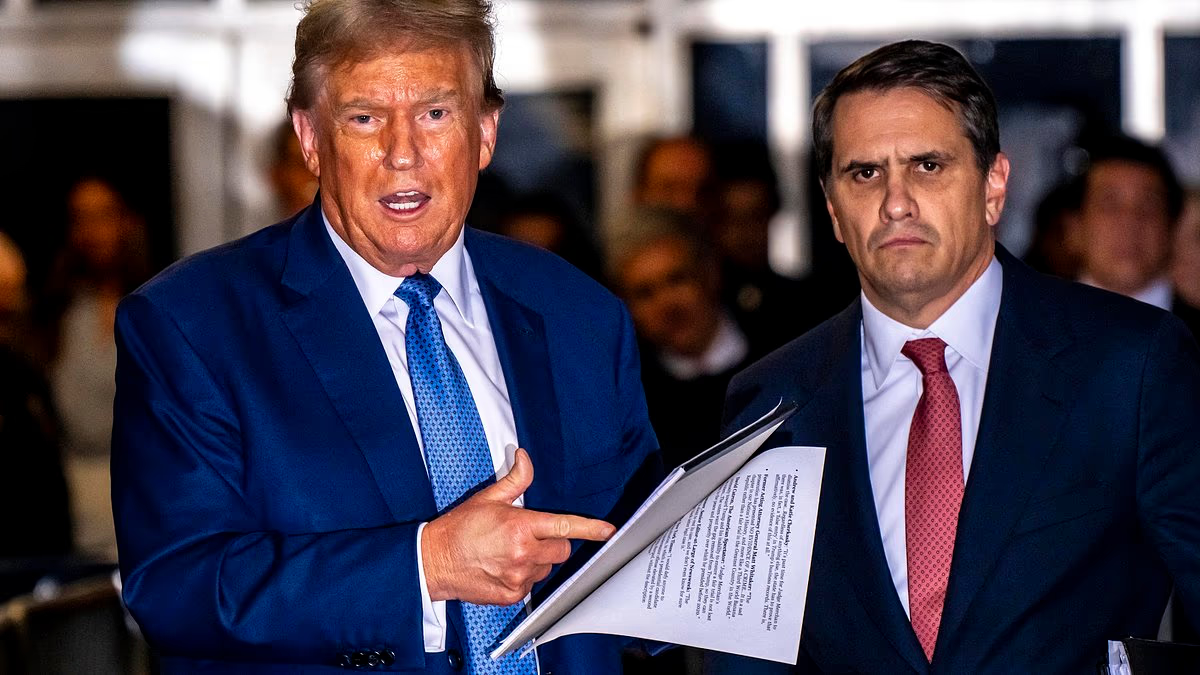
Trump and his then-personal lawyer, Todd Blanche, speak to the press outside the Manhattan Criminal Court in New York City. Blanche was just confirmed over the weekend to lead DOJ

The OLC memo seeks to give Trump broad authority to shield his communications under the guise of executive privilege

Then-Acting Attorney General Todd Blanche and FBI Director Kash Patel are seen at a press briefing in Washington, DC
Trump cited executive privilege in a bid to head off Democrats from obtaining White House visitor logs, from subpoenaing his former advisers, and blocking requests for other information as part of their investigations into the Jan. 6, 2021, US Capitol riot.
The memo from OLC represents a legal position from the Justice Department, and is not an official ruling.
Still, the memo seeks to drastically expand the scope of materials that Trump could ostensibly cite as being covered by executive privilege – opening the door to broader criticism from Democrats, and from former Justice Department officials and career employees.
Former DOJ employees have criticized Blanche and other senior officials of ‘politicizing’ the Justice Department during Trump’s second White House term – including by launching criminal investigations into Trump’s most outspoken political foes, and by firing or otherwise penalizing career officials who resisted these efforts.
But that’s not to say Congress would be without options, should Democrats retake the majority of the House, Senate, or both in the midterm elections.
Though Democrats’ chances of winning a Senate majority remain slim, recent polling suggest there is room for optimism in the House.
A new Kalshi forecast gives Democrats an 85 percent chance of retaking the House majority in November, compared to a roughly 15 percent chance for Republicans.

Then-Acting Attorney General Todd Blanche is seen prior to his testimony before the Senate Judiciary Committee in July

Trump spoke during a rally in Washington, DC, protecting the electoral college certification of his predecessor, Joe Biden on January 6, 2021

Then-Reps. Liz Cheney, Adam Schiff, and Adam Kinzinger are seen during a House select committee hearing investigating the Jan. 6, 2021 riot at the US Capitol
The new OLC memo states that Congress, in seeking information from the executive branch, may overcome the higher burden of proof by demonstrating that the information in question is ‘demonstrably critical’ to carrying out its constitutional responsibilities.
It is unclear how exactly that process might play out, and the memo did not go too far into specifics.
The OLC memo could give Trump and future presidents broad legal cover to resist subpoenas from Congress, including documents requests, requests for communications between a President and their direct advisers, as well as private citizens or consultants.
A Justice Department official said that the new order ‘reaffirms’ the longstanding position of OLC going back to 1972.


