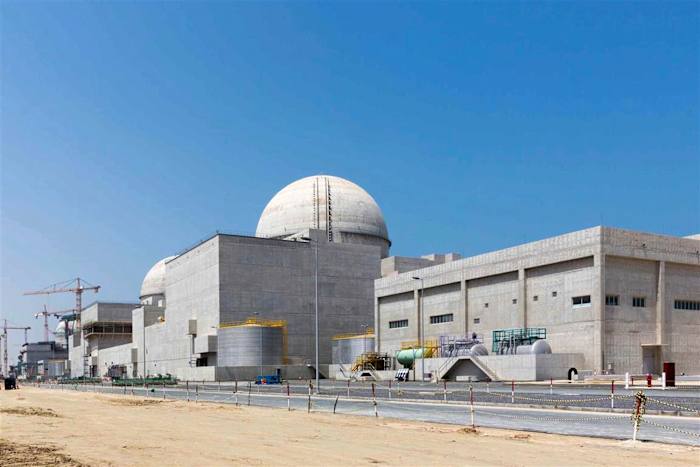


DUBAI — The United Arab Emirates’ Barakah nuclear power plant recently came under drone attack, with the UAE’s Defense Ministry attributing the assault to drones originating from Iraq. This development suggests the involvement of Iranian-backed Shiite militias.
These militias have a history of launching drone attacks against Gulf Arab nations, especially following the onset of hostilities between Israel, the United States, and Iran on February 28. Historically, these groups have enabled Iran to divert blame for such aggressive actions.
Fortunately, the assault on Barakah resulted in no injuries or radiation leaks, although a generator located on the facility’s outskirts was struck, according to Emirati officials. The UAE, which collaborates with Israel on air defense, has accused Iran of continuing drone and missile strikes despite a ceasefire. Tensions remain high over the strategically crucial Strait of Hormuz, currently under the gaze of a U.S. naval blockade.
While no group has officially taken responsibility for the attack, fingers point towards Iran and its affiliated forces.
In response to the UAE’s Defense Ministry’s findings, Iraqi government spokesperson Bassem al-Awadi issued a statement condemning the drone attacks on the UAE, though he did not directly comment on the report.
“We stress the need for strong regional and international collaboration to prevent any escalation, ensuring regional stability, and protecting the security and sovereignty of friendly nations,” al-Awadi stated.
There were three other drones that targeted the country over the last two days, the Defense Ministry added, without elaborating on their targets.
The $20 billion Barakah nuclear power plant was built by the UAE with the help of South Korea and went online in 2020. It is the only nuclear power plant in the Arab world and can provide a quarter of the energy needs in the UAE, a federation of seven sheikhdoms that is home to Dubai.
Earlier Tuesday, a prominent Emirati diplomat elliptically criticized regional countries over the attacks the country has faced.
“The confusion of roles during this treacherous Iranian aggression is baffling, encompassing the Gulf Arab region’s surrounding states,” Anwer Gargash wrote on X. “The victim’s role has merged with that of the mediator, and vice versa, while the friend has turned into a mediator instead of being a steadfast ally and supporter.”