
What was Agatha Christie’s Net Worth?
Dame Agatha Christie, the illustrious English writer and playwright, possessed a net worth of $30 million at the time of her passing in 1976, which equates to approximately $175 million today when accounting for inflation. Further insights into Christie’s financial legacy, including her assets, estate, and inheritance specifics, follow in the subsequent sections.
Celebrated as one of the most esteemed mystery writers of all time, Agatha Christie is renowned for her detective novels featuring the likes of Hercule Poirot and Miss Marple. Among her most famous works are “Murder on the Orient Express,” “Death on the Nile,” “The Body in the Library,” and “The Moving Finger.” She also penned the highly acclaimed “And Then There Were None” and the iconic plays “The Mousetrap” and “Witness for the Prosecution.”
Net Worth, Assets & Inheritance
Upon her death on January 12, 1976, Christie’s estate was recorded at a modest £106,683, which translates to about £900,000, or nearly $1.1 million in today’s currency. This figure seemed surprisingly low for such a prolific author, but it only accounted for her liquid assets and tangible property owned outright at her death. It did not reflect the far more substantial value held within her corporate interests, which managed the rights to her vast collection of literary works and adaptations.
Over the years, Christie strategically organized her financial affairs to mitigate the effect of the UK’s high estate and income taxes. In 1955, she established Agatha Christie Limited to manage the copyrights to her extensive portfolio. By 1968, she had sold a 64% controlling interest in the company to the Booker McConnell conglomerate, generating considerable capital and securing the business aspects of her literary legacy. At her death, Christie retained a 36% stake in the company, a crucial part of her wealth not reflected in her personal probate records.
Christie also applied thoughtful tax planning to her real estate holdings. She acquired Greenway, her cherished Devon estate, in 1938 for £6,000. However, she transferred ownership of Greenway to her daughter, Rosalind Hicks, in 1959, effectively excluding it from her taxable estate 17 years prior to her death.
Rosalind became the chief beneficiary of Christie’s estate, inheriting the significant 36% share in Agatha Christie Limited, which provided her with substantial income and influence over her mother’s literary works. Christie’s second husband, Sir Max Mallowan, received personal belongings, financial arrangements, and assets they jointly owned. Additionally, Christie left monetary gifts for her loyal staff, including £500 for her gardener, £250 for her secretary, and £200 for her garden manager.
Using only the probate figure, Christie’s net worth at death was £106,683. But that number dramatically understates her true wealth. Factoring in her 36% stake in Agatha Christie Limited, her actual 1976 net worth was likely closer to £15 million to £20 million. Using an average 1976 exchange rate of roughly $1.80 per £1, that would equal approximately $27 million to $36 million at the time. Adjusted for inflation, Agatha Christie’s true net worth at death was likely in the range of $160 million to $210 million.
Early Life and Education
Agatha Christie was born Agatha Miller on September 15, 1890 in Torquay, Devon, England into an affluent upper-middle-class family. She was the youngest of three children of Clarissa and Frederick. Due to her siblings being much older than her, Christie spent much of her childhood playing by herself and with her pets. She eventually befriended other girls and starred in a youth production of Gilbert and Sullivan’s “The Yeomen of the Guard.”
For her formal education, Christie was homeschooled. In addition to learning the basic subjects, she learned to play the piano and mandolin. Christie’s world was irrevocably changed when her father passed away in late 1901. Now living with just her mother, she attended Miss Guyer’s Girls’ School for a while. In 1905, Christie was sent by her mother to Paris, where she attended various boarding schools. She studied piano and voice but eventually decided not to pursue professional performing.
Start of Literary Career
After spending some time in Egypt with her ailing mother, Christie penned her first short story, “The House of Beauty,” at the age of 18. She followed that with many more short stories, although none of them were accepted by magazines to publish. Christie similarly faced rejection with her first novel, “Snow Upon the Desert,” which she wrote under the alias Monosyllaba.
Detective/Mystery Novels
In 1916, Christie wrote her first detective novel, “The Mysterious Affair at Styles.” Published in 1920, it introduced her most famous character, Hercule Poirot. Christie’s second published detective novel, “The Secret Adversary” (1922), introduced detective couple Tommy and Tuppence. She returned to Poirot for her third detective novel, “Murder on the Links,” which was published in 1923. Christie subsequently published a number of short stories featuring Poirot. Among her other novels in the 1920s were “The Man in the Brown Suit,” “The Murder of Roger Ackroyd,” “The Big Four,” and “The Seven Dials Mystery.” In 1930, Christie published “The Murder at the Vicarage,” her first novel featuring elderly spinster detective Miss Marple. Most of her novels over the subsequent years featured Poirot, including “Peril at End House,” “Murder on the Orient Express,” “Death in the Clouds,” “Murder in Mesopotamia,” “Death on the Nile,” and “Appointment with Death.”
In late 1939, Christie published the mystery novel “And Then There Were None” in the United Kingdom. The book was published in the United States about two years later. It would go on to become one of Christie’s most famous works, as well as one of the best-selling novels of all time. After that, Christie returned to Poirot novels with “Sad Cypress,” “One, Two, Buckle My Shoe,” and “Evil Under the Sun.” During the rest of the 1940s, she alternated between Poirot and Miss Marple, and also wrote novels featuring her characters Tommy and Tuppence, Superintendent Battle, and Colonel Race. These characters appeared in such novels in the ’40s as “Five Little Pigs,” “The Moving Finger,” “Towards Zero,” “Sparkling Cyanide,” and “The Hollow.”
In the 1950s, Christie mostly focused on Poirot and Marple, with novels including “A Murder is Announced,” “They Do it with Mirrors,” “After the Funeral,” “A Pocket Full of Rye,” and “Dead Man’s Folly.” She also published such mystery novels as “They Came to Baghdad,” “Destination Unknown,” and “Ordeal by Innocence.” In the 1960s, Christie published the Poirot novels “The Clocks,” “Third Girl,” and “Hallowe’en Party” and the Marple novels “The Mirror Crack’d from Side to Side,” “A Caribbean Mystery,” and “At Bertram’s Hotel.” Additionally, she published the Tommy and Tuppence novel “By the Pricking of My Thumbs.” Christie published less in the 1970s due to a heart attack and fall in 1974. The final Poirot novel, “Curtain,” was published in 1975, and the last Marple novel, “Sleeping Murder,” came out in 1976. Both were written in the 1940s.

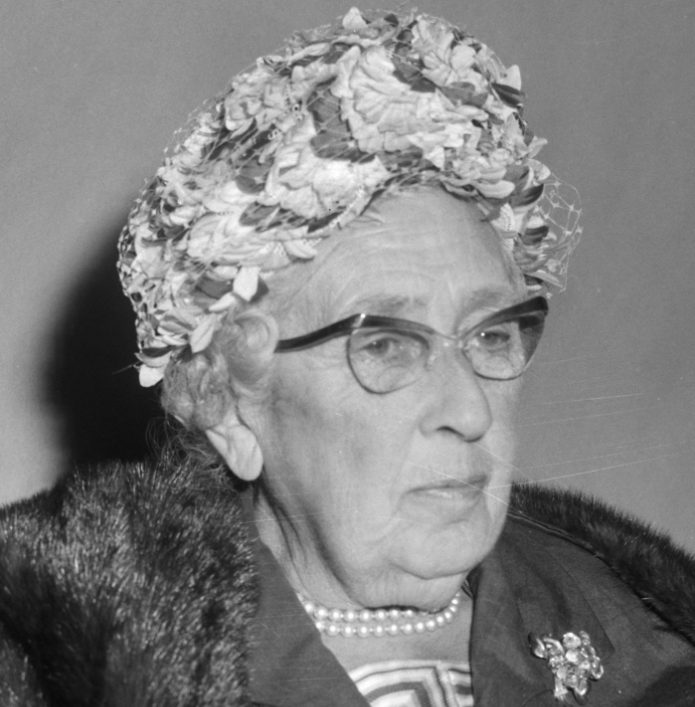
(Dutch National Archives public domain)
Other Works
Beyond her detective and mystery works, Christie published six mainstream novels under the pseudonym Mary Westmacott: “Giant’s Bread” (1930), “Unfinished Portrait” (1934), “Absent in the Spring” (1944), “The Rose and the Yew Tree” (1948), “A Daughter’s a Daughter” (1952), and “The Burden” (1956). She also wrote some non-fiction books, including “Come, Tell Me How You Live” (1946), about her work on an archeological dig, and “An Autobiography,” which was published posthumously in 1977.
Some of Christie’s most renowned works were her plays. After opening her first play, “Black Coffee,” in late 1930, she adapted a few of her detective novels for the stage, including “And Then There Were None” and “Appointment with Death.” On the West End in 1952, Christie opened her murder mystery play “The Mousetrap,” based on her short radio play. Despite low expectations, it went on to become the longest-running play in history, with over 27,000 performances through 2018. Christie’s other famous play is “Witness for the Prosecution,” which opened on the West End in 1953 and on Broadway in late 1954.
Personal Life
Amid her active social life in the early 1910s, Christie had brief relationships with a number of men and got engaged. At a dance in 1912, she met Royal Artillery officer Archibald Christie, and they quickly fell in love. The couple married on Christmas Eve in 1914. During World War I, Christie served as a nurse in the Voluntary Aid Detachment of the British Red Cross. She had her first and only child, Rosalind, in 1919. Christie enjoyed her married life and career until 1926, when the death of her mother plunged her into a deep depression. This was compounded by her husband asking for a divorce. Following a fracas with her husband in late 1926, Christie disappeared, sparking a national scandal. She was located 11 days later at the Swan Hydropathic Hotel in Harrogate, Yorkshire. In 1928, Christie and her husband divorced.
Following her divorce from her first husband, Christie traveled to Istanbul and Baghdad and befriended archeologist Leonard Woolley and his wife. On a dig with them in early 1930, she met archeologist Max Mallowan, whom she subsequently married. They remained wed until Christie’s passing. Christie accompanied Mallowan on his many archaeological expeditions over the years, with several excavations in the Middle East serving as inspiration for her fiction stories. In 1950, Christie was elected a fellow of the Royal Society of Literature, and in 1956 she was appointed Commander of the Order of the British Empire. Later, in 1971, she was promoted to Dame Commander.
Death
Between 1971 and 1974, Christie’s health deteriorated, with some reports claiming she had complications from dementia. Her condition worsened in 1974 after a heart attack and a severe fall. On January 12, 1976, Christie passed away at her Winterbrook House in Oxfordshire.
All net worths are calculated using data drawn from public sources. When provided, we also incorporate private tips and feedback received from the celebrities or their representatives. While we work diligently to ensure that our numbers are as accurate as possible, unless otherwise indicated they are only estimates. We welcome all corrections and feedback using the button below.
(function() {
var _fbq = window._fbq || (window._fbq = []);
if (!_fbq.loaded) {
var fbds = document.createElement(‘script’);
fbds.async = true;
fbds.src=”
var s = document.getElementsByTagName(‘script’)[0];
s.parentNode.insertBefore(fbds, s);
_fbq.loaded = true;
}
_fbq.push([‘addPixelId’, ‘1471602713096627’]);
})();
window._fbq = window._fbq || [];
window._fbq.push([‘track’, ‘PixelInitialized’, {}]);