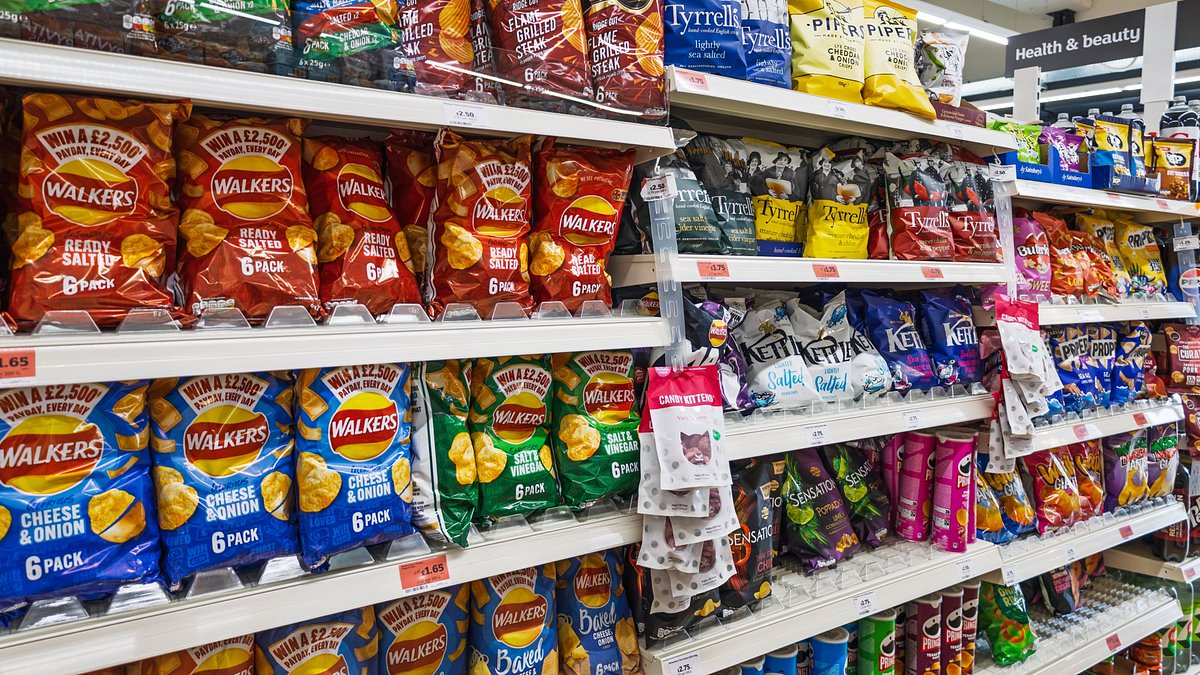

A recent ranking has unveiled the UK’s least healthy snacks, revealing that even those labeled as ‘better for you’ might not be as beneficial as they seem.
A comprehensive investigation by Which? scrutinized over 60 popular savory snacks, ranging from Walkers crisps to lentil and quinoa chips touted as healthier alternatives.
The study discovered that more than half of these snacks did not meet the government’s official health standards, according to the Nutrient Profiling Model (NPM). This finding raises concerns about the potential for consumers to be misled by snacks bearing ‘health halo’ branding.
Among the snacks examined, some fared significantly worse than others.
Jacob’s Mini Cheddars Original emerged as the least healthy, scoring a mere 20 out of 100 on the NPM scale.
The review revealed that a packet of Mini Cheddars contains 14.4g of saturated fat per 100g. In contrast, Kettle Chips lightly salted, one of the better-rated snacks, contains only 2g of saturated fat per 100g.
What’s more, Mini Cheddars are high in salt (2.4g per 100g) and low in fibre (2.6g per 100g).
This means that while they’re relatively high in protein with 10.3g per 100g, there are not enough positives to outweigh the negatives.

A new ranking has revealed the least healthy snacks – and it’s bad news for fans of Mini Cheddars and Pom Bears
The NPM is a tool that determines what are ‘less healthy’ foods and drinks by calculating the balance of beneficial nutrients against less beneficial ones per 100 grams of a product.
In the UK, foods that fail these thresholds are often referred to as High in Fat, Salt, or Sugar (HFSS).
Which? also found that some snacks with a ‘health halo’ (marketed with ingredients like lentils, quinoa, or vegetables) still failed the NPM.
Researchers found some of these products relied heavily on salt to make them more palatable, compromising their nutritional value.
Among the worst, Proper Chips Lentil Chips Barbecue only scored 36 out of 100 – joint second worst with Skips and Wotsits Really Cheesy.
Despite the brand’s claim on its website that its snacks are ‘not just better for you, but better than anything,’ they have high salt levels (2.55g per 100g), which gives it a large number of ‘negative’ points in the NPM.
Although lentil flour makes up just over a quarter of this product, contributing to its decent protein levels, the fibre is extremely low (0.7g – the lowest of the dataset), meaning the protein benefits are not enough to offset the high salt and 4.5g of sugar per 100g.
Pom–Bear Original, another common lunchbox item and children’s party snack, received an NPM of 54.
Which? found these crisps offer minimal nutritional benefit beyond simple calories, containing virtually no fibre (0.8g).
They are high in calories and are further penalised for their salt content, which is 1.3g per 100g or 0.17g in a 13g bag (classed as medium or amber).
Also among the famous crisps failing Which?’s NPM audit were Skips, Cheesy Wotsits, Frazzles, Quavers Cheesy, Monster Munch roast beef, sweet and spicy, McCoy’s salt & malt vinegar ridge cut and Hula Hoops Original Salted.
Walkers Sensations scored surprisingly well in multiple flavours including balsamic vinegar and caramelised onion and the Thai sweet chilli.
Shefalee Loth, a nutritionist at Which?, said: ‘We all know crisps aren’t the healthiest snack, but our audit shows some can be a much healthier option than others.
‘However, it is concerning to see that many childhood favourites are actually some of the least healthy options on the shelf.
‘With half–term and summer holidays coming up, it’s easy to be misled by a ‘health halo’ on packaging when you’re just trying to grab a quick snack on a day out.
‘Look for the front–of–pack traffic light labels to easily spot the healthier greens and ambers over the high–salt and high–fat reds.
‘However, because this system is currently voluntary, shoppers are left completely in the dark on far too many products.
‘We are calling on the government to update the scheme so it is simpler and make front–of–pack traffic light labelling mandatory across all food and drink products.
‘Consumers shouldn’t need a degree in nutrition just to understand what’s in their shopping basket; we need a compulsory system so everyone can see exactly what they are buying.’