
Donald Trump’s recent call for his Arab allies to acknowledge Israel as part of a broader peace agreement with Iran has been met with a range of reactions, from silence to unease, and even laughter, according to insiders.
Officials from countries with Muslim majorities have outrightly rejected Trump’s proposal to extend the Abraham Accords, a notable achievement from his first term that facilitated the normalization of relations between Arab nations and Israel.
However, some sources suggest that Trump’s demand might be a calculated move to satisfy conservative Republicans who worry that the President might be yielding too much to Iran.
“It’s a clever strategy to appease the disgruntled base,” an Arab diplomat shared with Politico. “He will continue to bring it up repeatedly, but it will not be a part of the agreement.”
During a Saturday conference call with leaders from Saudi Arabia, Qatar, Turkey, Egypt, and Pakistan, Trump was met with a shocked silence when he insisted that a peace deal with Iran depended on these nations recognizing Israel.
After an extended pause, Trump nervously joked, “Are they still there?”
One former US official sent mock congratulations to his Arab government contacts on joining the Abraham Accords, only to receive laughter emojis in reply, Politico reported.
Arab officials view Trump’s ultimatum as a ‘poison pill’ that ‘creates new conditions for peace that neither Iran nor the states in question will accept,’ the former diplomat added.
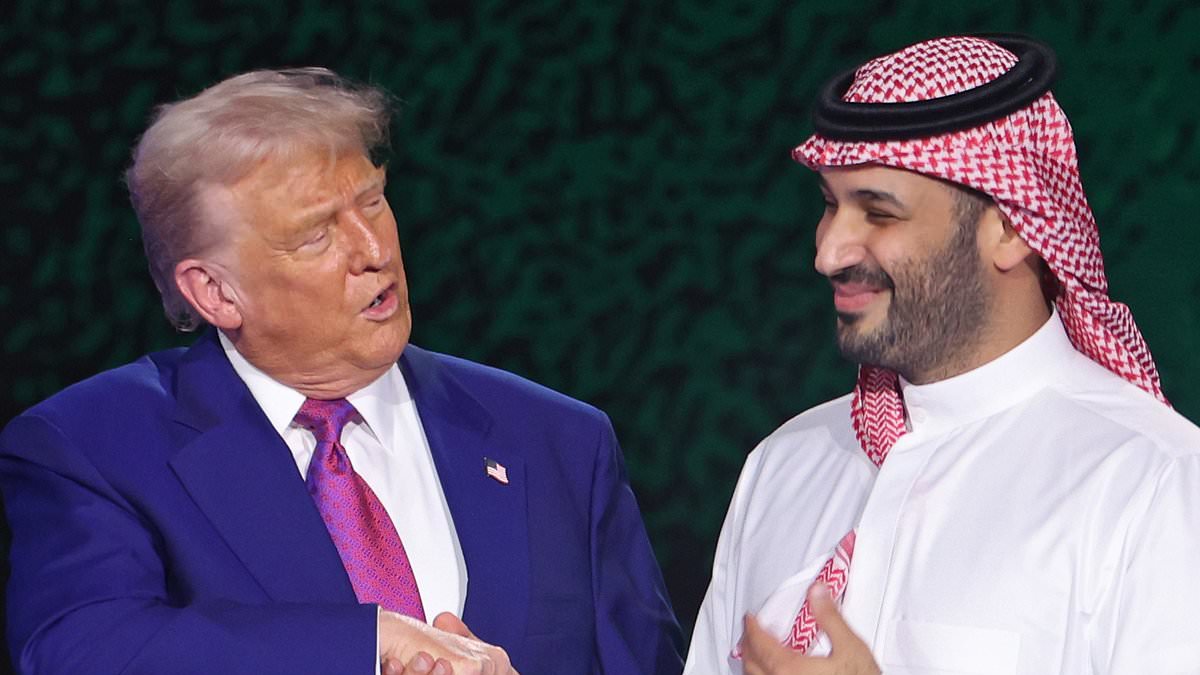
Donald Trump (L) and Saudi Crown Prince Mohammed bin Salman bin Abdulaziz Al Saud (R) attend the Keynote Address at the Saudi-US Investment Forum in Riyadh, Saudi Arabia, May 13, 2025
White House senior adviser Jared Kushner, right, walks with Ivanka Trump at the Royal Court Palace, in Riyadh, Saudi Arabia, in May, 2017. The Abraham Accords were brokered by Trump’s son-in-law in 2020
A second former US official described the mood across Middle East governments as one of ‘disbelief and frustration.’
The White House pushed back, insisting the Abraham Accords had been a resounding success since Trump struck them in his first term, deepening both diplomatic and economic ties across the region.
‘The Abraham Accords have provided massive economic benefits to all countries involved and enabled historic cooperation, so this would be a natural complement to a peace deal between the United States and Iran,’ spokeswoman Anna Kelly said.
The new demand lands at a precarious moment in the negotiations, with US forces carrying out fresh strikes on Iranian missile sites and mine-laying boats on Monday as Israel ramped up its offensive against Iran proxy Hezbollah in Lebanon.
Oil prices tumbled 4 percent on Wednesday amid reports by Iranian state TV that the deal’s framework included reopening the Strait of Hormuz, with global benchmark Brent crude sliding to $95 per barrel.
The draft ‘Islamabad Framework’ would see Tehran restore commercial shipping through the strait to pre-war levels within a month, in return for Washington lifting its blockade of Iranian ports, state network IRIB reported.
The thornier issue of Iran’s enriched uranium stockpile would be pushed back to a 60-day window of direct US-Iran talks, according to IRIB.
Trump convenes his Cabinet at 11am to thrash out next steps.

A drone view shows vessels in the Strait of Hormuz, as seen from Musandam, Oman, May 25
The President is racing to finalize a deal after weeks of stalemate, with the Strait of Hormuz still locked down by Iran’s Islamic Revolutionary Guard.
The war is bleeding into the November midterms, with soaring gas prices sending Trump’s approval ratings into a tailspin.
He is also fending off Republican hawks who warn the emerging terms look dangerously close to the 2015 Obama pact Trump spent years trashing as ‘the worst deal in history.’
The Abraham Accords, brokered by Trump’s son-in-law Jared Kushner in 2020, normalized ties between Israel and the United Arab Emirates, Bahrain, Morocco and Sudan, marking the first formal Arab recognition of the Jewish state since Jordan in 1994.
Saudi Arabia, long seen as the crown jewel of any expansion of the accords, has insisted it will not normalize relations with Israel without a credible pathway to a Palestinian state, a condition Jerusalem has rejected.
A November 2022 poll found 76 percent of Saudis viewed the Abraham Accords negatively, and opposition has only hardened since the Gaza war.