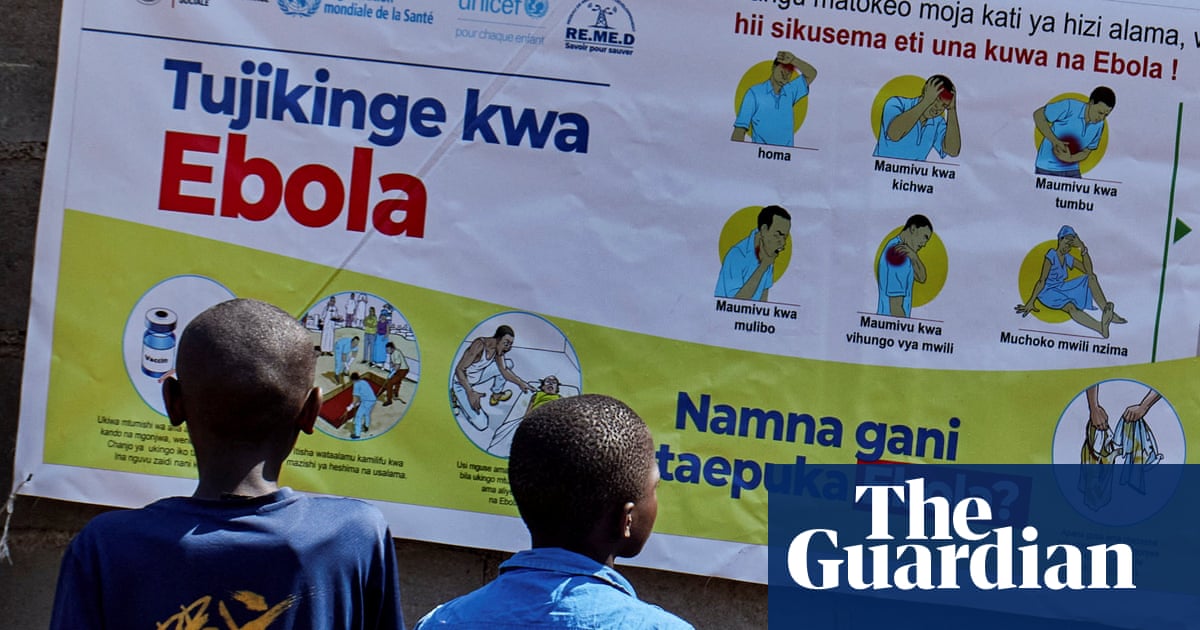

An unnoticed Ebola outbreak is currently spreading across central Africa, with the United States seemingly taking a backseat in efforts to control it, following significant reductions in global and domestic public health funding.
This outbreak involves the Bundibugyo strain of Ebola, a rare variant for which no vaccine or cure exists, previously responsible for two outbreaks in recent history. Health experts are now scrambling to track the virus’s spread and contain it, yet the absence of US involvement is striking.
Over the past year, the US Agency for International Development (USAID) has been dismantled, resulting in thousands of layoffs at US health agencies, stalled communications, and the cancellation of crucial scientific research.
Since April, the Democratic Republic of the Congo (DRC) has reported 482 suspected cases and approximately 116 deaths, with Uganda confirming two cases and one fatality, and potential spread to South Sudan. Kristian Andersen, an immunology and microbiology professor at Scripps Research, suggested the outbreak “might have been going on for a few months”.
Tedros Adhanom Ghebreyesus, the World Health Organization (WHO) director-general, quickly declared the outbreak a public health emergency of international concern (PHEIC) even before assembling the usual committee for such a decision. Officials warn that the situation could persist for months.
Matthew Kavanagh, director of the Center for Global Health Policy and Politics at Georgetown University, noted that the DRC, a key recipient of USAID funding, has one of the world’s most fragile health systems. The abrupt cessation of US funding has “disrupted basic activities” within the country, he stated.
US foreign assistance to the DRC dropped from $1.4bn in 2024 to $431m in 2025 and only $21m so far this year. Assistance to Uganda dropped from $674m to $377m in 2025 and a negative $1.2m so far in 2026.
“It was pennies compared to what you get in return,” Andersen said of global health investments. It is far cheaper and easier to prevent and contain outbreaks than it is to respond to them, he said. With the US cutting off the first option, the second scenario will become increasingly common.
The US also announced it would leave the WHO and end $130m in funding, which resulted in 2,371 lost jobs at the organization, Kavanagh said, calling the cuts a “self-inflicted wound that the administration has really brought on us”. This outbreak and response was “deeply foreseeable when you gut public health surveillance and you gut public health capacity”, Kavanagh added.
“It’s not just that we’re leaving the table, we are completely cutting ourselves out of the conversation,” Andersen said. “We are upending the table.”
The CDC has “always been the premier agency” when it comes to country-level leadership and played a key role as a partner “you could turn to”, Andersen said.
But under the second Trump administration, Ebola response teams were suspended, and health centers and medical supplies – particularly crucial with a virus spread through touch, with supportive care the only treatment – were dramatically cut back.
A world-class Ebola lab in Frederick, Maryland, with the National Institutes of Health (NIH) was designed for exactly this scenario. The lab would normally be swinging into action, following up on research indicating monoclonal antibodies and a vaccine might be effective against this strain, possibly testing those treatments and vaccines, performing in-depth sequencing work on the samples shared during the outbreak.
But that lab was shuttered last year, with staff laid off abruptly and their work – key for preventing and responding to outbreaks – ended with no notice. The website for the lab is still closed, indicating it has not been revived during this outbreak.
Satish Pillai, an incident manager for the CDC’s Ebola response, said he “can’t speak” to the NIH lab when the Guardian asked about it in a press conference on Monday. Instead, Pillai said that the US is able to test for Ebola through its laboratory network, a comment unrelated to the Guardian’s questions.
Because of layoffs, terminations and high-profile departures, key confirmed positions at US health agencies are vacant. Currently, the CDC has no director; there’s no US surgeon general; there’s no commissioner at the FDA.
Officials say there are now between 25 and 30 staff in the DRC country office. The CDC is sending one more person, Pillai said, and other experts are available remotely.
The DRC office suffered massive and sudden cuts when USAID was unexpectedly dissolved last year. Former employees sued the US government after they were abandoned and lost everything, with no jobs or options to evacuate from DRC, they said.
“When those USAID stop-work orders came out, there was a whole series of people who were actively looking for spillover in the DRC and in Uganda,” Kavanagh said. “There were hundreds of health workers doing surveillance activities, and then, of course, you had the bigger picture, which is the thousands of health workers who were doing HIV, TB, malaria, maternal and child health – all of these things funded through US funding from USAID and also some from CDC to be doing global health activities – who were the frontlines of detection.”
Patients don’t usually come to the clinic suspecting they have Ebola, he pointed out; they usually come in with a fever or other symptoms, and “those frontline community health workers … are always the ones that detect outbreaks early”.
That work ended abruptly and is now being replaced with country-by-country agreements, some of which appear to be predicated on resource-sharing agreements. The US government is “essentially holding hostage” the countries that have built health systems around US guidance, “and then from one day to the next you just cut it”, Andersen said.
In the past, the US had ensured that “many, many potential global outbreaks didn’t become global”, but now it’s stepping back, Kavanagh said, adding: “This outbreak should have been detected weeks ago, and exactly how and why will be figured out as we go, but it certainly says that the United States has stopped playing the role.”
Instead, the US is announcing travel bans for noncitizens who have recently traveled to the region, which is “public health theater” that essentially punishes the countries and doesn’t actually stop cases, Kavanagh said. The Africa CDC called for countries to refrain from “fear-driven” travel bans. “The fastest path to protecting all countries in the world is to aggressively support outbreak control at the source,” Dr Jean Kaseya, director general of the Africa CDC, said in a statement.
“At this point, this is an out-of-control epidemic that has now crossed borders, and this is really bad for the region, and will result in lots more deaths, and could be a real crisis,” Kavanagh said. Health leaders in the DRC are among the smartest, most experienced Ebola responders – but now they’re confronting an outbreak “with hundreds of millions of dollars cut from the global capacity to help them respond”.
Andersen noted “these countries are way more competent than we are in responding to something like Ebola” and that African scientists have done “remarkable” work already sequencing the virus, which demonstrates a new spillover event and could offer clues to where the outbreak originated.
“But that doesn’t mean that we should just completely cut ourselves out of the picture,” he said.
Outbreaks like these have economic, geopolitical and global stability implications, Kavanagh said. But they also matter because allowing anyone to die “needlessly of a disease that can be stopped is immoral, and we are living in a world where we don’t have to allow infectious diseases to spread unchecked”, he said. “Ebola can be stopped, and if we don’t mobilize the dollars and the public health efforts, then we are simply choosing not to stop the outbreak. Because it can be stopped. The question is, will it be? And when?”


