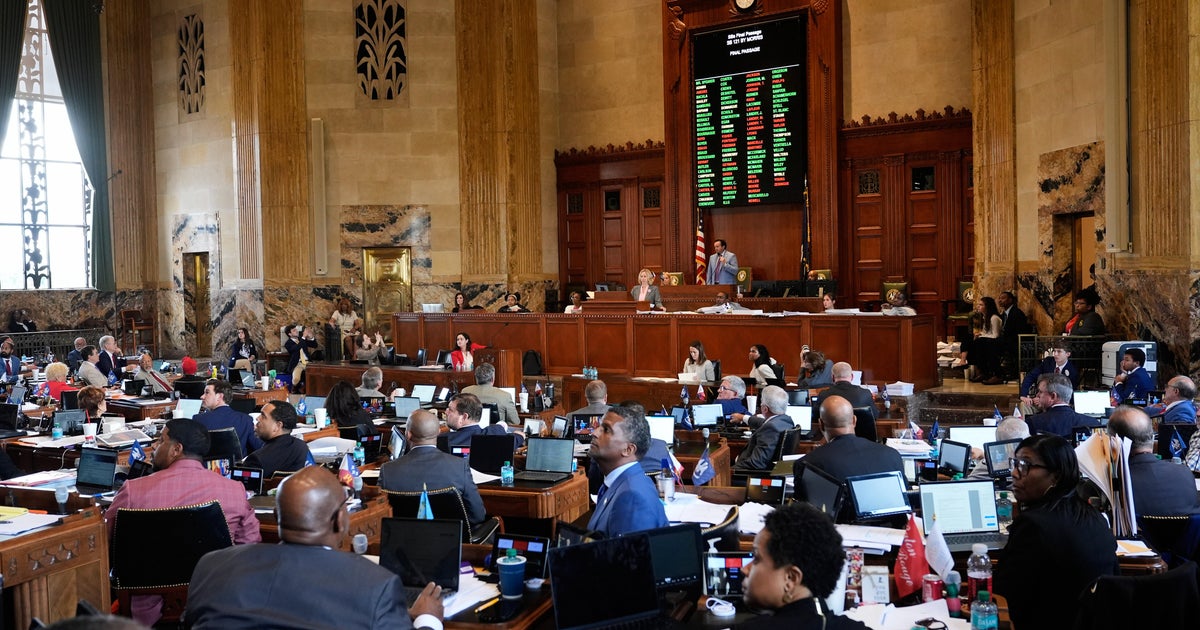

On Friday, Louisiana’s legislators approved a new congressional map aimed at increasing Republican representation by one seat, reducing the Democratic presence to just one majority-Black district in the state.
The map is anticipated to be enacted by Republican Governor Jeff Landry. This development follows a recent U.S. Supreme Court ruling that invalidated the state’s existing map, labeling it as a racial gerrymander, which has weakened the historic Voting Rights Act of 1965. The ruling has heightened the national debate over redistricting, influenced by former President Trump’s efforts to safeguard the Republican Party’s narrow majority in Congress.
Initially, Louisiana Republicans considered a map that would allow them to potentially control all six of the state’s U.S. House seats. However, this strategy would have necessitated incorporating more Black voters into Republican-held districts, possibly resulting in electoral setbacks. Some party members believe that a 5-1 map is a more secure approach to protect U.S. House Speaker Mike Johnson’s position from becoming vulnerable.
Following the Supreme Court’s decision, several other Republican-led Southern states have taken advantage of the weakened Voting Rights Act to attempt their own redistricting. This move is part of an ongoing national struggle over redistricting as the November elections approach, a conflict intensified by presidential influence.
Currently, Republicans are leading in the redistricting efforts. However, this does not guarantee a victory in the closely contested U.S. House this November. Republicans hope their redistricting strategies could net them up to 14 additional seats, while Democrats anticipate gaining six from revised districts in California and Utah.
In Louisiana, Republicans presently occupy four out of six congressional seats under a court-mandated map from 2024, which was crafted to comply with the Voting Rights Act by ensuring a second district with a majority-Black population.
That map, however, was challenged in court, and the Supreme Court responded on April 30 by striking it down as an illegal racial gerrymander.
Landry postponed the state’s U.S. House primary, scheduled for May 16, until later this summer to allow time for Republican lawmakers to draw and pass a new map.
The proposed map redraws Democratic Rep. Cleo Fields’ district, clustering it around predominantly white communities in the Baton Rouge area and southern Louisiana. It also adds part of Baton Rouge to a heavily Democratic, majority-Black district based in New Orleans currently represented by Democratic Rep. Troy Carter.
More lawsuits were expected over the new map.
Democrats say the proposed map could still constitute a racial gerrymander because it packs Black voters into a single congressional district. Meanwhile, the plaintiffs in the U.S. Supreme Court’s decision criticized the Legislature’s map for leaving a majority-Black district in place.
Several other Southern states also have acted on redistricting since the Supreme Court’s decision.
Florida’s Legislature passed new congressional districts just hours after the ruling, completing a redrawing that was in the works in anticipation of the decision. It could yield Republicans as many as four additional seats in the midterm elections.
Tennessee adopted new U.S. House districts a week after the ruling, carving up a majority-Black district based in Memphis in a Republican attempt to win an additional seat.
In Alabama, Republicans are attempting to pick up another seat by redrawing two districts where Black residents compose a majority or close to it. Democrats hold both seats, and the proposal is mired in a court battle.
South Carolina’s Senate, meanwhile, decided against redistricting, despite pressure from Mr. Trump.