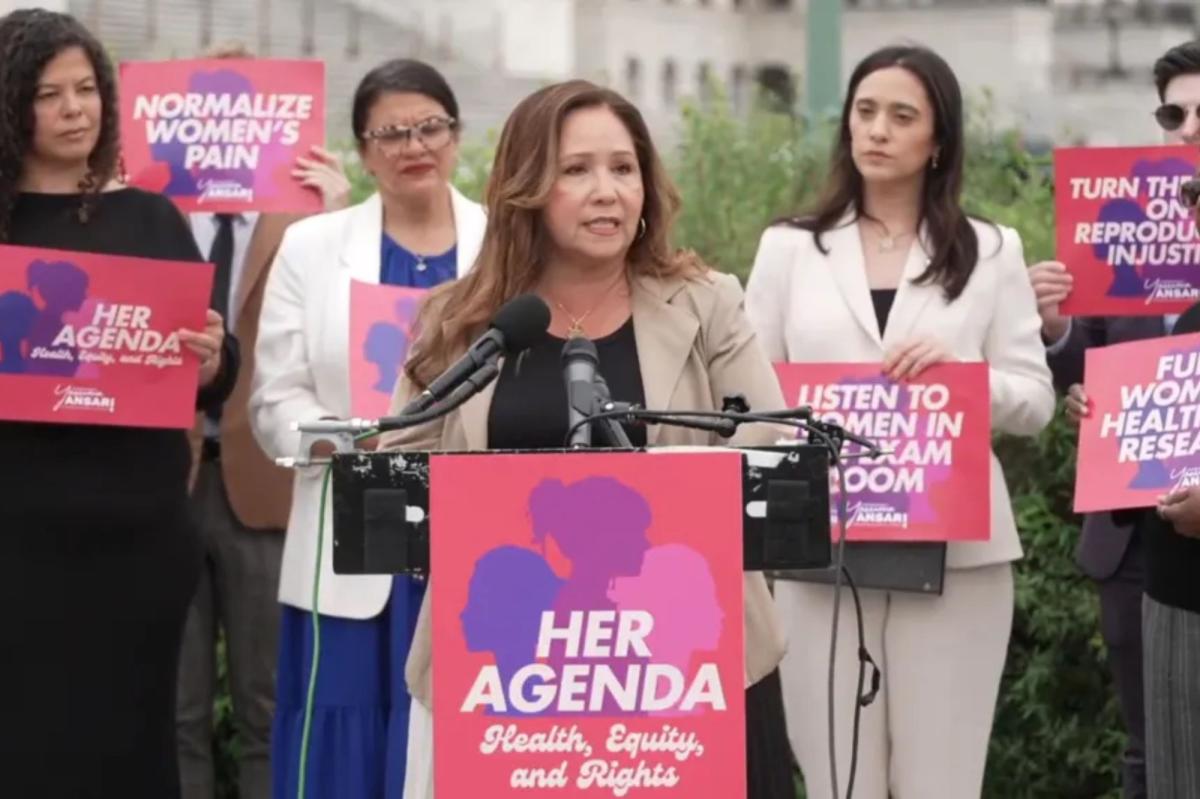


In late May, Democratic lawmakers expressed concerns about the lack of paid leave for employees suffering from painful menstrual cycles, labeling it as a form of “economic violence.”
At a press conference on May 21, Representative Adelita Grijalva from Arizona emphasized, “A worker shouldn’t have to choose between paying rent or losing a day’s wage to recuperate from an intense gynecological procedure. That’s not a choice—it’s economic violence.”
Grijalva, along with fellow Representatives Yassamin Ansari, D-Ariz., and Rashida Tlaib, D-Mich., is advocating for Ansari’s Reproductive Healthcare Leave Act. This proposal is a significant component of her broader “H.E.R.” (Healthy, Equity, Rights) Agenda.
The proposed Reproductive Healthcare Leave Act (H.R. 8158) aims to grant up to 12 days of paid leave annually for reproductive health issues. These would cover severe menstrual cramps, abortions, menopause symptoms, miscarriages, biopsies, vasectomies, and more. The “H.E.R.” Agenda also seeks to promote research into gynecological pain management and increase awareness of Premenstrual Dysphoric Disorder.
During the press conference, Tlaib stated, “No one should have to choose between their paycheck and their health when dealing with such excruciating pain.”
In a personal note, Ansari, the youngest woman in Congress, connected the bill to her own experiences. She recounted to TIME how she once found herself on the floor of a local store, drenched in sweat, before being taken to the hospital. She described enduring monthly episodes where she feels as if “barbed wire” is inside her.
The bill, introduced Saturday with 28 Democratic cosponsors and zero Republican sponsors, has already received backlash.
“Ladies, you can’t keep saying men can be women, but then also say that women are a special category. You’ve got to pick a lane. You’re very confusing to the rest of us.” Rhode Island state Rep. Marie Hopkins, R., posted on X.
Some social media users also questioned whether the bill could more easily allow employees to discriminate against hiring women and shared concerns that despite it covering vasectomies, men wouldn’t receive paid days for prostate issues and testosterone-related conditions.
Other users also questioned if the bill could force employers to pay workers for time off to recover from abortions.
The bill is endorsed by Planned Parenthood, the National Organization for Women (NOW) and the American College of Obstetricians and Gynecologists.
Planned Parenthood Votes vice president Angela Vasquez-Giroux told Bloomberg in an article published on Friday that though there were “roadblocks to the bills becoming law,” it doesn’t mean lawmakers shouldn’t try.
“We’ve seen overwhelming success from candidates who have a plan and have a point of view,” vice president of communications for Planned Parenthood Votes Angela Vasquez-Giroux told Bloomberg. “Just because we can’t get something passed over the opposition of the majority at the time doesn’t mean that we shouldn’t be putting forward our vision for the world we want to create.