

Washington — Republican Rep. Thomas Massie of Kentucky launched an ultimately unsuccessful effort to impeach Defense Secretary Pete Hegseth, accusing the Pentagon leader of committing a sweeping list of high crimes and misdemeanors while in office.
Massie presented the allegations in a 34-page impeachment resolution containing eight articles, which he introduced in the House on Monday. The chamber voted late Tuesday to send the measure to a committee, effectively ending the effort after no Republicans joined Massie and House Democrats in supporting it.
The resolution targets Hegseth’s role in several of the most contentious episodes of President Trump’s second term, including the war with Iran, U.S. boat strikes in the Caribbean, an attack on an Iranian school and the capture of then-Venezuelan President Nicolás Maduro. Hegseth dismissed the measure as a “political spectacle” during a Tuesday morning news conference.
Here is a breakdown of the allegations outlined in the impeachment resolution:
Article I: Launching the Iran war without congressional approval
AP Photo/Nathan Howard 
The first article alleges that Hegseth carried out unlawful orders to begin military action against Iran.
According to Article I, “Secretary Hegseth directed and caused United States Armed Forces to be introduced into hostilities against the Islamic Republic of Iran” even though Congress had neither declared war nor authorized the operation.
Massie’s resolution argues that the defense secretary violated the War Powers Resolution of 1973, a law that permits the president to use military force without congressional approval only in limited circumstances.
“Secretary Hegseth nevertheless knowingly executed and implemented the order to commence such hostilities, employing the powers, personnel, weapons, and resources of the Department of Defense to initiate military action against another sovereign nation,” the article states.
Article II: Defying Congress and continuing the conflict
The second article claims Hegseth disregarded a bipartisan congressional resolution directing the administration to end the war with Iran.
In June, the House and Senate both approved a measure ordering the administration to “remove United States Armed Forces from hostilities against the Islamic Republic of Iran.” The measure used the War Powers Resolution’s process for compelling the executive branch to halt military action. Massie’s filing describes it as “the first successful passage of such a legislative vehicle by both chambers of Congress” in American history.
“In response, and without lawful cause or excuse, Secretary Hegseth continued to direct United States Armed Forces into hostilities with the Islamic Republic of Iran on June 26, 2026, and continues to do so,” the article says.
The administration maintained at the time that active “hostilities” with Iran had already ended, meaning the War Powers measure did not apply.
Article III: Violating the War Powers Resolution’s time limit
Under the War Powers Resolution, the executive branch must stop using military force within 60 days unless Congress authorizes the operation. The law provides an additional 30 days for an orderly withdrawal of troops.
President Trump notified Congress about the hostilities on March 2, placing the end of the initial 60-day period on May 1. In a letter sent that day, the administration informed Congress that “hostilities” had “terminated.” Hegseth separately told senators, “We are in a ceasefire right now, which in our understanding means the 60-day clock pauses or stops in a ceasefire.”
Massie’s resolution disputes that interpretation, arguing that Hegseth continued directing military action after the deadline and beyond June 1, “the date on which even the maximum possible additional 30-day withdrawal period would have expired.”
The article further alleges that Hegseth ordered U.S. forces to continue fighting “in a manner calculated not to terminate the unauthorized use of such forces and bring about their prompt removal, but rather to continue prosecuting the war to pursue additional military objectives not authorized by Congress.”
Article IV: Dismantling safeguards intended to protect civilians
The fourth article alleges that Hegseth weakened or eliminated Pentagon systems created by Congress to reduce civilian casualties. Massie argues those changes contributed to a deadly strike on an Iranian school during the first wave of attacks in February. Iranian media has reported that the Tomahawk missile attack killed about 170 civilians, most of them children. The United States has not directly acknowledged responsibility for the strike.
The resolution says Hegseth oversaw “the systemic deterioration and removal of Department of Defense infrastructure that Congress had mandated by law to limit collateral damage to civilians and non-military objects during military operations.” It points to cuts affecting personnel tasked with preventing civilian deaths, his dismissal of the military’s top lawyers and his public criticism of what he called “stupid rules of engagement.”
Massie contends that those decisions helped create the conditions for the school strike.
RELATED: Passenger Arrested Over Bomb Claim on Newark-New Orleans Flight
“By directing the Department of Defense in a manner that foreseeably dismantled the safeguards necessary to distinguish civilian objects from military objectives, Secretary Hegseth thereby effected the murder of civilians,” the article says.
The resolution adds that “the strike on the elementary school was not an isolated targeting failure divorced from the conduct of the Secretary of Defense, nor can Secretary Hegseth’s conduct be dismissed as a single targeting error or isolated failure in the fog of war.”
Article V: Alleged extrajudicial killings in boat strikes
U.S. Southern Command 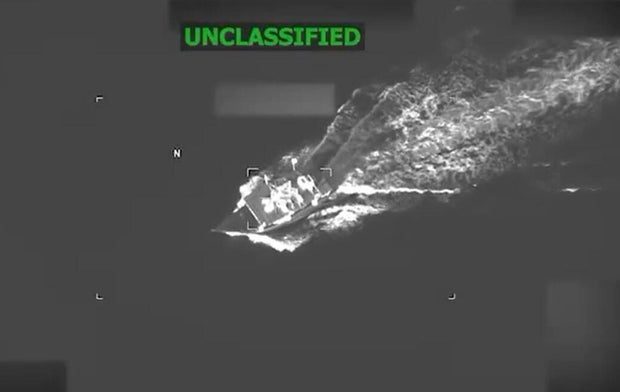
The fifth article focuses on the Pentagon’s campaign against boats suspected of transporting drugs in the Caribbean and eastern Pacific. According to the resolution, the strikes have killed at least 243 people since September 2025.
Massie alleges that Hegseth used the U.S. military to kill people who had only been suspected of criminal activity.
“By subjecting persons merely suspected of criminal conduct to lethal military force without judicial process, without congressional authorization, and without establishing a lawful basis for treating such persons or vessels as military targets, Secretary Hegseth arrogated to himself and the Executive Branch the roles of judge, jury, and executioner and asserted a unilateral power to determine who may live and who may die,” the article states.
The filing also highlights the campaign’s first strike, carried out on Sept. 2, 2025, when the military attacked the same boat a second time.
“The strike destroyed and capsized the vessel. Approximately 45 minutes later, while two survivors clung to the wreckage, a secondary strike was ordered, killing both survivors,” the resolution says. It adds that the action “has endangered members of our Armed Forces in future military engagements by encouraging adversaries to subject American service members to the same treatment.”
Article VI: Retaliation against Sen. Mark Kelly
Heather Diehl / Getty Images 
The sixth article accuses Hegseth of “retaliating against a Member of Congress for constitutionally protected speech,” identifying Democratic Sen. Mark Kelly of Arizona as the target.
Kelly, a retired Navy captain, appeared in a video in November 2025 with other lawmakers to address military and intelligence personnel. Their message was direct: “Our laws are clear. You can refuse illegal orders.”
Hegseth responded with a letter of censure and threatened to lower Kelly’s military rank, a move that could have reduced his retirement benefits. A federal judge later blocked the action.
Massie’s resolution says Hegseth “weaponized the Department of Defense to chill a core function of the Legislative Branch” and put “the First Amendment rights of millions of United States veterans at risk of irreparable harm.”
Article VII: The operation to capture Maduro
XNY/Star Max/GC Images 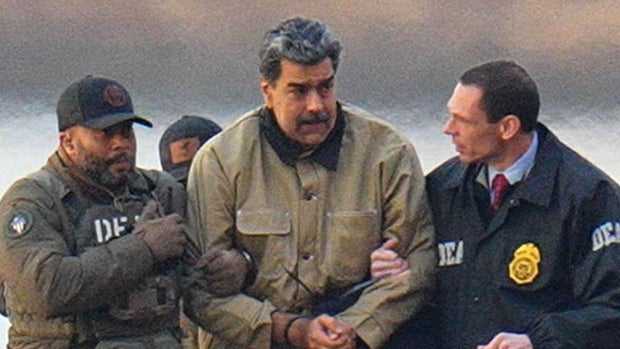
Article VII examines the January 2026 military operation to seize Maduro and his wife in Caracas. The resolution describes the raid as “an act of war against a sovereign country executed under the guise of narcotics law enforcement, though in actuality intended to assert U.S. control over Venezuela’s oil reserves.”
It says the mission involved more than 200 special operations personnel and over 150 aircraft and drones, while resulting in at least 83 deaths. Massie argues that Hegseth authorized the operation without a congressional declaration of war or other approval, violating the War Powers Resolution.
The filing points to remarks by President Trump after the raid, including his statement that “we’re going to run the country” and that U.S. oil companies would “go in… and start making money.”
“Hegseth gambled the lives of Army, Navy, Air Force, and Marine Corps personnel in order to facilitate the illegal taking of national oil,” the article alleges.
Article VIII: U.S. strikes in Yemen
The eighth and final article addresses more than 1,100 U.S. strikes on Houthi targets in Yemen between March and May 2025.
Massie again claims Hegseth used military force without authorization from Congress and says the campaign caused civilian deaths.
“In less than eight weeks, there were nearly as many civilian deaths in Yemen as United States military actions had caused in that country during the preceding twenty-three years,” the resolution says.
The article also cites messages leaked from a Signal group chat involving Hegseth and other senior officials, which The Atlantic published last year. Massie argues the messages indicate that the administration understood the Houthis did not present an imminent danger requiring an immediate U.S. military response.