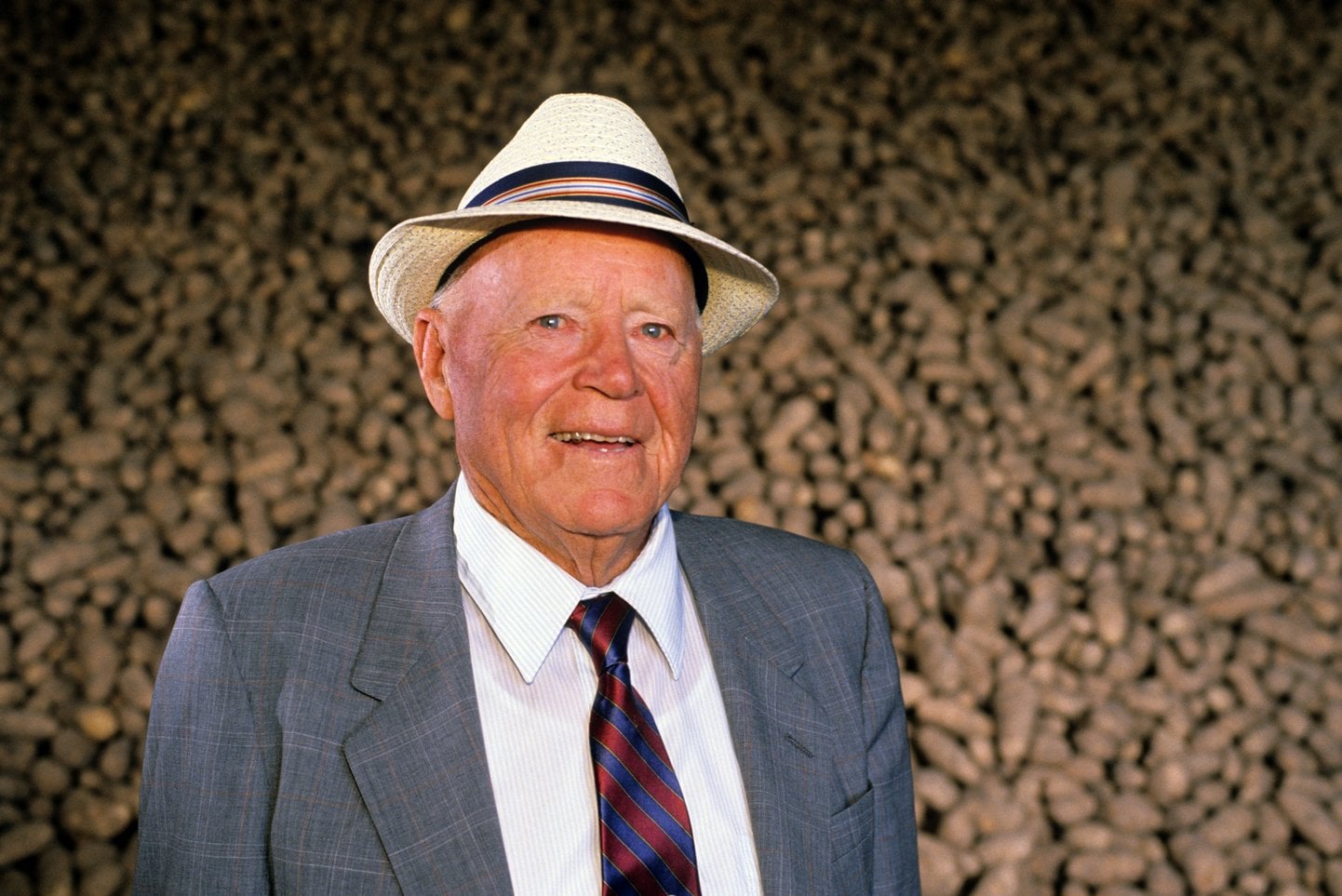

Unless you’re from Idaho, the name J.R. Simplot might not ring a bell.
However, it’s quite surprising because I’m almost certain you’ve tasted one of his innovations.
In fact, you’ve probably enjoyed numerous offerings from his agricultural genius.
J.R. Simplot was instrumental in revolutionizing agriculture, becoming a key potato supplier for a well-known giant: McDonald’s.
This partnership, as you might guess, proved to be exceptionally profitable.
By the time Simplot passed away in May 2008 at the ripe age of 99, his net worth was an impressive $3.7 billion. While his wealth was largely built on potatoes, a significant portion—several hundred million—stemmed from an unexpected investment he made years before.
In 1980, at the age of 70, J.R. Simplot – who had no knowledge of computer technology – invested $1 million in a tiny Boise semiconductor startup called Micron Technology.
In exchange, he received a 40% stake in the young venture.
On the day of his death in May 2008, Micron’s market cap was around $5 billion. A few months later, at one of the lowest points of the 2008 financial crisis, you could have bought 100% of Micron for $2 billion.
Earlier today, Micron’s market cap topped $1 trillion.
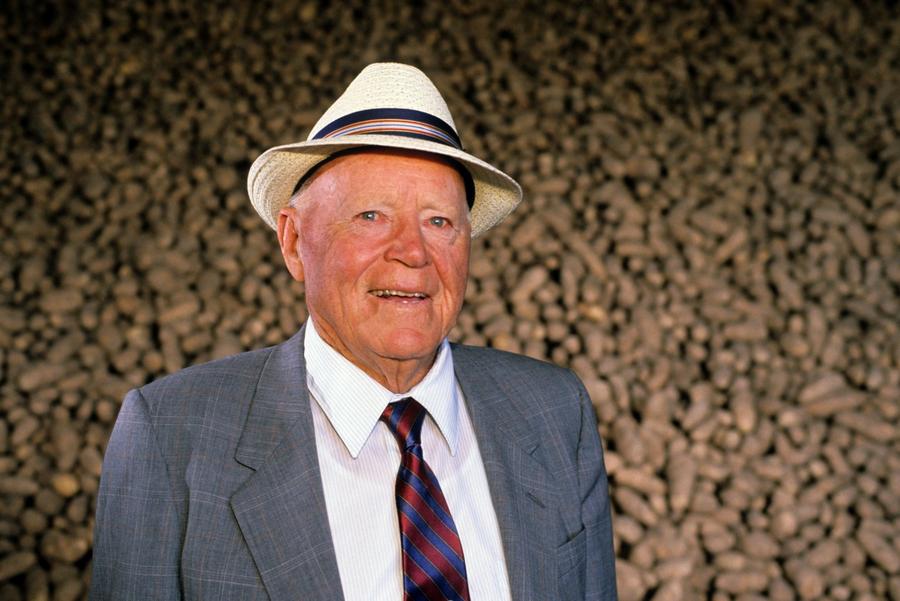
Portrait of J R Simplot (via Alamy)
From Runaway Teenager To Potato Billionaire
John Richard Simplot was born in 1909 in Dubuque, Iowa, but his family moved to Idaho when he was still a baby. He grew up in the newly irrigated farm country of the Magic Valley, where life was hard, money was scarce, and opportunity belonged to anyone willing to work longer, move faster, and take bigger risks than the next guy.
Simplot did all three.
According to family legend, he left home at 14 after an argument with his father, who refused to let him attend a basketball game. His mother gave him a small amount of money, and young Jack moved into a local hotel. That alone would have been a wild beginning. But what happened next was pure Simplot.
At the hotel, he noticed that local teachers were being paid in interest-bearing paper called scrip. The problem was that the teachers needed cash immediately. Simplot offered to buy the scrip at a steep discount, reportedly around 50 cents on the dollar, then used it as collateral to borrow money from a bank.
He used that money to buy hundreds of pigs.
Then came his first great business breakthrough. During a harsh winter, traditional animal feed was expensive and scarce. Simplot realized he could fatten his hogs cheaply by boiling potato scraps and wild horse meat into a kind of high-calorie pig slop. While other farmers brought skinny animals to market, Simplot brought fat ones. He reportedly made more than $7,000 from the sale, an astonishing amount of money for a teenager in the 1920s.
That first score became his launchpad.
He bought farm equipment. He bought horses. And he moved into potatoes. By his early 20s, Simplot was already one of the largest potato shippers in the region. By his 30s, he had warehouses across Idaho and Oregon. He expanded into dehydrated onions and potatoes, and during World War II, his company became a major supplier of dried food for the U.S. military. That wartime business supercharged his growth and gave him the capital to expand into processing plants, fertilizer, phosphate mining, cattle, animal feed, and other agricultural operations.
The pattern was always the same:
- Find the bottleneck.
- Control the input.
- Improve the process.
- Scale the output.
- Waste nothing.
Potato scraps became animal feed. Fertilizer supported the farms. Processing plants created higher-margin products. Warehouses and shipping networks gave him control over distribution. Simplot was building a vertically integrated agricultural empire before most people had a name for that strategy.
Then came the innovation that made him truly rich: frozen French fries.
A Frozen Potato Revolution
For decades, French fries were a logistical nightmare for restaurants. Every location had to buy fresh potatoes, store them properly, peel them, cut them, soak them, blanch them, fry them, and hope the final product came out roughly the same every time. That was fine for a single diner. It was a huge problem for a national chain trying to make the same French fry in thousands of locations.
The obvious solution was frozen fries, but there was a major structural hurdle: raw potatoes do not freeze well. When a raw potato drops below freezing, the water inside its cells expands into ice crystals, which ruptures the potato’s internal cell walls. When those damaged fries were thawed and dropped into a fryer, they couldn’t hold their shape, resulting in a mushy, watery, and unappetizingly gray mess.
Simplot and his team of food chemists solved this by developing a multi-step process that stabilized the potato before it ever hit the freezer. Instead of freezing them raw, the potatoes were peeled, cut, and blanched in hot water. Next, they were partially fried in hot oil, and only then were they flash-frozen and packaged. This created a stable, restaurant-ready product that preserved the ideal texture and color, allowing cooks to simply drop them into hot oil for a quick, consistent finish.
For Ray Kroc, that was a miracle. McDonald’s was not merely selling hamburgers and fries. It was selling uniformity. A customer in Boise, Chicago, Los Angeles, or Miami needed to get the same French fry every time. Simplot’s frozen fry technology helped make that possible.
In the mid-1960s, Simplot struck a handshake deal with Kroc to supply frozen French fries to McDonald’s. It was a perfect match. Kroc needed a supplier that could deliver the same fry, at the same quality, at the same scale, to a rapidly expanding fast-food empire. Simplot had spent his entire life figuring out how to produce a better agricultural commodity at a lower cost than everyone else.
The McDonald’s relationship turned the J.R. Simplot Company into one of the most important potato processors in America. It also made Simplot one of the richest men in the country.
And it taught him the business philosophy that would define the second great act of his life: The way to win in a commodity business is to become the lowest-cost producer of the highest-quality product.
Micron
Micron was founded in 1978 by Ward Parkinson, his twin brother Joe Parkinson, and two of Ward’s semiconductor colleagues, Dennis Wilson and Doug Pitman. Ward, Wilson, and Pitman had experience in the chip industry, including work connected to Mostek, a Texas semiconductor company. Joe, a lawyer, helped give the young company its business and legal structure.
At first, Micron was not trying to build a giant manufacturing operation. It was a tiny semiconductor design company working out of extremely humble quarters: the basement of a Boise dentist’s office. The early goal was to design advanced memory chips, including a next-generation 64K DRAM chip, and get paid for that design work.
But when Micron’s early customer path dried up, the founders faced a much bigger decision. They could remain a small design shop, or they could attempt something far more ambitious: manufacture their own memory chips. That meant building a fabrication plant, buying expensive equipment, hiring technical workers, and competing against much larger American and Japanese semiconductor companies.
That second path required serious capital, which is how a tiny chip startup in a dentist’s basement eventually found its way to Idaho’s richest potato farmer.
The Boise Seed Money
One of Micron’s earliest believers was Allen Noble, a potato farmer, rancher, and self-taught inventor. Noble had made his fortune in agriculture but possessed a deep interest in practical machinery, having pioneered self-propelled irrigation equipment to make Idaho farms more efficient. Ward Parkinson had previously helped Noble with the electronics for that equipment, establishing a crucial relationship.
Noble connected the Micron founders with a fellow Idaho potato farmer he knew… J.R. Simplot.
Simplot had absolutely no knowledge of computer technology. At best, he knew tractor technology.
Simplot may not have understood the physics of a memory chip, but he understood the economics of making a commodity product. He understood what it meant to spend heavily upfront, squeeze every penny out of production, and survive when prices collapsed. He understood that the winner in a commodity market was not necessarily the flashiest company. It was the company that could produce a reliable product at the lowest cost.
So, in 1980, J.R. Simplot wrote Micron a check for $1 million. In exchange, he received 40% of the company.
The Road to $1 Trillion
Micron went public in 1984, just as the global memory chip market was turning into a knife fight. Micron made “DRAM,” the fast, short-term working memory that powers everything from early PCs to modern AI infrastructure.
That market was brutal.
Japanese semiconductor companies were flooding the world with memory chips. Prices collapsed. American competitors folded, exited the business, or shifted their attention to other kinds of chips.
Micron hung on.
Through the 1980s and 1990s, Micron built its reputation as one of the lowest-cost producers in the memory-chip business. It used Idaho’s cheaper land and power. It obsessed over manufacturing efficiency. It found ways to squeeze more chips out of every silicon wafer. It simplified production steps. It modified equipment. It reduced waste. It treated semiconductor manufacturing with the same ruthless cost discipline that Simplot had brought to potatoes.
That approach did not make Micron immune from pain. Memory chips are brutally cyclical. When demand is strong and supply is tight, profits can explode. When too many companies build too much capacity, prices collapse and earnings evaporate. Micron lived through all of it: price wars, recessions, tech crashes, oversupply gluts, and repeated predictions that the company would be crushed by larger foreign competitors.
But each cycle also did something important.
It wiped out weaker players.
By the mid-1990s, Micron had become one of the dominant names in DRAM.
By the time J.R. Simplot died in May 2008, Micron was worth only around $5 billion. A few months later, during the worst of the financial crisis, the entire company could be valued at roughly $2 billion.
The company was not dead. Far from it. But it was not obvious that it would become one of the most important companies in the world. It was still a memory-chip manufacturer in a brutal commodity business, and the global economy was melting down.
Then the world changed.
Smartphones exploded. Cloud computing exploded. Data centers exploded. Artificial intelligence exploded.
Every one of those trends needed memory.
Lots of memory.
Memory to store data. Memory to move data. Memory to train models. Memory to run inference. Memory to power servers, phones, cars, graphics systems, and AI infrastructure. The same DRAM business that had once looked like a low-margin commodity slog suddenly became one of the essential building blocks of the digital economy.
And Micron was still there.
That is the key. Micron survived long enough for the world to need exactly what it made.
Earlier today, May 26, 2026, that long survival story reached a milestone that would have sounded absurd when the company was operating out of a dentist’s basement in Boise: Micron’s market cap topped $1 trillion.
The immediate catalyst was an AI-driven semiconductor rally. Micron’s stock surged more than 19% in a single day after UBS raised its price target from $535 to $1,625. Investors were suddenly treating high-performance memory not as an overlooked corner of the chip world, but as a critical piece of the AI boom.
What Could Have Been
To reiterate, J.R. Simplot invested $1 million in Micron in 1980 and received 40% of the company. If that original stake had somehow never been diluted or sold, it would be worth around $400 billion at a $1 trillion valuation.
Even the roughly 20% stake he controlled in the mid-1990s would be worth around $200 billion today. That would make the Simplot family one of the richest families on Earth without even counting their still-thriving potato empire.
According to SEC filings, by September 2000, Simplit’s beneficial ownership in Micron had dropped to 3.6%. If by some luck, the Simplots still own a 3% stake, today that would be worth $30 billion. Unfortunately, there is no public evidence that the Simplot family or the J.R. Simplot Company still owns a major Micron position today. Roughly 80% of Micron is owned by giant institutional investors today. If the family still held anything close to a multi-percent stake, it would almost certainly be visible.
From Fries to Chips
J.R. Simplot didn’t need to understand computer chips to recognize a good business. He knew that the most efficient producer of a vital commodity eventually wins the market. Today, as Micron helps power the global AI revolution, that trillion-dollar valuation proves his potato philosophy was right all along.
(function() {
var _fbq = window._fbq || (window._fbq = []);
if (!_fbq.loaded) {
var fbds = document.createElement(‘script’);
fbds.async = true;
fbds.src=”
var s = document.getElementsByTagName(‘script’)[0];
s.parentNode.insertBefore(fbds, s);
_fbq.loaded = true;
}
_fbq.push([‘addPixelId’, ‘1471602713096627’]);
})();
window._fbq = window._fbq || [];
window._fbq.push([‘track’, ‘PixelInitialized’, {}]);