
NASA has officially deemed one of its Mars-orbiting probes ‘unrecoverable’ after the spacecraft mysteriously lost contact following its observations of the interstellar object 3I/ATLAS.
On Wednesday, the space agency announced that the MAVEN spacecraft, which has been orbiting Mars, has ceased its scientific operations and is no longer sending data back to Earth. This comes six months after it began to spin erratically while in orbit around the Red Planet.
In a statement, NASA explained, “The spacecraft was last heard from on December 6, when it unexpectedly lost signal after emerging from behind Mars. The review board has concluded that the MAVEN spacecraft cannot be recovered.”
Since 2014, MAVEN has been orbiting Mars, acting as a communications link for rovers exploring the Martian terrain. This role continued until its close encounter with the mysterious 3I/ATLAS, a visitor from another star system.
While tracking 3I/ATLAS, which NASA has classified as a comet, MAVEN moved behind Mars. Upon reappearing from the planet’s shadow, the spacecraft unexpectedly halted its transmissions and began to spin more rapidly than usual.
In October, MAVEN was a mere 18 million miles from the swiftly moving object when it captured a series of images. However, these images, taken as the suspected comet passed Mars, faced criticism for their lack of clarity.
NASA still has no explanation for what caused the $583 million space probe to start spinning rapidly, which scientists believe caused the batteries to drain and the communications system to die.
‘These preliminary findings do not address a potential root cause for the anomaly, which still is being investigated,’ NASA added.
This is a breaking story. More details to follow.
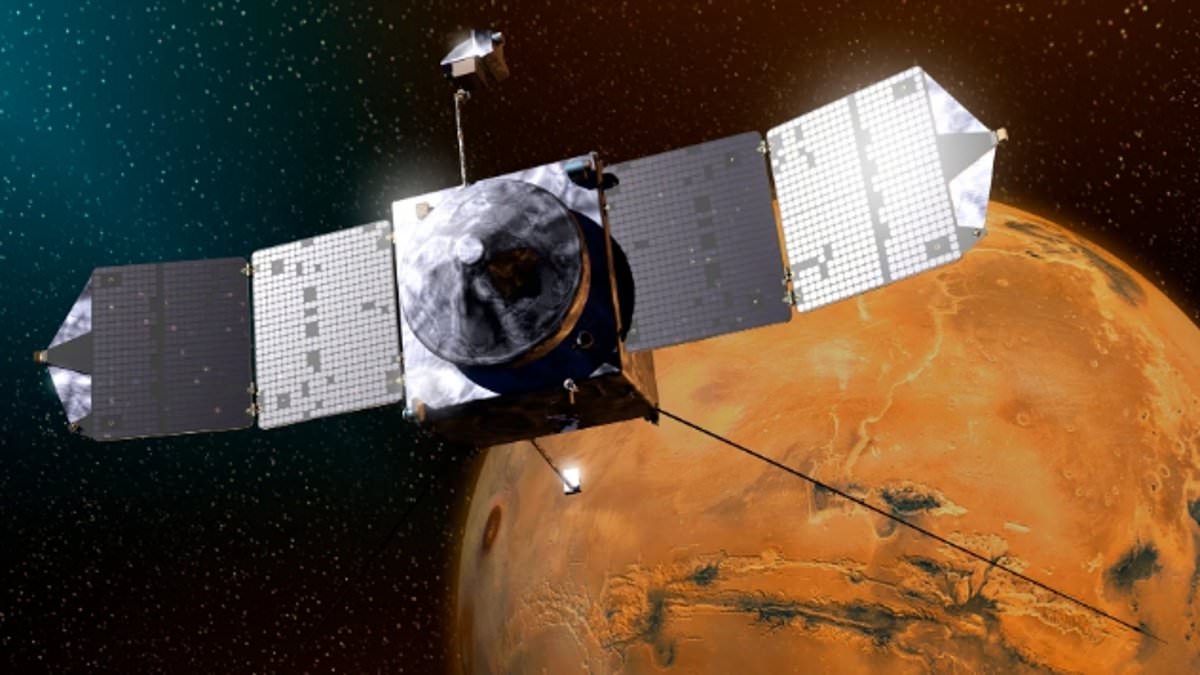
Artist’s concept of NASA’s MAVEN spacecraft at Mars. The spacecraft entered orbit around the planet in 2014
In 2025, amateur stargazers took clear images of the interstellar object 3I/ATLAS (Pictured) using common telescopes during its close passes by several planets
While the NASA spacecraft dealt with minor technical issues in the past, this was the first time in over a decade that something actually knocked the probe offline and disrupted its orbit.
When MAVEN initially went dark in December, the incident set off wild theories on social media that the communications blackout was somehow tied to 3I/ATLAS making its closest pass by Earth that same week.
While the problems that ultimately shut down MAVEN are not believed to be related to 3I/ATLAS, NASA still drew sharp public criticism for the images the probe took near Mars, which came back blurry and undetailed, sparking claims of an alien coverup.
Even without MAVEN online to track the object, the interstellar object got close enough to Earth for amateurs to photograph it with common telescopes, producing images which appeared to show an illuminated object with jets of gas flowing from it.
Scientists from NASA and the European Space Agency have declared that the object was a rare comet with a unique chemical makeup that was randomly passing through our solar system. They also said there were no signs of life coming from the object.
Despite their conclusions, Harvard Professor Avi Loeb has continued to maintain that 3I/ATLAS has displayed too many anomalies to completely dismiss the possibility that it was sent here by an unknown intelligence.
In May, Loeb, the director of the Galileo Project, an effort to find signs of extraterrestrial life, revealed that 3I/ATLAS was releasing a surprising amount of methane – which is a common byproduct of living organisms.
Loeb said in a statement: ‘In the atmospheres of exoplanets, methane is considered a prominent biosignature.’ He added other scientists have argued that ‘methane could be the first detectable indication of life beyond Earth.’
MAVEN spacecraft (Pictured) stopped transmitting to Earth on December 4, 2025, weeks after observing 3I/ATLAS and moving behind the far side of Mars

3I/ATLAS (Pictured) exhibits unique features, including an anti-tail, extreme color changes, an extremely unusual course, and a massive coma
Loeb said this methane appeared only when the object approached Earth’s sun. He questioned if living things inside the ice may have produced that methane.
In a paper published on the platform Medium on May 25, he theorized that chunks of ice and dust breaking off the object may have carried tiny dormant life forms and ‘seeded’ them toward Earth and other planets 3I/ATLAS passed on its journey.
Loeb compared it a dandelion blowing seeds in the wind. The theory is called panspermia, the act of life traveling between worlds on rocks or ice.
As for MAVEN, NASA praised the dead probe’s accomplishments, noting that its main job was to study how Mars was losing its thin atmosphere to space.
MAVEN showed that the sun’s wind and solar storms strip away gas much faster than scientists thought, especially during big solar events.
Shannon Curry, MAVEN’s principal investigator said: ‘The MAVEN mission has truly advanced our understanding of the Martian atmosphere and evolution. This dataset has had a tremendous impact on the field.’
Louise Prockter, director of the Planetary Science Division at NASA Headquarters in Washington, added: ‘The data collected from MAVEN will continue to provide valuable insight into Mars for decades to come.’