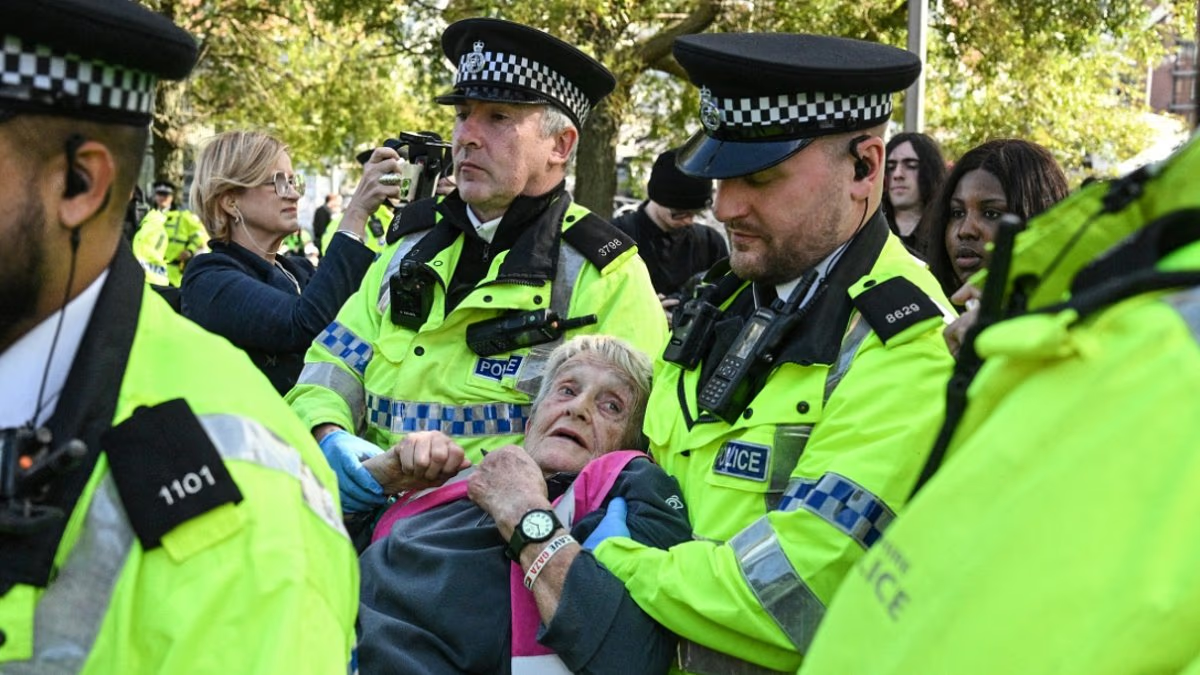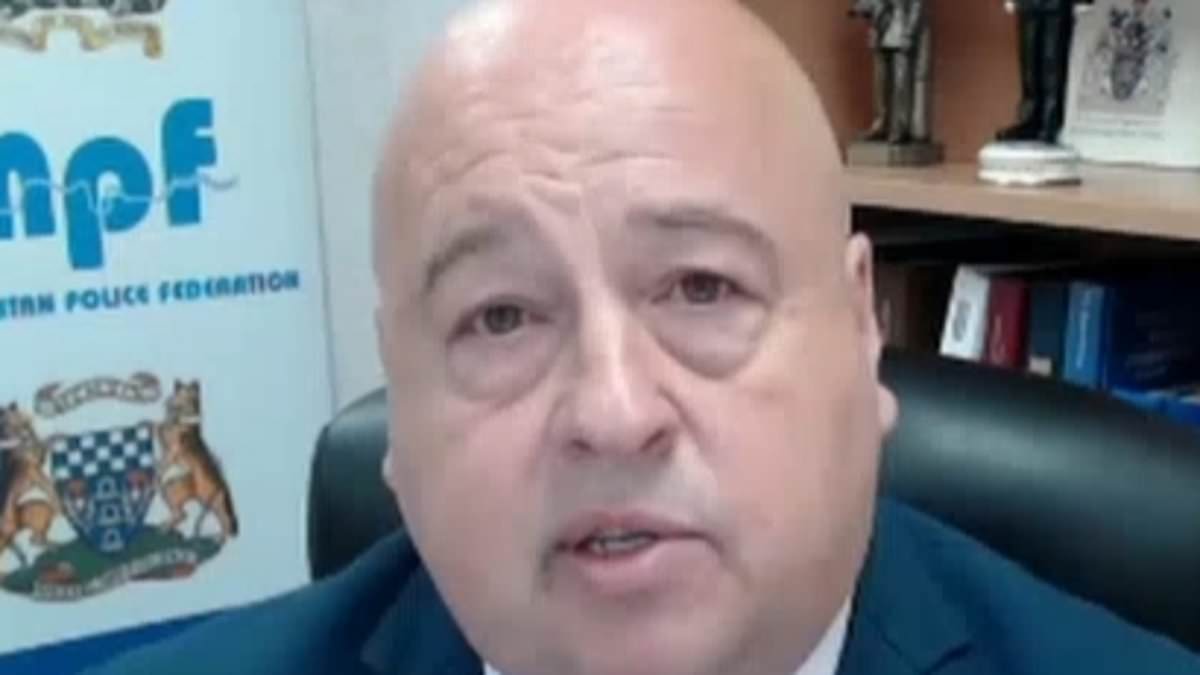

A whistleblower has raised alarms about Scotland Yard, claiming it has fallen prey to the ‘woke mind virus’ and now fails to enforce the law impartially.
Rick Prior, who once led the Metropolitan Police Federation, argued that the department has been focused on ensuring equal outcomes among diverse ethnic communities rather than offering equal opportunities for over ten years.
According to Prior, this shift in priorities has resulted in a decline in the force’s skill set, affecting the safety and order of London’s streets.
Last year, when tasked with creating new Diversity, Equity, and Inclusion (DEI) guidelines, Prior recommended prohibiting officers from displaying political symbols, like rainbow lanyards linked to the LGBT community. However, police authorities dismissed his proposal.
In a foreword for a report by the Free Speech Union, Prior expressed his apprehensions about the DEI initiatives within the nation’s largest police force.
These concerns arise following the tragic murder of Henry Nowak in Southampton.
The 18-year-old student was arrested and handcuffed after his killer Vickrum Digwa, falsely claimed that Mr Nowak had racially abused him.
Rick Prior, the former chairman of the Metropolitan Police Federation, said Scotland Yard has been captured by the ‘woke mind virus’
Mr Prior was suspended from the Met Police Foundation in 2024 after voicing concerns on GB News about officers being scared of racism complaints.
The High Court later found he had been unlawfully treated by then-chief executive Mukund Krishna.
After being ousted, Mr Prior was tasked with creating new DEI guidelines.
He said: ‘My own ongoing ordeal made me determined to produce a document that would create greater balance, and so restore the confidence of both officers and the public we serve.’
In his suggestions, he also stated that after the Supreme Court’s ruling that the Equality Act’s definition of sex meant biological sex, this should be implemented within the force.
However after presenting his proposals, he was told by a supervisor that he would be ‘better off in a different department’.
Mr Prior added: ‘Needless to say, my policy document was never adopted. Thus, the country’s largest police force jettisoned a chance to bring itself into line with the law and to lead by example.
‘It seemed that the Met’s senior management had been captured by the woke “mind virus”, and that its resistance to change was insurmountable.’
He was then re-assigned to the Culture, Diversity and Inclusion Directorate, which he said ‘currently takes up the entire second floor of New Scotland Yard’.
He added: ‘I lasted there less than a week. My sin was to ask, very politely, why a civilian supervisor included her preferred pronouns in her official police email signature.’
Mr Prior said that his treatment was a symptom of a larger problem within the force.
He wrote: ‘It has been clear to me that for more than a decade, the Met has been pursuing equity of outcome between ethnic groups rather than equality of opportunity and equal treatment under the law. I have seen it in the forced rotation of skilled firearms officers to manufacture “churn” and diversify armed policing, at great cost in lost skills.
‘I saw it in 2022, when two very senior officers were found by a tribunal to have racially discriminated against a white inspector, by removing him from a promotion process and inserting a less qualified black candidate instead.’
Hampshire Police wanted to put out a statement about ‘disinformation’ during the trial of Henry Nowak’s killer – but were told that to do so could jeopardise the entire case

Vickrum Digwa repeatedly stabbed the student before lying to police that he had been racist in a disturbing case that sparked national furore
After the death of George Floyd in 2020 in the United States, Mr Prior said the idea of equal outcomes had turned from an ideology to policy within the force.
He continued: ‘Even worse is the national Police Anti-Racism Commitment issued in March last year, a smoking gun of two-tier policing, which baldly states that its goal of “producing equality of policing outcomes … does not mean treating everyone the same” or being “colourblind”.
‘I have seen this logic in action. One very senior officer told me the Met had what she termed a “disproportionality matrix”: a system to assess which “low-level” crimes are likely to bring the Met disproportionately into conflict with the black community if it seeks to enforce the law.’
Mr Prior called for the IOPC to take a deeper look into Henry Nowak’s arrest and why officers arrested a ‘visibly dying murder victim, instead of his killer, who falsely accused him of a racial attack’.
He added: ‘When I saw the video of them handcuffing his limp, grey hands that night, I kept asking: “Why are you doing this? What threat are you mitigating?” Were they ticking off a mental checklist for an alleged hate crime, and giving only secondary thought to saving a life?
‘I do not think they harboured any malice, but I suspect they could not escape what their training and their senior officers had instilled: the mantra that a racially motivated incident must be recorded as such on the victim’s say-so, whatever the evidence in front of their own eyes.’
Mr Prior said the process that led to Mr Nowak’s death began with the murder of Stephen Lawrence in 1993 and the subsequent MacPherson Report.
He echoed calls by former Labour Home Secretary Jack Straw to re-evaluate the report.
A Met spokesperson said: ‘As the public would expect, we police London without fear or favour and strive to serve all communities equally.
‘As society and politics become more polarised, it is vital policing remains impartial, and all operational decisions are grounded in legal principles.’
A Met police source also denied the force uses a ‘disproportionality matrix’ to determine its priorities and instead uses the Violent Harm Assessment since 2023 to identify the most harmful individuals in London.
The source also said that the force’s uniform policy does not allow for badges, lanyards or other items which show support for particular causes. It made two exceptions for the red Haig Poppy and the Police Memorial Badge during their respective periods.