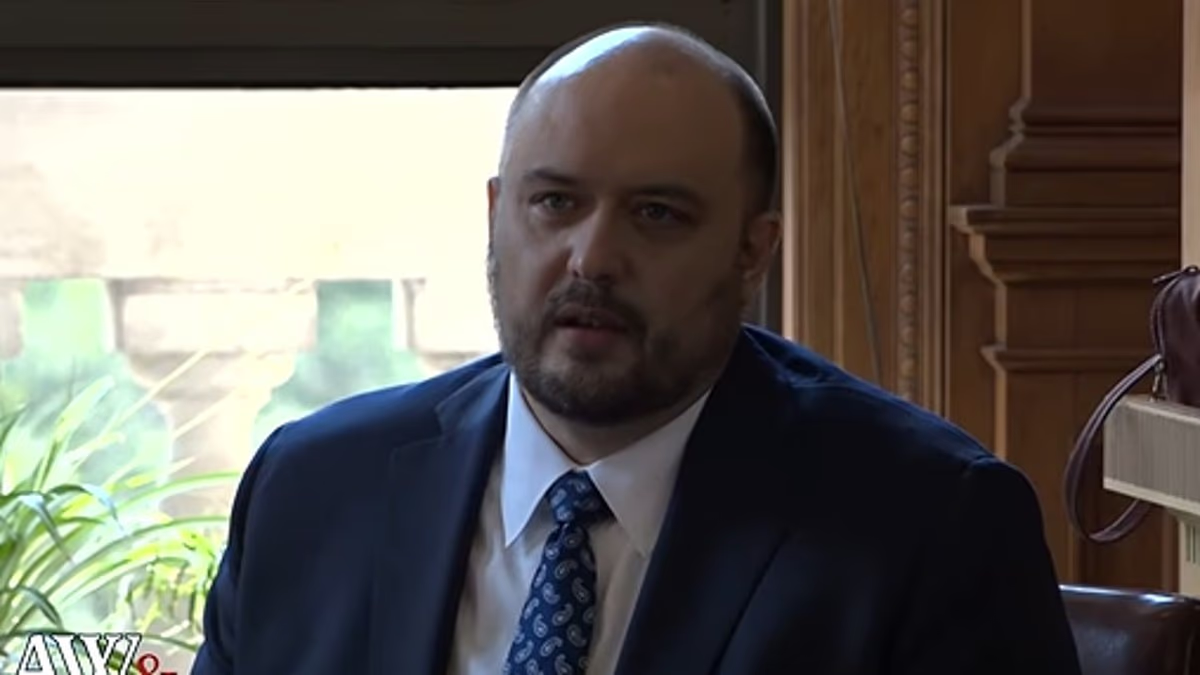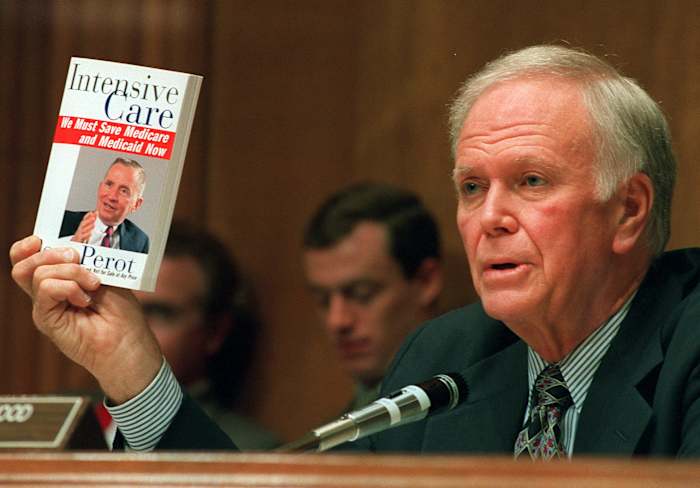


PORTLAND, Ore. – Bob Packwood, a prominent figure in Oregon politics and former U.S. Senator known for his advocacy of women’s rights and abortion, has passed away at the age of 93. Packwood’s career came to an abrupt halt due to claims of sexual harassment.
The news of Packwood’s passing on Saturday was shared through an obituary issued by his family to the press. The announcement did not disclose any further details regarding his death.
Renowned for his tenacity, Packwood initially resisted stepping down from his 27-year Senate career, determined to ensure his legacy wasn’t solely defined by scandal.
Long before the rise of the MeToo movement, Packwood’s story served as a cautionary tale of how personal misconduct can tarnish public accomplishments. Despite his controversies, he had been a celebrated figure for organizations like Planned Parenthood.
Coming from a lineage that included a participant in Oregon’s 1857 Constitutional Convention, Packwood carved out a reputation as a socially moderate and fiscally conservative leader who often crossed party boundaries. In 1980, he contemplated a presidential bid.
First elected to the Senate in 1968, Packwood made his mark as the foremost Republican supporter of abortion rights. He gained considerable admiration from women’s advocacy groups nationwide until 1993, when the Senate Ethics Committee began investigating allegations of sexual and official misconduct against him.
More than two dozen women, former employees and acquaintances, accused him of making unwanted or uninvited sexual advances.
The allegations remained the target of an ethics probe that widened to include other alleged acts of official misconduct. He resigned in September 1995, then went to start a lucrative lobbying business in Washington.
Democratic U.S. Sen. Ron Wyden, who replaced Packwood in 1996, said while he should be praised for his record on abortion rights and tax reform, how he treated women overshadows it all.
“His horrible history as documented in his own diaries will forever overshadow that public record. Simply put, historians’ first line about Bob Packwood must include those women who he abused and assaulted for years and years,” Wyden said in a statement.
As chairman and then ranking Republican on the Senate Finance Committee, Packwood was a master of cutting deals and forging compromises needed to pass tax legislation through Congress. He was most proud of the lead role he played in a sweeping tax reform of 1986 that lowered the top income tax bracket and eliminated many itemized deductions.
Over his career, he was described as a blunt, independent, outspoken politician who was a maverick, boat-rocker, loose cannon, skilled partisan, and, above all, political survivor.
“I think they probably all ring true,” Packwood told The Associated Press in December 1992.
“I would like to think that I am nobody’s lackey. I try to reach conclusions independently and then I’m willing to fight for those conclusions; if necessary, having to fight against my party or my party’s president,” he said.
Packwood won his first Senate election at age 36, narrowly defeating Democratic Sen. Wayne L. Morse, an Oregon legend who had held the seat for 23 years. He quickly grabbed attention as a rising star in the GOP. By 1980, he was elected chairman of the National Republican Senatorial Committee.
But he lost the seat when the White House backed a competitor after Packwood publicly accused President Ronald Reagan of alienating women, African Americans and Jews.
Just two weeks after Packwood’s reelection in 1992, The Washington Post printed allegations from former female employees and acquaintances that the senator had subjected them to uninvited sexual advances.
The Senate Ethics Committee also investigated allegations that Packwood solicited jobs from lobbyists for his ex-wife, used his staff to try to threaten the female accusers into keeping quiet and obstructed the investigation by altering his personal diaries.
The Senate held two days of extraordinary debate in 1993 over whether Packwood should have to comply with an ethics committee subpoena for his diaries, in which he reportedly made entries relevant to the investigation. The Senate voted 94-6 to enforce the subpoena.
Packwood took the case to federal courts and lost, ending when Chief Justice William Rehnquist refused Packwood’s request for the U.S. Supreme Court to intercede.
Packwood launched his lobbying business, Sunrise Research Corp., in 1997. By 1999, the firm was grossing $1.5 million a year. His business slowed in later years, but he told a City Club of Portland audience in 2010 that he was still spending about half his time in Washington lobbying for a number of clients.
It was interesting work, Packwood told the audience, according to The Oregonian, but “it is not as much fun as being in the Senate.”
As Congress became increasingly partisan following his departure, Packwood continued to advocate a centrist tact and called for Oregon to create nonpartisan elections in his 2010 City Club speech.
Packwood’s wife, Elaine Franklin, was his former chief of staff who became a political consultant in Portland. The couple had homes in the Portland area and Washington.
In a November 2002 interview with the Salem Statesman Journal, Packwood said he had gotten past the scandal that forced him out of office.
“People have told me it must have been tough on me, or it seems unfair,” he said. “But you cannot go through the rest of life and say look what happened. Pretty soon you become a bore to your friends.
“I told myself I was not old enough to retire,” Packwood said, “so I have got to get at life and not complain about it.”