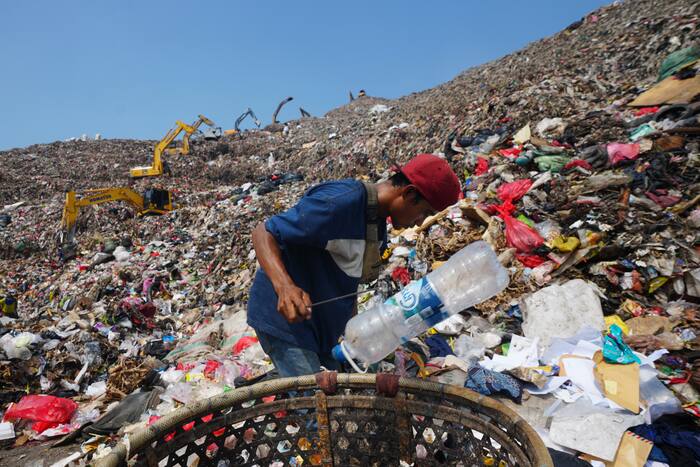


ANTALYA – As world leaders met Wednesday for United Nations climate negotiations in the Turkish resort city of Antalya, host Turkey called on nations to back a zero-waste initiative designed to cut emissions and revive stalled efforts to address climate change.
Turkish President Recep Tayyip Erdogan highlighted his country’s recycling gains, saying the national rate climbed from roughly 13% in 2017, when Turkey launched its zero-waste campaign, to about 40% by the end of 2025.
“Around 90 million tons of waste have been returned to our economy,” Erdogan told the leaders’ summit. “We will not stop there. We will continue working and making every effort until we achieve the goal of zero waste.”
Turkey has set out 10 priorities for this year’s climate conference, known as COP31. Among the issues dominating the opening days are a push to speed electrification and a renewed focus on zero-waste policies.
Turkish first lady Emine Erdogan, who attended Wednesday’s discussions, has played a leading role in promoting the initiative. Its goals include reducing methane pollution, limiting food waste and expanding a circular economy in which products and materials are reused rather than discarded.
“Recovered materials can be more affordable when dependable supplies, efficient processing and nearby demand outweigh the costs of collection, sorting and transportation,” said Samed Agirbas, president of the nonprofit Zero Waste Foundation and a high-level COP31 climate champion.
Energy experts say the proposals, if carried out, could help slow global warming while reducing the environmental costs associated with renewable technologies such as solar panels and batteries. Yet there are concerns that the climate pledges may not translate into meaningful action.
Agreements reached at climate conferences are frequently nonbinding, and previous host nations have faced criticism for failing to deliver on their commitments. Turkey, meanwhile, is under scrutiny over its own environmental record.
“The zero-waste target is a good one and clearly deserves support through concrete measures and additional action,” said Berk Butan, who leads Greenpeace Turkey’s waste campaign. “But fundamentally, we also have to acknowledge its shortcomings.”
Methane cuts could slow global warming
Methane is the second-largest contributor to climate change after carbon dioxide, and cutting those emissions could substantially slow the rise in global temperatures, according to the United Nations. During the first three days of the talks, leaders repeatedly urged faster and more decisive climate action.
The U.N. recently revised a decades-old target for limiting global warming after the world surpassed earlier temperature thresholds.
Although Turkey is asking countries to reduce methane pollution, it has not joined the Global Methane Pledge. Introduced at the 2021 climate conference in Glasgow, the pledge calls for cutting methane emissions by at least 30% from 2020 levels by 2030.
Turkey is also the world’s fifth-largest source of methane emissions from solid waste, according to the nonprofit emissions tracker Climate TRACE.
“Methane emissions from waste disposal represent a major challenge,” said Agirbas of the Zero Waste Foundation.
Circular economy could reduce emissions, but obstacles persist
A circular economy — an approach that emphasizes recycling and other regenerative practices to minimize waste — could help lower emissions. However, many countries lack the money, systems and infrastructure needed to adopt it.
Ke Wang, an energy expert at the WRI’s Polsky Center for the Global Energy Transition, described the model as “a vital strategy for cutting greenhouse gas emissions.”
Food waste is particularly difficult to recycle because it decomposes rapidly, making separation and treatment costly. Gathering and transporting wet, odorous food waste also demands specialized logistics and infrastructure that many nations do not have.
“Waste and food loss account for nearly 10% of total emissions, so these efforts need to be integrated,” Adalberto Maluf, a senior official at Brazil’s environment ministry, told The Associated Press.
Experts say recycling materials that have already been mined will be crucial to reducing dependence on new extraction. That need will grow as renewable technologies require increasing amounts of critical minerals.
The International Energy Agency estimates that expanded recycling could reduce the need for new mining by 25% to 40% by 2050.
Most countries do not recycle critical materials because extracting new supplies is less expensive. Recycling technology and infrastructure are also concentrated in a small number of countries, including China. The IEA estimates that the European Union and the United States may have the capacity to recycle only 30% of their raw materials by 2040.
“We need to do much more to recover, reuse and recycle our materials,” said Aimee Boulanger, executive director of the Initiative for Responsible Mining Assurance. She called for incentives that would encourage “recovering materials, taking products apart and finding ways to reuse them in a circular system.”
___
Arasu reported from Bengaluru, India; Milko from Islamabad, Pakistan; and Delgado from Bangkok.
___
The Associated Press’ climate and environmental reporting receives financial support from several private foundations. The AP is solely responsible for all content. Information about AP’s standards for working with philanthropies, its supporters and funded coverage areas is available at AP.org.


