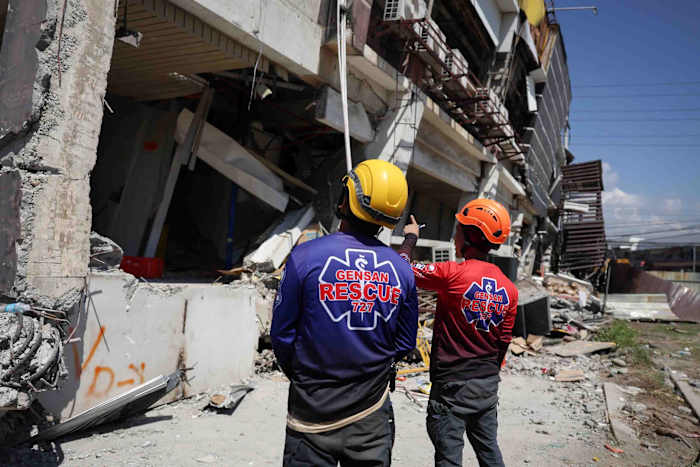


In the aftermath of a powerful earthquake that shook the southern Philippines, rescue teams were meticulously combing through the debris of collapsed structures in search of any survivors. This seismic event, one of the most formidable to strike the nation in five decades, claimed at least 37 lives and left over 20,000 individuals without homes.
While official reports listed only four individuals as missing in the southern provinces closest to the earthquake’s epicenter, authorities from the Office of Civil Defense emphasized the importance of inspecting the numerous collapsed and severely damaged buildings. Their concern was to ensure no one remained trapped beneath the rubble.
The earthquake, registering a magnitude of 7.8, struck near Mindanao, the Philippines’ second most populous island. In its wake, nearly 500 people suffered injuries, and tens of thousands were driven to seek refuge in emergency shelters.
Fears of a tsunami prompted many to abandon their homes. Although waves as high as 1.4 meters (4.6 feet) were recorded, the impact was minimal, with damage limited to six shanties on stilts in a coastal village. The tremors sent smaller waves to shores as distant as Indonesia, Palau, and southern Japan.
The disaster’s toll was exacerbated by landslides and collapsing buildings. In General Santos, a bustling city renowned for its tuna industry and home to over 700,000 residents, at least 13 people lost their lives due to structural collapses and falling debris.
The earthquake left a trail of destruction, including in General Santos, a lively coastal city of more than 700,000 people known as the country’s tuna capital, where at least 13 people were killed in collapsed buildings and due to falling debris.
At least 18 died in Sarangani province mostly in a landslide that buried houses in the mountainside town of Glan, according to Rafaelito Alejandro of the Office of Civil Defense.
The other deaths were reported in the southern provinces of South Cotabato and Davao Occidental, and on Balut Island, disaster-response officials said.
About 2,000 houses and 117 government buildings and facilities were damaged in several provinces, according to an initial government damage assessment. The international airport in General Santos remained shut, forcing the cancellation of 63 domestic flights except for those on humanitarian mission.
About 6,000 public school buildings in quake-hit provinces must be assessed before classes can resume. The quake struck on the first day of classes nationwide after a two-month summer break and many who sustained injuries were young students who had gathered with excitement for morning flag-raising ceremonies.
Authorities have warned that buildings that sustained cracks could collapse due to aftershocks, some of them dangerously powerful.
“We cannot force the immediate reopening of schools because we have to ensure the integrity of the buildings,” Alejandro said.
It was the strongest Philippine quake since 1976
Monday’s earthquake was centered at sea at a depth of 33 kilometers (20 miles), about 32 kilometers (20 miles) southwest of Maasim town in Sarangani province.
It was set off by movement in the Cotabato Trench and was the strongest since the same undersea depression triggered an 8.1-magnitude quake that whipped up tsunami waves on Aug. 17, 1976, said Teresito Bacolcol, the director of the Philippine Institute of Volcanology and Seismology.
About 8,000 people died from that quake and tsunami waves of up to 8 to 10 meters (26 to 33 feet) that engulfed several towns and provinces, Bacolcol said.
The Philippine seismological institute was scheduled to commemorate the anniversary of the 1976 quake and tsunami in August by installing markers to remind vulnerable towns and cities of the need for constant vigilance, Bacolcol told The Associated Press.
A 1990 earthquake that also had a magnitude of 7.8 left more than 1,000 people dead, injured thousands and caused extensive damages in northern provinces and cities.
President Ferdinand Marcos Jr. deployed top defense-mitigation officials from Manila to help oversee search and rescue, the distribution of tens of thousands of food packs and construction materials to quake victims and assess damage to bridges, roads and other infrastructure.
The United States, a treaty ally of the Philippines, said it was coordinating with Manila and was ready to support Philippine response efforts. France, Japan and New Zealand also expressed support.
The Philippines is often hit by earthquakes and volcanic eruptions due to its location on the Pacific “Ring of Fire,” an arc of seismic faults around the ocean.
The archipelago is also battered by about 20 typhoons and tropical storms each year, making it one of the world’s most disaster-prone countries.
___
Gomez reported from Manila, Philippines. AP journalists Basilio Sepe in General Santos, Philippines, and Haruka Nuga in Bangkok contributed to this report.