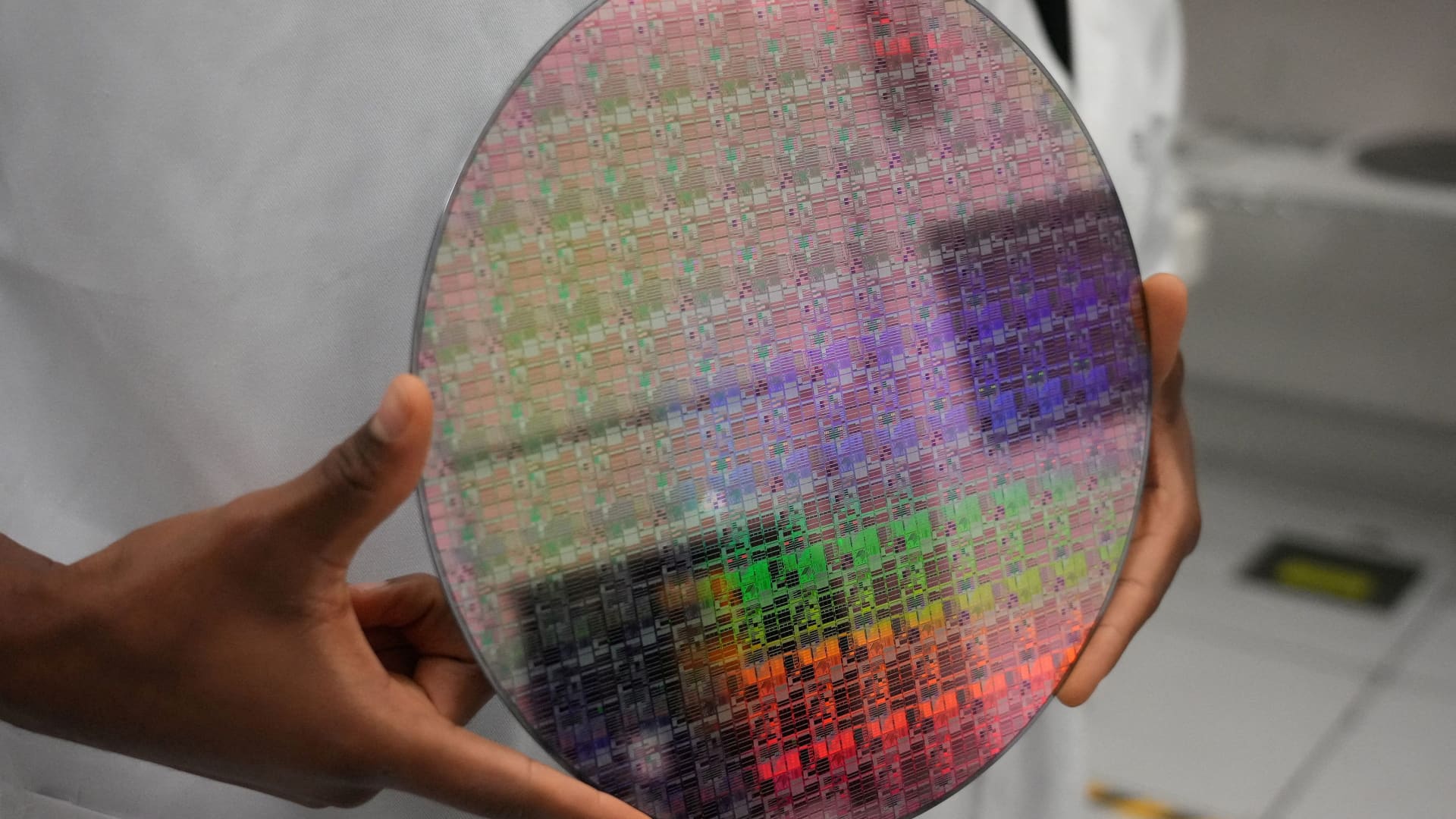

During U.S. Vice President Kamala Harris’s visit to a future research facility of Applied Materials in Sunnyvale, California, a silicon wafer adorned with chips was showcased on May 22, 2023.
Photo courtesy of Pool | Reuters.
The global technology and semiconductor market faced further declines on Wednesday, reflecting Wall Street’s overnight downturn. An initial rally among chipmakers fizzled out as worries persisted about the inflated valuations related to artificial intelligence investments.
Softbank Group, a leading Japanese technology investor, saw an 8.3% drop in its stock price. This decline was part of a broader tech sector slump and followed complications in securing a $6 billion margin loan backed by its stake in OpenAI, as reported by Bloomberg News. The company is now considering other financing strategies, although it might revisit the original loan plan in the future.
Japanese companies specializing in chip equipment, such as Advantest and Renesas Electronics, also experienced declines, with shares closing down by 4.2% and nearly 2%, respectively.
In South Korea, SK Hynix, a major player in the memory chip industry, saw its shares fall by 7.5%, while Samsung Electronics experienced a 6.1% decrease. Additionally, LG Display, known for its display panels, faced a 7.6% drop, and a battery manufacturer also saw its shares decrease by 3.6%.
Taiwan’s chip sector was also under pressure. The world’s largest chipmaker, Taiwan Semiconductor Manufacturing Co., fell about 2%, while Apple supplier lost more than 5.2%.
Why chip stocks fell
The declines followed a weaker session on Wall Street, where the tech-heavy Nasdaq Composite fell 0.97% and the S&P 500 slipped 0.26%. A rally in semiconductor stocks that had helped fuel gains a day earlier quickly faded, with the iShares Semiconductor ETF dropping 1%.
Ahead of Wednesday’s regular trading session, Nvidia was down 2.1%, while the iShares Semiconductor fund was trading 2.7% lower. Microsoft and Google parent Alphabet were both more than 1% lower.
In Europe, London-listed computing firm Raspberry Pi was down more than 12% in early afternoon trading, while the Stoxx 600 Technology index led regional losses on a 1.6% drop. Dutch chipmaking equipment manufacturer ASML, which recently became Europe’s most valuable public company, was 1.3% lower.
AI-related fundraising appears to be diverting money away from existing technology stocks. Upcoming listings such as SpaceX, Anthropic and OpenAI could absorb investor capital that previously flowed into publicly traded tech companies, potentially weighing on the sector.
OpenAI confidentially filed for an initial public offering on Monday, boosting excitement around AI-related investments. Meanwhile, SpaceX is scheduled to begin trading on Friday following what is expected to be the largest IPO on record. While some investors see the listing as another catalyst for the AI rally, others worry its $1.75 trillion valuation could signal overheating in the sector.
What investors are watching next
Andrew Jackson, equity strategist at Ortus Advisors, said the latest volatility in technology shares could prompt investors to rotate into defense names, particularly in Japan, where the government is expected to strengthen its focus on military preparedness.
“With retail punters gnashing their teeth and looking for something new to play with, heavies could snap back into focus after their recent pullback,” Jackson said, citing defense contractors Mitsubishi Heavy Industries, Kawasaki Heavy Industries, IHI Corp. and Japan Steel Works as potential beneficiaries.
“Yesterday’s selloff on Wall Street didn’t turn out to be too disastrous, with the Nasdaq clawing back much of its losses by the end of the session. That has helped to avoid contagion on the markets, albeit investors are slightly nervous about the heightened volatility this week,” Dan Coatsworth, head of markets at AJ Bell, said in a Wednesday morning note.

He added that there are many reasons why markets are “wobbly” right now.
“The prospect of interest rates staying higher for longer, inflation fears, frustration that the Iran war is still going on and potential liquidation events if investors are trimming holdings to raise cash to back some mega IPOs on the horizon,” he said.
Money markets are currently pricing in a 98.2% chance that the Fed holds its key interest rate steady at its FOMC meeting next week, according to the CME’s FedWatch tool. Traders now see a roughly 40% chance of a hike by the Fed’s October meeting.
The European Central Bank is also overwhelmingly expected to raise interest rates by 25 basis points at its own monetary policy meeting on Thursday, LSEG data shows.
May inflation data for the U.S. is due on Wednesday morning. Annual inflation is expected to have hit 4.2% last month.